

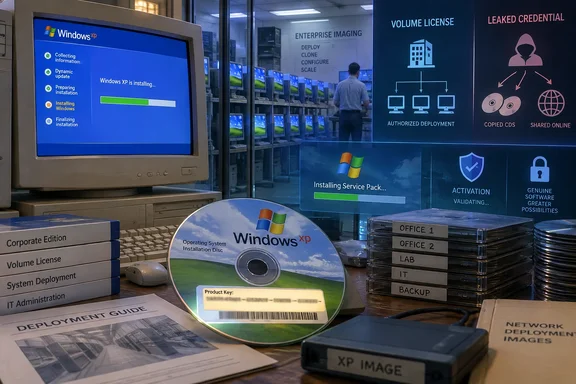
The meaningful correction is still worth making for anyone who remembers the era: the key was not a cryptographic break of Windows XP Product Activation. According to Plummer, who says he wrote the operating-system-side integration for Windows Product Activation, it was a legitimate Windows XP Professional volume-license credential that escaped alongside matching corporate installation media before XP reached retail on October 25, 2001.
That distinction explains both why the key became so widespread and why it did not work on every Windows XP CD. Microsoft’s own surviving documentation confirms that Windows XP keys were tied to a particular licensing channel, edition, and language. A Volume License Key could be accepted by matching volume-license media, while a retail or OEM disc would reject it as invalid.
The corporate exception that bypassed activation
Windows XP made Product Activation a highly visible part of Microsoft’s anti-piracy strategy. Consumer and retail installations generated a hardware-based identifier and required online or telephone activation, a process Microsoft said at the time was aimed at discouraging casual copying.
Large organizations had a different problem. A business imaging hundreds or thousands of PCs—especially machines that were offline or deployed in controlled environments—could not reasonably call Microsoft or connect every workstation to the internet. Microsoft therefore issued volume-license media and keys that avoided the normal consumer activation path.
Microsoft’s original technical material was explicit: an installation made with the appropriate XP volume-license media and Volume License Key had “no activation, hardware checking, or limitations on installation or imaging.” That was an intentional deployment feature, not an accidental hole in the ordinary retail installer.
The security boundary was supposed to be the combination of two things: a valid volume key and media from the correct channel. Microsoft’s later Knowledge Base article on replacing compromised XP volume keys says precisely that the media and key had to match in channel, SKU, and language. In other words, having the famous key alone was insufficient; users also needed the corporate edition built to recognize it.
Plummer’s newly recirculated explanation adds an unusual implementation detail. He says XP’s volume media contained a roughly 10 MB binary data block used to distinguish it from ordinary discs, and that he used transformed Microsoft Bob data as the bulk material. That detail rests on Plummer’s first-hand account, not a Microsoft technical document, but it matches the broader behavior Microsoft documented: installation media carried licensing-channel information that the setup and activation components could check locally.
A leaked credential, not evidence against the key algorithm
The operational failure was not that pirates derived a valid key from Windows XP’s licensing mathematics. It was that a valid corporate credential and compatible installation image apparently became public before the retail launch. Plummer says the warez group Devils0wn distributed a Windows XP Professional Corporate image with the credential roughly five weeks before launch, turning what should have been an enterprise deployment mechanism into a ready-made piracy package.
That is a more consequential failure than a single leaked code might suggest. Product Activation was designed around a consumer copy being installed on a specific PC and then validated against Microsoft’s activation service. The volume-license route deliberately removed those checks for managed fleets. Once the matching media and key were both circulating, XP treated the installation as belonging to that trusted route; the hardware-binding process had no reason to begin.
The source of the leak remains unproven. Plummer speculates that an OEM or hardware partner with early access to final media is the most plausible origin, and Dell and Intel are names that have been repeated in old discussions. But Plummer also says he does not know who leaked it. There is no public primary record establishing that either company was responsible, and repeating the speculation as fact would turn an anecdote about a licensing-control failure into an unsupported allegation.
The timing does make the general partner-access theory plausible. Microsoft announced on August 24, 2001 that Windows XP had reached PC manufacturers, well before its October 25 retail launch. OEMs needed time to test final images, prepare drivers, manufacture systems, and ship launch hardware. But “plausible” is the furthest the public evidence goes. The identity of the source is still an unresolved part of the story.
Microsoft’s response was more targeted than the legend suggests
The other point often lost in nostalgia is that Microsoft did respond, and it did not shut down XP volume licensing wholesale. Microsoft’s own Knowledge Base article, originally published as KB 328874, warned that systems deployed using a product key “known to be available to the public” could be unable to install Windows XP Service Pack 1 or later releases and might lose access to Windows Update.
That documentation matters because it corroborates the core of Plummer’s account independently: Microsoft recognized that leaked volume-license credentials had become a deployment problem, and it used service packs and validation checks to force affected systems onto legitimate replacement keys. The KB instructed administrators to change the compromised credential with the Activation Wizard or a WMI-based script, then install SP1 or later.
So the practical history was not “Microsoft found a magic key and left it active forever.” It was closer to a rolling containment exercise. Older corporate images could spread easily because they paired a valid key with media that skipped normal activation. Later servicing became a pressure point: systems using publicly compromised credentials could be denied a service pack or Windows Update until their key was replaced.
Plummer’s claim that Service Pack 2 made the checks more aggressive is consistent with the direction of Microsoft’s anti-piracy program, including Windows Genuine Advantage validation. But the Microsoft document most directly establishes the SP1-and-later consequence rather than identifying every internal check or every key Microsoft blocked. The safe conclusion is narrower: Microsoft blacklisted leaked volume credentials over time while preserving the volume-license deployment path for organizations using legitimate keys.
Why channel-bound licensing still matters to administrators
XP’s old model looks primitive beside modern cloud licensing, but its lesson remains familiar: a licensing system is only as strong as the exceptions needed to make deployment practical. Enterprise IT needs unattended installation, offline scenarios, rapid recovery, imaging, and automation. Any product that makes those workflows possible has to decide where trust is placed—and what happens if credentials or installation artifacts leave their intended environment.
Microsoft redesigned portions of that model after XP. Later Windows generations used Multiple Activation Keys and Key Management Service for volume licensing, bringing enterprise activation closer to managed, auditable workflows rather than relying on a permanently activation-free corporate channel. Those systems have their own operational risks, but they avoid the XP-era arrangement in which one reusable key plus matching media could establish a broad activation exemption.
For present-day administrators, the historical point is less about a two-decade-old pirated installer than credential hygiene. Deployment shares, golden images, unattend files, recovery media, build servers, and licensing portals are privileged assets. A secret embedded in a commonly copied image can become more dangerous than one exposed in a narrowly held database because the image itself is designed to be replicated.
XP is long out of support, and its legacy activation mechanics should not be treated as a viable way to keep old systems running. Organizations maintaining XP for industrial hardware, laboratory equipment, or other legacy dependencies should isolate those systems, retain legitimate media and records, and plan replacement rather than attempting to revive obsolete activation workarounds.
The real correction is about trust, not piracy folklore
PC Gamer is right on the central technical point: the famous XP credential was effective because it belonged to the licensing channel designed to bypass consumer activation, not because it defeated the activation algorithm. But its framing overstates the novelty of Plummer’s account, which had already been reported after his October 2025 post.
The stronger story is that Windows XP’s early anti-piracy architecture contained a necessary enterprise trust exception, and that exception became globally reusable once matching media and a valid volume credential leaked. Microsoft’s later blacklist response limited the damage, but only after the combination had already become part of PC folklore.
For sysadmins, that is the enduring consequence: the weak point was never merely a memorable 25-character string. It was the moment a trusted deployment package stopped being confined to the people and machines it was built for.