

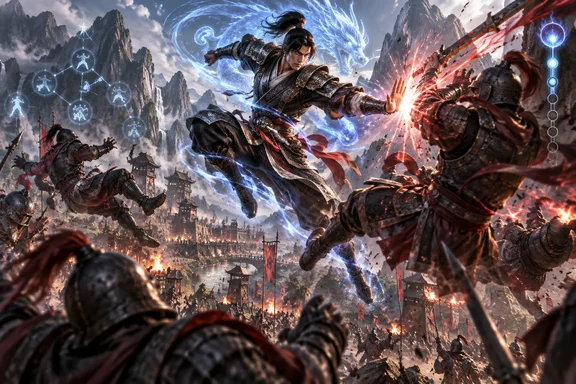
For PC players, the immediate news is also a commitment rather than a distant possibility. Koei Tecmo has confirmed Wo Long 2 for Xbox on PC, Steam, Xbox Game Pass and Xbox Cloud, with Xbox Play Anywhere support. Steam currently lists a Q1 2027 target, while Team Ninja’s site says “early 2027”; neither listing has published PC system requirements, pricing, supported frame-rate features, or a firm release date.
The preview’s most consequential finding is not that Team Ninja has added more moves. It is that the new moves appear designed to change the decision-making around Spirit, the resource system that made many of the original game’s offensive options feel unnecessarily expensive at launch. If that balance holds through release, Wings of Ember could be a much deeper action game without abandoning the fast, counter-driven identity of the first Wo Long.
Deflection remains, but it no longer appears to solve every encounter
The original Wo Long: Fallen Dynasty built fights around Deflection, a timed evasive parry that avoids damage and shifts the enemy’s Spirit balance toward a devastating Fatal Strike. It was fast, satisfying and accessible once learned. It also made a broad share of the game’s spellcasting, Martial Arts and weapon-switching systems feel secondary on its initial difficulty setting: when a successful deflect was cheap, safe and led directly to a major punish window, there was little incentive to accept the Spirit risk of a slower offensive option.
Wccftech’s Francesco De Meo, who played a Gamescom 2026 demo, reports that the sequel changes Spirit consumption and recovery so that Martial Arts and weapon-specific techniques can be used more freely. The report describes unlockable Martial Arts assigned through a Skill Tree, including the ability to use them as combo finishers. That is a significant departure from a combat loop in which a weapon’s moveset could be less important than the player’s parry timing.
Team Ninja has independently acknowledged the issue in comments reported by Automaton. Producer Masakazu Hirayama said the sequel is intended to answer criticism that players could over-rely on Deflection, with more proactive options to widen the combat. That does not establish final balance, but it confirms that the shift Wccftech felt in the demo reflects a stated development goal rather than a reviewer reading too much into a single encounter.
The important practical difference is whether offensive tools can create reliable advantages before an enemy reaches a Critical Blow moment. If Martial Arts are affordable enough to extend pressure, reposition targets or create launch opportunities, then a player who can execute combinations well should have a credible alternative to waiting for a red attack. That is the kind of flexibility that has traditionally separated Team Ninja’s strongest games from parry-focused action titles built around a narrower defensive test.
The new counter moves are described under conflicting names
The clearest complication in the early coverage is terminology. Wccftech calls the new evasive technique “Insight Skill” and its enhanced parry “Insight Deflection.” Other hands-on reporting from Chinese demo sessions has used “Focus Jump” and “Focus Deflect,” while another account uses “Focused Deflect.” All describe the same broad idea: special Spirit-consuming responses that add vertical movement or strong knockback to the familiar deflection framework.
According to Wccftech, the aerial option can let the player evade by using an enemy as a foothold, gain height, or knock certain airborne threats downward. The stronger deflect variant makes normal parrying costlier in Spirit terms but sends enemies backward, potentially turning one enemy into a projectile against a group. Coverage of an earlier public demo similarly described a Spirit-costing counter that throws enemies into nearby foes and leaves sturdier targets vulnerable after they collide with terrain.
The naming mismatch matters because these are not minor flavor abilities. They appear to be the sequel’s attempt to turn a single defensive input into distinct tactical choices. A standard Deflection preserves the familiar response to an incoming strike; the vertical move changes positioning and opens aerial follow-ups; the knockback variant creates crowd-control value at a resource cost.
Koei Tecmo has not yet published an English mechanics guide that settles the official terms or explains exact Spirit costs, timing windows, enemy attack categories and upgrade paths. Until it does, PC players should treat the various “Insight,” “Focus,” and “Focused” labels as early-preview translations, not confirmed final UI language. The mechanics have been shown in playable demos, but their names and balance remain subject to change.
Aerial attacks and open battlefields widen the game’s options
Wccftech also reports that weapon techniques and spells can be used in the air, allowing players to chain airborne attacks with less immediate risk of retaliation. That is a meaningful addition for Wo Long, whose original combat had jump attacks but did not make vertical fighting a central layer of its encounter design. Team Ninja’s official material has emphasized “evolved Chinese martial arts,” while its Tokyo Game Show listing describes the new demo as featuring acrobatic action; the emerging picture is of a sequel built to make movement itself a combat resource.
The level structure is changing alongside that system. Wccftech describes a battlefield divided into zones with enemy camps, elite enemies, loot and separate objectives, rather than the more linear mission spaces associated with the original. Battle Flags return to provide checkpoints and affect Morale, the system that adjusts relative player and enemy power in a mission.
This is an evolution rather than a confirmed open world. Wccftech says sections of the demo were still gated by story progression, and Team Ninja’s public descriptions call the locations battlefields rather than a seamless map. That distinction is useful: players expecting a fully free-roaming Nioh 3-style world should wait for a detailed explanation of mission structure, revisitability and co-op progression.
Still, broader spaces could make the new tools matter more. A knockback counter is more valuable when terrain and groups create opportunities for collisions. Wall jumps and air movement become more than traversal flourishes if there are elevated routes, ranged threats and camps that can be approached from multiple angles. Team Ninja needs the arenas to support these options, rather than simply placing them in larger spaces that still funnel players into one-on-one exchanges.
The PC release is confirmed, but its technical details are still blank
There is no question that Wo Long 2: Wings of Ember is coming to PC. Team Ninja’s official site lists Xbox on PC and Steam alongside Xbox Series X|S, PlayStation 5 and Nintendo Switch 2. Xbox Wire has also confirmed a day-one Xbox Game Pass release and Xbox Play Anywhere support, meaning one digital Xbox purchase should cover both the PC and console versions.
What is absent is nearly everything PC buyers need to judge the port. Steam lists both the minimum and recommended operating system requirement as “TBD.” Koei Tecmo has not provided CPU, GPU, storage, memory, upscaling, ray tracing, ultrawide, high-refresh-rate, shader-compilation, Steam Deck, or cross-save details. It has also not said whether Game Pass and Steam players will be able to play co-op together.
Those omissions are routine for a game targeting early 2027, but they carry extra weight after Wo Long: Fallen Dynasty arrived on PC with widely reported performance complaints, including stuttering and uneven frame pacing. Subsequent patches improved the situation, yet the sequel’s more vertical combat and larger battlefields will place greater pressure on frame-time consistency. A technically competent port is not a cosmetic concern for an action game built around narrow timing windows; it determines whether a Deflection failure feels like a player mistake or a system problem.
The unresolved risk is enemy variety, not the parry system
Wccftech’s demo report flags repeated enemies, including bosses, as its main concern. That is the right issue to watch. Team Ninja can improve player expression through selectable Martial Arts, aerial extensions and specialized counters, but repeated enemy patterns would still push players back toward the safest universal answer: learn the timing, deflect, punish, repeat.
The available evidence suggests Wo Long 2 is addressing the original’s most visible combat limitation with systems that reinforce one another rather than a token dodge bolted onto a parry game. It is arriving on PC through both Steam and Xbox’s Play Anywhere/Game Pass routes in early 2027. Before then, Team Ninja still needs to show the PC version running, publish its requirements, define its online compatibility, and demonstrate that its larger battlefields contain enough enemy and encounter variety to make the expanded toolkit worth mastering.
Update: TechRadar demo highlights nunchucks, Virtues, and readable unblockable attacks (September 16, 2026)
TechRadar’s Gamescom 2026 hands-on adds a few combat details not covered in the earlier preview. Its reporter used wooden nunchucks and says weapon choice is tied more directly to character-building: investing in the Wood Virtue increased damage and weapon proficiency for that setup, alongside the elemental-stat progression carried forward from the first game.
The report also describes standard blocking and conventional evasive movement as practical options alongside the expanded Deflection system. That supports the impression that Team Ninja is broadening defensive play rather than merely adding new parry variants.
According to TechRadar, unblockable attacks were frequent in its demo but had readable patterns rather than deliberately obscure animations. If that holds across the full enemy roster, it could help preserve Wo Long’s fast timing-focused combat without making its new counter options feel mandatory.