

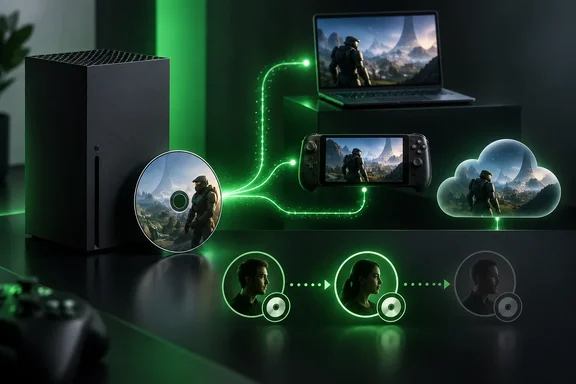
That design makes the feature more consequential than a free upgrade program, but less revolutionary than the “true digital ownership” future described by The Verge. Microsoft’s August 26 announcement confirms the broad outline—insert a supported disc into an Xbox One or Xbox Series X console, launch the game, and claim a digital entitlement with Xbox Play Anywhere and Xbox Cloud Gaming benefits where available. It also confirms that the rollout began as an Xbox Insider test on August 31, rather than a completed public release.
For Windows and handheld users, the immediate payoff is real. A compatible disc can now unlock the PC and cloud rights that come with the digital Xbox version, where a game supports Xbox Play Anywhere. But collectors, secondhand buyers, and anyone expecting to turn a shelf full of games into a permanent digital library should understand the condition Microsoft has not spelled out in its public announcement: the disc remains the transferable proof of ownership.
The disc is now a movable license key
Microsoft’s public description says a claimed disc provides the “benefits of digital” while continuing to work normally as physical media. That phrasing leaves out the feature’s defining behavior.
According to Windows Central, once a player claims an eligible game, the disc can be removed and the game can be installed from the account library, played without the disc, used through Xbox Play Anywhere on Windows PCs and supported handhelds, and streamed through Xbox Cloud Gaming where the title is eligible. There is no recurring requirement to reinsert the disc simply to keep the entitlement active.
But the digital right is not detached from the object that generated it. If the owner sells, gives away, or lends the disc and the next person claims it on another Microsoft account, the entitlement transfers away from the prior account. The original owner loses access until the disc returns or they acquire another license.
That is a deliberate attempt to preserve one feature of physical ownership that conventional digital storefronts do not offer: resale. A normal Microsoft Store purchase remains tied to the purchasing account under the platform’s license terms. Disc to Digital instead treats the disc as a persistent bearer credential. The practical result is closer to a physical game’s existing resale model, with the convenience of digital installation and cloud access during the period when the player possesses the disc.
It also means buyers should resist treating the program as a way to digitize a collection and immediately sell the discs. Doing that hands the associated entitlement to the purchaser. The used-disc buyer, meanwhile, has a new reason to test an eligible disc in a compatible Xbox before assuming the digital right still belongs to the seller.
Microsoft has not published a detailed public FAQ explaining transfer timing, disputes, replacement discs, or how it will handle a disc that changes hands through a retailer rather than between two players. Those omissions are material, because the system’s value depends on the license moving predictably—and on buyers knowing that it moves.
“Fifteen years” measures the plan, not the public hardware policy
The Verge reports that Microsoft was considering a broader form of digital ownership in 2011, including digital gifting, reselling, and retail disc exchanges. If 2011 is the starting point, the “15 years in the making” description is numerically accurate in September 2026.
The publicly documented connection is clearer from 2013. Before the Xbox One launched, Microsoft announced a licensing model under which retail games would be associated with an Xbox Live account, playable without the disc after installation, shareable with designated family members, and potentially tradeable through participating retailers. Microsoft’s June 2013 Xbox Wire posts explicitly described disc-free access and resale plans.
Then came the backlash. The Xbox One policy required periodic online connectivity and created widespread confusion and hostility around used games, sharing, and ownership. On June 19, 2013, Microsoft reversed course: disc games would work offline after initial setup, and the console would return to the familiar model of requiring a disc for validation.
That reversal is the historical reason the current feature looks both new and strangely familiar. The original Xbox One policy tied physical distribution to online account licensing. Disc to Digital revives part of that architecture while removing the most toxic element of the 2013 proposal: a mandatory check-in schedule that could lock players out of their games.
Both The Verge and Windows Central report that Xbox One-era disc manufacturing incorporated readable identifiers that enable today’s entitlement system. Microsoft has not publicly described the identifier format, when it became standard, or why some discs lack the required data. That technical detail therefore remains attributable to the outlets’ sourcing, not a fully documented Microsoft platform specification.
The history also puts a limit on the preservation narrative. Microsoft did not spend 15 years building a public preservation program from the outset. The public record shows a 2013 licensing strategy that was withdrawn, followed by a later reuse of the disc-identification groundwork in a much narrower, more consumer-friendly feature.
Compatibility is broad, but the authoritative list is missing
Microsoft says “most” Xbox One and Xbox Series X disc-based games support Disc to Digital, that the program begins with thousands of titles, and that more will be added. It has not, however, published the itemized compatibility database players need before they start purchasing used discs or planning a library migration.
That gap is already being filled by community testing. Windows Central reported more than 800 compatible disc editions in an independently compiled list, including some games that are no longer available to buy digitally. Those delisted titles may be the program’s strongest preservation use case: a person who still owns a compatible physical copy can potentially regain practical access through a modern Xbox library, PC entitlement, or cloud option that would otherwise be unavailable at retail.
The distinction between Microsoft’s “thousands of titles” and a community list containing hundreds of confirmed discs is not necessarily a contradiction. Microsoft may be counting all eligible SKUs, regional editions, and games not yet tested by the public. Still, the company’s lack of an official searchable list makes its headline number difficult to use. A player holding a particular copy of Deadpool, a sports annual, or a game delisted over licensing issues needs a title-specific answer, not a broad assurance.
The other boundaries are clearer. Xbox 360 and original Xbox discs are excluded from Disc to Digital. Windows Central reports those older media were not manufactured with the necessary identifiers, and Microsoft’s announcement limits the feature to Xbox One and Xbox Series X disc-based games.
That does not mean Microsoft has abandoned older games. In July, Xbox launched its backward-compatibility program on PC with four original Xbox titles—Blinx: The Time Sweeper, Conker: Live and Reloaded, Crimson Skies: High Road to Revenge, and Fuzion Frenzy. Existing digital owners of those titles can carry their licenses to PC and supported handhelds. But that separate initiative is a curated catalog program, not a mechanism for transforming an original Xbox or Xbox 360 disc into a PC entitlement.
This helps Windows gaming—but only inside Xbox’s walls
Disc to Digital matters to PC players because Xbox Play Anywhere can make a single eligible Xbox entitlement usable on Windows. Microsoft says its Play Anywhere catalog now exceeds 1,500 games, and the Disc to Digital announcement specifically calls out Play Anywhere as a benefit where supported.
The wording “where supported” does significant work. Claiming a disc does not make every Xbox game a Windows game. The title must have a PC version and participate in Play Anywhere. Nor does the new entitlement grant a Steam key, a PlayStation license, a Nintendo license, or a license portable between independent stores.
That reality is where The Verge’s broader argument for cross-platform, transferable game licenses moves from reporting into aspiration. The current system is a more flexible Microsoft ecosystem license attached to a particular piece of physical media. It is not an interoperable ownership standard.
Microsoft’s March description of Project Helix, its next-generation Xbox hardware, reinforces why the company is investing here. Xbox says the forthcoming system is designed to play Xbox console and PC games, with developer hardware planned for 2027, while committing to keep four generations of Xbox games playable for years. Disc to Digital gives Xbox One and Series X discs a path into that account-based future, provided the title is supported and the owner keeps possession of the disc.
Sony’s decision to stop producing physical discs for newly released PlayStation games beginning in January 2028 makes the contrast sharper. Sony has confirmed existing discs and games released before that date will not be affected, but it has not announced a comparable disc-to-digital migration program. Whether PlayStation’s media carry comparable identifiers is unknown; claims that Sony cannot replicate Xbox’s approach are speculation until Sony explains its own options.
Preservation depends on the catalog, not the marketing
Microsoft deserves credit for preserving a resale path where most digital game stores offer none. Letting a supported disc unlock cloud and PC access without requiring the player to surrender the disc—or to endure periodic disc checks—is a meaningful improvement over both traditional disc authentication and 2013’s rejected Xbox One proposal.
Yet the program’s preservation value will be decided by the exceptions. Publishers can limit participation, discs can be incompatible because of manufacturing differences or damage, and games that rely on discontinued servers, expired music rights, removed DLC, or vanished online services will not become fully preserved merely because an entitlement appears in an account.
For now, the sensible move is simple: Xbox owners with Xbox One or Series X discs should test eligible games during the Insider rollout, confirm that the entitlement appears in their library, and keep the physical media if they want to retain the associated rights. The feature gives old discs a useful digital future, but the disc is still the asset that makes that future transferable.