

What the reported records reveal
Wolf’s Gaming Blog’s October 6 report traces the discovery to a GamingLeaksAndRumours post linking to Spectrum-hosted customization files. The community post describes configuration records and 16 3D component models, connecting Edessa to an accessory and customization product called “Beatrice.” These are reported development assets—not a retail specification sheet.
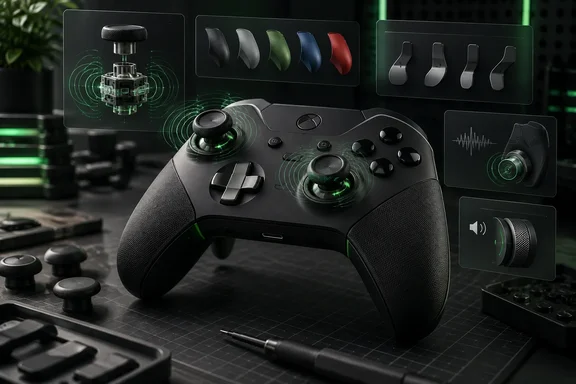
The reported options cover considerably more than paint:
- Thumbstick sensing: Hall-effect and TMR module entries, plus loose, standard and tight Hall-effect variants.
- Feedback: A motor setting identifying impulse-trigger ERMs and advanced-haptics VCAs, with inclusion and exclusion options.
- Audio controls: A color selector for an audio scroll wheel.
- Physical customization: Different stick heights and shapes, low-friction or silent options, D-pad choices, several paddle designs, faceplate colors and engraving.
- Accessories: An Elite Complete Package upgrade.
That is an intriguing menu, but configuration labels do not establish which combinations will reach customers. Nor does “Thumbstick Module” prove that owners could replace the complete sensing mechanism themselves. A configurator can describe manufacturing choices without promising user-serviceable hardware.
Why Hall-effect and TMR matter
The two sensor labels are the most technically interesting part of the report. Texas Instruments documents joystick designs that combine a magnet with a three-dimensional Hall-effect sensor to measure movement. This is magnetic position sensing, rather than simply a different thumbstick cap.
TMR means tunnel magnetoresistance. TDK describes its TMR angle sensors as detecting the direction of a magnet’s magnetic field, and its broader TMR range supports contactless position and angle measurement, including gaming applications. Neither manufacturer’s documentation identifies the component allegedly planned for Edessa.
The practical distinction is between how a stick measures movement and how it feels under your thumb. Microsoft’s existing Elite Series 2 already offers three mechanically adjustable tension settings, using an included adjustment tool. It also supports sensitivity-curve adjustments through Xbox Accessories. Resistance customization would therefore not, by itself, be a new Elite feature.
The potentially meaningful change is a choice of sensing technology alongside resistance. Even then, these entries provide no basis for declaring one alleged configuration faster, more accurate or permanently immune to drift. Those conclusions would require final hardware specifications and testing—not enthusiasm with a soldering iron.
Haptics and the wheel remain open questions
The reported motor labels suggest Microsoft may be exploring different feedback configurations. They do not establish how the controller would feel, which games would support any new effects, or whether excluding motors represents a consumer option rather than an internal development variant. Similarly, an audio-wheel color entry suggests an audio-related control, but does not tell us whether it adjusts volume, chat balance or something else.
There is relevant earlier reporting. In its August 12, 2026 article, TechRadar described photos of an alleged controller bought through OfferUp, showing a small screen, two lower scroll wheels, a revised D-pad and a removable rechargeable battery. The owner reportedly could not pair it with their consoles. That account explains the interest in the new wheel label, but does not authenticate the backend records or prove that both leaks concern the same finished product.
What Windows players can—and cannot—conclude
Microsoft’s public Design Lab page still identifies its customizable Elite controller as Series 2. Its official Series 2 documentation specifies Windows 10/11 connectivity through Bluetooth, a compatible USB-C cable or an Xbox Wireless adapter, with Xbox Accessories features available on those Windows versions. Those are established Series 2 capabilities; they cannot automatically be assigned to Edessa.
For PC players, the unanswered questions are therefore practical: connection methods, feature differences between wired and wireless use, software configuration, and support for any new haptics or audio controls.
There is also a verification limit. The captured Edessa API response returned an error indicating that no matching object could be located. That does not establish why the endpoint failed or disprove previously captured files, but it prevents that response from independently confirming the alleged feature list.
Bottom line: this is a potentially revealing customization leak, not an Elite Series 3 launch. Magnetic stick options deserve attention, especially when distinguished from the tension adjustments Series 2 already provides. Until Microsoft identifies the hardware and publishes its specifications, however, the sensible reading is “possible development choices”—not “features guaranteed to ship.”
References
- Xbox Elite Series 3 Appears In Design Lab Backend With Hall-Effect And TMR Stick Options - wolfsgamingblog.com wolfsgamingblog.com · 2026-10-06T00:25:43+00:00
- The Xbox Elite Series 3 seems to have leaked — and, in a twist no one expected, might have a built-in screen | TechRadar techradar.com
- Xbox Elite Wireless Controller Series 2 | Xbox xbox.com