

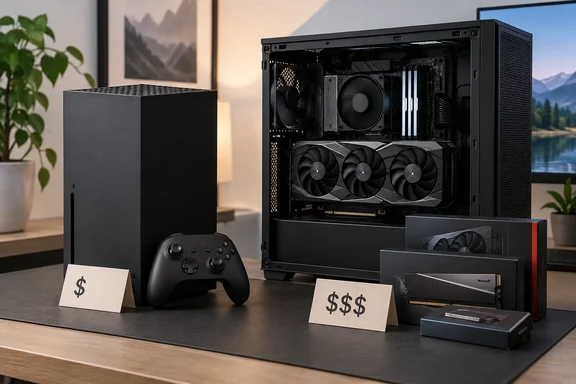
A new BGR feature by Callum Marshall looks at the question directly. It estimates that a PC comparable to the Series X would cost about $800 to $1,000, and only if you find the best retail and secondhand deals. BGR concludes that buying the console is the cheaper choice. That conclusion mostly holds up, but some of the article's numbers don't add up, and the phrase "equivalent PC" means less than it sounds.
What BGR says you should buy
BGR lists four parts it treats as essential, then says the rest of the build can be done cheaply:
- CPU: AMD Ryzen 5 5600
- GPU: Radeon RX 6700 XT 12GB
- RAM: 16GB DDR4-3600 (2×8GB)
- Storage: 1TB WD Black SN770 NVMe SSD
Its price estimates:
| Component | BGR estimate |
|---|---|
| Radeon RX 6700 XT 12GB (used) | ~$250 |
| RTX 3060 Ti (new, the alternative) | $400 or more |
| Ryzen 5 5600 | $150–$180 |
| 1TB SSD | $100–$150 |
| Case, motherboard, PSU, cooling, OS and peripherals combined | $350–$500 |
| 16GB DDR4 | No figure given; BGR calls finding it affordable used "the most difficult part" |
BGR says buying a new graphics card isn't realistic on this budget. It also rejects claims that an old RX 580 can match the Series X, saying that card falls well short. That is a fair correction to a comparison that still shows up online.
Section summary: BGR builds around a used RDNA 2 graphics card and an older AM4 platform, and admits that RAM is the part it couldn't price with confidence.
The price target: is $799.99 still right?
BGR measures its build against $799.99, which it calls the current Series X price. Given how often Xbox prices changed in 2026, that was worth checking. It holds up.
Microsoft announced that effective August 1, 2026, it would update prices worldwide, with Xbox consoles rising by US$100 for 512 GB models and US$150 for 1 TB models, while sunsetting its 2 TB model. Variety reported the result: the Xbox Series X now costs $749.99 for the 1 TB digital model and $799.99 for the 1 TB disc drive version. The Series S is $499.99 for the 512 GB and $599.99 for the 1 TB.
For context, the Series X went from $649.99 to $799.99, and it launched at $499.99 in 2020. Microsoft blamed components. It said "console storage and memory prices have increased by more than 2.5x and we expect another doubling by the fall of 2027." The same Xbox Wire post says the October 2025 increase added $20 to $70 in the U.S.
So $799.99 is the correct U.S. list price for the disc model. Two details make the console look cheaper than BGR suggests:
- The all-digital Series X costs $749.99. It has the same processor, GPU and memory as the disc model, according to Microsoft's spec sheet. If you don't need a disc drive, the target is $50 lower.
- Refurbished consoles cost less. In the same announcement, Microsoft says certified refurbished Xbox consoles are sold through Microsoft Stores for up to US$100 off MSRP.
Section summary: BGR's $799.99 target is accurate for the 1TB disc Series X. The digital model and refurbished units make the console target cheaper still.
BGR's total doesn't add up
This is the main weakness in the piece. Using BGR's own figures:
- GPU (~$250) + CPU ($150–$180) + SSD ($100–$150) = $500–$580
- Add BGR's $350–$500 for everything else = $850–$1,080
- Add RAM, which BGR doesn't price, and the total rises further.
BGR also says its best case "breaks even" with the $799.99 console before you buy an OS or peripherals. But the $350–$500 bucket already includes Windows and peripherals. Both statements can't be true. The $800–$1,000 headline is better read as a rough estimate than as a checked parts list. If anything, BGR's own components point to a total at or above the top of that range once you pay for memory.
That doesn't reverse BGR's conclusion. It makes the conclusion stronger: under current prices, the console is cheaper.
"Equivalent" hardware is a loose term
According to Microsoft's official specifications, the Series X has:
- An 8-core custom Zen 2 CPU at 3.8 GHz (3.6 GHz with SMT)
- A custom RDNA 2 GPU with 52 compute units at 1.825 GHz, rated at 12 TFLOPS
- 16GB GDDR6 on a 320-bit bus, split into 10GB at 560 GB/s and 6GB at 336 GB/s
- A 1TB custom NVMe SSD, rated at 2.4 GB/s raw and 4.8 GB/s compressed with a hardware decompression block
- One HDMI 2.1 port, with a stated target of up to 120 FPS
BGR's build doesn't match this layout. From general hardware knowledge rather than BGR's reporting:
- The CPU is different. BGR says an equivalent PC needs "an AMD 8-Core Ryzen CPU", then recommends the Ryzen 5 5600, which has six cores. Its newer Zen 3 design and higher clocks make it competitive in games, but it doesn't have more cores than the console.
- The GPU is a close relative, not a copy. The RX 6700 XT is also RDNA 2. It has fewer compute units (40) running at much higher clocks, which puts its raw throughput in the same range as the console GPU. It also has its own 12GB of memory.
- Memory works differently. The console shares one GDDR6 pool between CPU and GPU. The PC splits the work between 16GB of DDR4 system memory and the graphics card's VRAM. Comparing "16GB" to "16GB" doesn't tell you much.
- Consoles get tuned builds. Developers target one fixed Xbox configuration. PC ports vary a lot in quality, so the same hardware can perform differently from game to game.
BGR provides no benchmarks comparing its build with a Series X. Its claim that the PC will play most modern games comfortably at medium settings is a reasonable expectation for this class of hardware, but it hasn't been tested.
Section summary: The PC is built to deliver a similar gaming experience, not identical hardware. Aim for similar results and don't expect frame-for-frame parity.
Other outlets reached the same conclusion
BGR isn't alone:
- PCWorld (Michael Crider, February 2026) tried to build a respectable $1,000 gaming PC from new parts and failed. His first list came to about $1,250 after tax. A cut-down DDR4 build got just over $1,000, still without Windows. He also noted that prebuilt PCs can sometimes cost less than the parts bought separately, because large manufacturers may hold inventory bought at older prices.
- Tom's Hardware, in a guide updated August 3, 2026, dropped its $500 build tier and made roughly $800 its entry point. It said a competent 1080p gaming PC was no longer possible at the old price. It also left RAM out of its totals because bundle prices vary so much and sell out quickly. Its ~$800 build pairs a Core i5-14400F with a Radeon RX 7600 and a 512GB SSD, which is a different approach from BGR's used-GPU build.
Hidden costs on both sides
A fair comparison has to count what comes in the box and what doesn't:
What the console includes: Microsoft says the Series X comes with a controller, an Ultra High Speed HDMI cable and a power cord.
What the PC may cost extra:
- A Windows license. Tom's Hardware leaves it out of its build prices, saying you can get Windows 11 free or cheaply, but you should plan for it.
- A controller, if you want to play from the couch
- Keyboard and mouse
- Warranty risk on used parts. A used RX 6700 XT at $250 is only a good deal if the card works and hasn't been worn out by heavy use.
Long-term costs (general industry context): PC gamers don't pay a subscription for most online multiplayer. On Xbox, most paid multiplayer games require a Game Pass tier. PC games also go on sale more often. A PC can be upgraded one part at a time and doubles as a work computer, which a console can't do.
Which should you buy?
- If you want the cheapest way to play at a Series X level, buy an all-digital Series X at $749.99 or look at Microsoft's certified refurbished units. BGR's own numbers put its PC above that once RAM is included.
- If you already own some parts, such as a case, PSU, SSD or memory from an older PC, the math changes a lot. Keeping RAM costs down is what makes BGR's plan workable.
- If you don't want to deal with used parts, compare prebuilt desktops, as PCWorld suggests, before buying a new GPU.
- If you're buying used, test the card under load before you pay, check its fan and temperatures, and get a return window if you can.
Bottom line
BGR's conclusion is right: in late 2026, a Series X is cheaper than a DIY PC that performs about the same, and its $799.99 target price is accurate. Its figures are loose, though. Once you add RAM, its parts list likely comes in above the top of its own range, while the digital and refurbished consoles lower the target. The PC still offers upgradeability, cheaper games over time and use beyond gaming, but at current memory prices it now costs about the same as the console or more.
References
- How Much Would It Cost To Build A PC Equivalent To The Xbox Series X In 2026? bgr.com · 2026-09-29T14:47:00+00:00
- Xbox Price Hike for X and S Series, Discontinuing 2 TB Model variety.com
- How to build a $1,000 gaming PC in 2026: Don't | PCWorld pcworld.com