

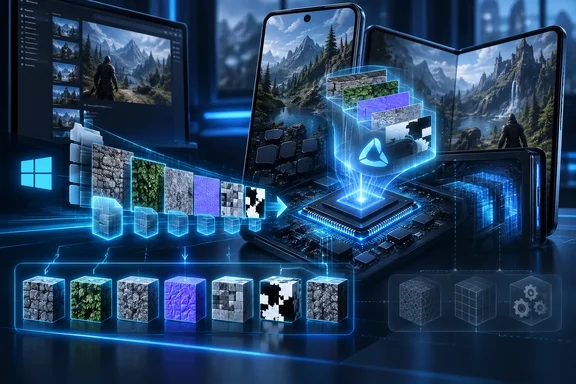
For Windows gamers and Android emulation users, the importance is narrow but real. Many PC games package textures in Microsoft’s BC formats, also called DXT or BPTC depending on the generation and API. When an Android GPU cannot consume those assets directly, the compatibility layer must either decompress them into much larger uncompressed textures or transcode them into a mobile-oriented format such as ASTC or ETC2. Both paths add work, consume memory bandwidth, and can introduce loading pauses or stutter.
The Xring O3 result does not establish that Xiaomi has solved Windows gaming on Android, nor does it prove a particular title will run better. It does establish something more basic: the device driver says the GPU can use the same compressed texture family that desktop Direct3D and Vulkan software commonly expects. That is a prerequisite that many current Mali-based Android devices have lacked.
What the Vulkan report actually shows
Khronos defines Vulkan’s textureCompressionBC feature as support for the BC compressed texture formats across the BC1 to BC7 range. The formats are not interchangeable: BC1 through BC5 cover older color, alpha, and normal-map use cases, while BC6H and BC7 are commonly associated with higher-quality HDR and RGBA texture assets used by newer PC games.
The Xiaomi 18 Fold’s public Vulkan report lists support across that family rather than showing only one or two legacy formats. That is the meaningful part of the finding. BC1 support alone would help with older DirectX-era assets; full BC support gives a translation layer a much better chance of accepting an unmodified PC game’s texture set without first rebuilding it.
The report also lists more than nominal format recognition. Sampling is the operation games need to read a texture in shaders. Blitting allows certain GPU-side image-copy and scaling operations. Transfer support handles copies between resources. In other words, the advertised capabilities line up with practical texture use rather than a driver merely identifying the formats by name.
Still, a public capability database is evidence of a driver-exposed feature, not a substitute for game testing. It does not show which Windows compatibility layer was used, whether the formats work correctly under every rendering path, how much memory is saved in a real title, or whether Xiaomi’s driver has edge cases with BC6H and BC7. Those questions need testing on retail firmware with applications such as Winlator-derived environments, Mesa-based translation stacks, and games that actually ship BC-compressed DDS assets.
The gap between Mali branding and shipped features
The immediate comparison is with MediaTek Dimensity and Google Tensor devices. Both have shipped with Arm Mali GPUs, but Android users running PC-oriented translation tools have repeatedly encountered a missing BC texture capability on those devices. That absence matters even where the underlying GPU architecture is otherwise modern enough to run Vulkan workloads.
Arm’s graphics IP is licensed into system-on-chips with vendor-specific configurations, drivers, memory systems, and feature choices. Notebookcheck argues that Xiaomi selected an optional BC texture-decoding block that other Mali licensees have left out. That explanation is plausible and consistent with years of developer discussion around Mali’s BC support, but Xiaomi and Arm have not publicly documented the Xring O3’s physical texture-unit configuration. The public record confirms the exposed Vulkan capability; it does not yet confirm which silicon option Xiaomi licensed or enabled.
That distinction prevents an easy but misleading conclusion: Xring O3 is not necessarily proof that every GPU built from the same Mali generation could expose BC1 through BC7 through a future driver update. A vendor may need the relevant hardware logic in the shipped configuration, and a driver must expose and validate the formats. The fact that a device reports the Vulkan feature says considerably more than a marketing label such as “Mali GPU.”
It also means MediaTek’s omission should be treated as a product-level limitation, not as a universal law of Mali graphics. For buyers who care about Windows game translation, “Mali” has become a shorthand warning because of what phones actually ship with—not because Arm’s designs are categorically incapable of BC decoding.
Why BC textures are a Windows compatibility issue
Android software normally does not need BC texture support. Android graphics workloads widely use ETC2, which is part of the OpenGL ES baseline, and ASTC, an Arm-developed format that is prevalent on higher-end mobile hardware. Game developers targeting Android can ship assets in those formats or use a system that selects an appropriate format at install time.
Windows games follow a different history. BC formats are deeply embedded in the Direct3D and PC-game asset pipeline, and BC7 in particular maps directly to a DirectX texture format. A Windows game ported properly to Android can repack those assets. A compatibility layer attempting to run a Windows build has much less freedom: it must deal with the files the game brings with it.
That is why native BC support affects compatibility more than benchmark scores. A device can have ample shader throughput and still suffer when a game’s compressed textures need conversion before the renderer can use them. Software decompression swells memory use dramatically because compressed 4-by-4 texture blocks become full pixel data. GPU compute conversion to ETC2 or ASTC can avoid some CPU cost, but it remains an additional startup or streaming job and can still require extra storage or RAM.
Community tools already exist to mitigate the problem. The open-source bcn_layer, for example, adds BC texture decompression through Vulkan compute shaders for configurations where native support is unavailable. Such projects are important because they make more games viable on Mali hardware. They also demonstrate the cost Xiaomi may be avoiding: a native path lets software upload and sample supported BC assets directly rather than converting each one along the way.
Qualcomm’s Adreno GPUs have generally been the safer Android choice for this particular workload because their drivers have exposed BC texture support alongside mature community tooling. Xring O3 therefore matters less as an across-the-board Snapdragon challenger than as the first reported alternative in an Android phone-class chip to clear a specific compatibility hurdle that has helped keep Qualcomm ahead in Windows-game experimentation.
The Pad 9 Pro Max is a promise, not a confirmed result
Xiaomi has also shipped the Xring O3 in the Xiaomi Pad 9 Pro Max. The shared SoC makes BC support likely there as well, but the claim should be kept at that: likely. The submitted evidence is a Vulkan report for the Xiaomi 18 Fold, not an equivalent report from the tablet.
That distinction can matter. Android vendors routinely maintain separate device firmware, graphics-driver packages, release schedules, and feature flags even when products use the same chip. Until a Pad 9 Pro Max Vulkan capability report or independent testing confirms the formats, buyers should not assume that the two devices behave identically.
The tablet could nevertheless be the more useful form factor for this feature. Windows translation setups benefit from sustained cooling, larger batteries, physical-controller support, and screen space. Native BC texture handling would not change the limits of ARM CPU compatibility, GPU driver maturity, anti-cheat, or the legal and technical realities of running PC software on Android. It could reduce one recurring resource penalty in a category where every avoided workaround counts.
What users should watch for next
The critical next evidence is practical, not another specification listing. Developers need to verify that Xring O3’s BC support survives the translation chain: Windows game API calls, Direct3D-to-Vulkan translation, the Android Vulkan driver, and the game’s own texture-loading behavior. BC7 and BC6H are particularly worth testing because their presence separates full modern support from the partial compatibility often associated with older compressed-texture extensions.
Xiaomi has also not positioned the Xring O3 publicly as a Windows-gaming chip, and no performance figures in the available reporting quantify an advantage over Dimensity hardware. Buyers should not purchase the Xiaomi 18 Fold or Pad 9 Pro Max expecting guaranteed compatibility with a favorite Windows title on the basis of a Vulkan database entry alone.
But for developers and enthusiasts, the finding changes the shortlist. The Xring O3 now appears to offer a driver-visible capability that can let Windows-oriented graphics stacks keep PC textures compressed from storage to GPU sampling. If independent testing confirms stable behavior, Xiaomi will have turned a technical detail most phone buyers never see into a concrete advantage over the Mali implementations inside many Dimensity and Tensor devices.
References
- Xiaomi's Xring O3 adds a key feature for Windows game emulation that's missing from Dimensity chips Notebookcheck · 2026-09-17T22:08:00+00:00