
The publication is not a new emergency advisory, a list of newly exploited Microsoft bugs, or a replacement for Microsoft’s monthly security updates. It is a CISA framework document aimed at changing how organizations decide which vulnerabilities demand immediate action. That distinction is important for IT departments that already receive far more scanner findings, vendor bulletins, and CVE notifications than they can realistically remediate at once.
CISA frames the review as a baseline taken before AI-enabled vulnerability discovery becomes more widespread. The agency’s central claim is that the industry can reduce a substantial portion of future exposure by preventing recurring software weaknesses at the producer level, instead of discovering individual instances only after vulnerable code has shipped.
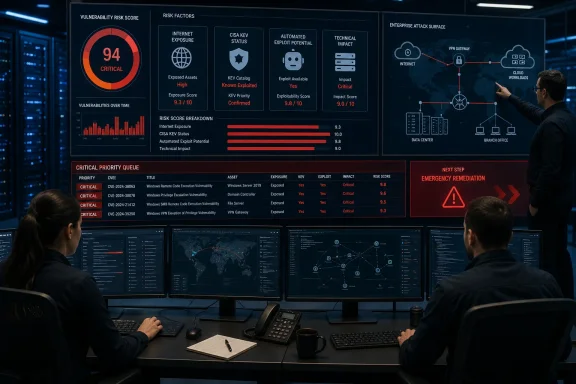 The review shifts attention from CVSS volume to exploit conditions
CISA’s review centers its prioritization advice on four criteria: whether an affected asset is exposed, whether the vulnerability appears in the Known Exploited Vulnerabilities Catalog, whether exploitation can be automated, and the technical impact of a successful exploit. Those factors answer questions that a base CVSS score cannot settle on its own: Can an attacker reach this system? Are attackers already using the flaw? Can it be exploited at scale? Does compromise hand over meaningful control?
This is a more operational model for a Windows estate than sorting every finding by “critical,” “high,” and “medium.” A critical vulnerability in a disconnected test virtual machine and a moderately scored weakness on an internet-facing remote-access gateway do not create the same risk. Nor does an elevation-of-privilege bug on a fully managed endpoint necessarily outrank a remotely exploitable flaw in a public web application that authenticates employees or partners.
CISA’s choice to foreground exposed assets deserves particular attention. Asset inventory has long been the unglamorous dependency beneath patch management, and many organizations still cannot reliably identify every public-facing application, VPN appliance, management console, development server, and cloud workload they operate. A vulnerability program cannot accurately prioritize exposure it has not found.
For administrators, this means the vulnerability scanner should not be the only system deciding urgency. Its findings need to be correlated with external attack-surface management data, DNS and certificate inventories, cloud accounts, load balancer configurations, firewall rules, and identity paths. If a system’s internet exposure is unknown, its remediation priority is also partly unknown.
KEV status is a decision signal, not a substitute for asset ownership
The Known Exploited Vulnerabilities Catalog has become one of CISA’s strongest practical filters because it denotes vulnerabilities for which there is evidence of exploitation in the wild. The new review explicitly incorporates KEV status into its broader risk framework, alongside exposure and impact. That approach is more useful than treating the catalog as either an optional threat-intelligence feed or a complete patching plan.
A KEV entry should initiate a fast ownership check: identify the affected product versions, locate every installed or exposed instance, establish whether the vulnerable component is enabled, and determine whether the system was reachable before remediation. For a Windows environment, the affected asset may be a Windows Server application host, a third-party management platform, an edge appliance managed from Windows workstations, or a cloud-connected service rather than Windows itself.
The important operational consequence is that patching may not be enough. If an exposed, actively exploited vulnerability granted an attacker authentication bypass, remote code execution, or administrative control, teams need to assess for compromise before declaring the incident closed. That can include reviewing web-server and VPN logs, endpoint telemetry, privileged-account activity, newly created scheduled tasks or services, remote-management tooling, and unusual outbound connections.
CISA’s announcement does not prescribe a universal retrospective hunting procedure for every KEV-listed flaw, nor could it: the evidence required depends on the product, vulnerability, exposure window, and available logging. But the review’s technical-impact criterion is a reminder that remediation and recovery are separate activities. Closing the hole after an intruder has entered does not remove persistence, stolen credentials, or altered configurations.
Binding Operational Directive 26-04 formalizes the risk-first approach for federal agencies
The review points organizations to Binding Operational Directive 26-04, CISA’s framework for prioritizing security updates based on risk. The directive applies to Federal Civilian Executive Branch agencies, not automatically to private companies, schools, hospitals, state governments, or home users. Still, its four-part decision model is portable because it is based on conditions attackers use to select targets rather than on a federal-only product stack.
For non-federal enterprises, the useful takeaway is not to copy a government deadline without considering operational constraints. It is to establish a written escalation path that prevents a publicly exposed, KEV-listed, automatable vulnerability with high technical impact from disappearing into an ordinary monthly patch cycle. A risk model that cannot override routine change-management scheduling is a reporting exercise, not a security control.
Teams should also be careful not to convert the four criteria into a mechanical score that masks uncertainty. “Automatable exploitation” may not always be obvious from a vendor advisory on day one, and technical impact can vary with configuration. An unauthenticated remote-code-execution flaw in a product used behind a reverse proxy, for example, may still be severely dangerous if a bypass or alternate access path exists.
The best response is to record the evidence behind the decision: the asset’s exposure, the installed version, whether a vendor fix or mitigation is available, whether exploitation has been confirmed, which logs were reviewed, and who accepted any temporary risk. That record helps security teams move quickly without losing the accountability needed after a breach or audit.
Secure by Design is the part software producers cannot outsource to customers
CISA’s larger argument is aimed at software producers: recurring weaknesses should be eliminated through design and development practices instead of left for customers to discover, deploy compensating controls around, and patch repeatedly. The review describes this as a shift from reacting to attackers toward preventing classes of defects from reaching production software.
That is an important corrective to the familiar enterprise pattern in which a vendor publishes a security bulletin, customers scramble to inventory and patch, and the same underlying coding or architectural weakness emerges later under a new CVE. A security team can compensate for some supplier failures with segmentation, least privilege, application control, endpoint detection, and rapid patching. It cannot indefinitely compensate for a product that routinely exposes unsafe defaults, weak authentication boundaries, insecure deserialization, injection flaws, or unsafe update mechanisms.
For organizations buying Windows-compatible business software, the review offers a procurement implication as well as a patching one. Security questionnaires should ask vendors whether their products are secure by default, how they eliminate recurring weakness categories, what secure-development practices they use, how long they support released versions, and whether customers can inventory deployed versions and disable high-risk features. A vendor’s speed at issuing advisories matters, but avoiding preventable defects matters more.
CISA’s publication does not identify a named vendor, product family, or Microsoft service as the subject of this review. Readers should therefore avoid interpreting it as evidence of a new Windows-specific vulnerability trend. Its relevance to Windows and enterprise administrators lies in the operating discipline it describes: inventory what is exposed, use active exploitation as a major escalation signal, measure impact in the context of real administrative control, and demand safer software upstream.
A useful first step is to test the current patch queue against CISA’s four factors
Security teams can apply the review immediately without replacing their existing vulnerability platform. Take the highest-priority open findings and determine which ones are on externally reachable systems, present in the KEV Catalog, plausibly automatable, and capable of yielding code execution, credential theft, broad lateral movement, or administrative control. Any finding that meets several of those conditions should be reviewed as an incident-risk decision rather than an ordinary maintenance ticket.
- Organizations should reconcile vulnerability findings with an authoritative inventory of public IP addresses, DNS records, cloud services, remote-access products, and externally reachable management interfaces.
- Teams should build a rapid workflow for KEV-listed products that includes patch or mitigation validation, exposure verification, named asset ownership, and a decision on whether compromise assessment is required.
- Administrators should preserve the evidence behind emergency remediation decisions, including installed builds, affected hosts, exposure dates, mitigation status, and relevant log-review results.
- Procurement and engineering leaders should track recurring weakness classes in their software suppliers, rather than measuring vendor security solely by the number and speed of patches released.
The immediate consequence of CISA’s review is not another item to add to an already crowded patch queue. It is a challenge to ensure that the queue reflects how attackers choose targets: exposed systems first, exploited flaws next, scalable attacks close behind, and vulnerabilities that hand over real control at the top.
