
The advisory is important because LUAFV is not an optional third-party driver. The Microsoft-supplied
luafv.sysfilter sits in the file-I/O path that supports User Account Control compatibility behavior for older applications. An elevation-of-privilege weakness there turns a component intended to keep legacy software running under standard-user permissions into a potential route for crossing Windows’ privilege boundary.
Microsoft’s Security Update Guide identifies the issue as a Windows LUA File Virtualization Filter Driver elevation-of-privilege vulnerability and lists August 11 as its publication date. At publication, however, the public material available through the advisory does not provide a root-cause description, a proof of concept, a named attacker group, or evidence of active exploitation. That is a meaningful limit on what defenders should claim: this is a patch-now local privilege-escalation issue, not evidence that an internet-exposed Windows service can be compromised remotely by CVE-2026-50472 alone.
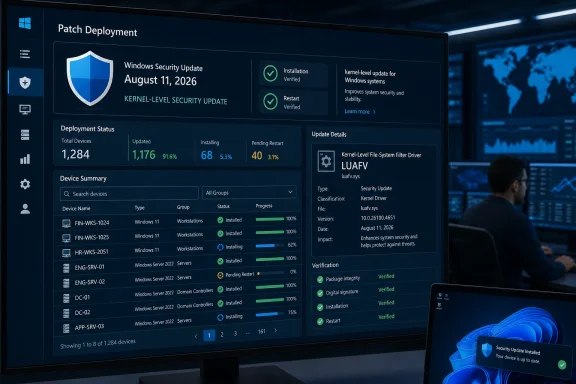 LUAFV is a legacy-compatibility layer with kernel-level consequences
Windows file virtualization dates back to Windows Vista and User Account Control. It helps certain older, generally 32-bit desktop applications operate without administrative rights when they attempt to write to protected locations such as Program Files or parts of the Windows directory. Rather than granting broad access, Windows can redirect eligible writes to per-user locations.
The compatibility goal is reasonable. The implementation is consequential because file virtualization is enforced through a Windows file-system filter driver, not merely through an application-level shim. Microsoft’s driver documentation places
luafv.sysin the file-system virtualization filter range, where it can observe and mediate file operations as they move through the operating system.
That position explains why a flaw in LUAFV is classified as elevation of privilege. A successful attack would begin from an account or process that already has some local footing on the target machine, then exploit incorrect handling in a privileged Windows component to obtain permissions it should not have. In a real intrusion, that is often the second stage after phishing, malware execution, stolen remote-access credentials, or misuse of a legitimate but low-privilege account.
It also means the vulnerability should not be confused with a UAC prompt bypass. UAC remains a broader set of token, consent, and application-control protections. CVE-2026-50472 concerns the driver that supports one compatibility behavior within that system. Disabling UAC wholesale to avoid a file-virtualization issue would weaken other defenses and is not an appropriate mitigation.
The CVE number matters: this is not July’s LUAFV patch
The immediate point that can be missed in vulnerability dashboards is that CVE-2026-50472 is a new identifier, not a reissue of the LUAFV problem Microsoft patched in July.
Microsoft’s July 14 release included CVE-2026-50371, also titled a Windows LUA File Virtualization Filter Driver elevation-of-privilege vulnerability. Independent vulnerability records described that July issue as a race-condition problem and rated it Important, with no public disclosure and no known exploitation at release. Earlier, Microsoft patched CVE-2026-27929 in April, another LUAFV elevation-of-privilege issue that outside analyses also described as a time-of-check/time-of-use race condition.
Three CVEs sharing the same Windows component name in four months should change how administrators read a “fully patched” report. A device patched through July 2026 may have the fix for CVE-2026-50371 but is still missing the August fix for CVE-2026-50472. Conversely, a device that successfully installs the August cumulative update should receive the prior monthly fixes included in the servicing chain for its supported release.
The repetition does not prove that CVE-2026-50472 is the same bug under a new number, that Microsoft’s July remediation failed, or that the issues share an exploit technique. Microsoft has not publicly supplied enough technical detail to make any of those claims. The defensible conclusion is narrower: LUAFV has received multiple privilege-escalation fixes in 2026, so organizations should treat the component as an active patch-management concern rather than dismissing this month’s entry as duplicate scanner noise.
Patch by Windows release, not by a guessed KB number
For most organizations, CVE-2026-50472 should be remediated through the August 11 monthly cumulative security update delivered through Windows Update, Windows Update for Business, Microsoft Intune, Windows Autopatch, WSUS, Configuration Manager, or the Microsoft Update Catalog. The correct package depends on the installed Windows release and servicing channel; administrators should not assign a single KB number fleet-wide without matching it to the OS build.
The verification workflow should be equally routine:
- Confirm the endpoint’s Windows version and current OS build before deployment, particularly where Windows 10, Windows 11, Windows Server, LTSC, Server Core, and Azure Edition releases coexist.
- Approve or target the August 11, 2026 security quality update for the applicable product branch, rather than searching for a standalone LUAFV driver download.
- Confirm installation success and the required restart, then inventory the post-update OS build through endpoint-management telemetry or local
winverand build reporting. - Investigate machines that remain on superseded monthly builds, including offline systems, paused update rings, servers with maintenance-window exceptions, and devices blocked by known update holds.
- Keep a closer watch on endpoints that run older line-of-business software, because those applications are more likely to rely on the compatibility behavior that file virtualization was designed to preserve.
Organizations that deliberately disable UAC virtualization for compatibility testing should not assume they are outside the affected population unless Microsoft’s final product applicability data says so. File virtualization settings can affect whether a particular process uses the feature, but the vulnerable code remains part of the installed Windows servicing baseline. Security teams should map exposure from Microsoft’s affected-product record and installed build level, not from assumptions about which users may encounter a legacy application.
Local elevation remains a high-value ransomware and intrusion step
A local privilege escalation is rarely the first thing an attacker does, but it can determine whether a foothold becomes a compromise. Higher privileges can let an attacker tamper with security controls, access protected files, create services, establish persistence, steal credentials, or move toward domain-level assets. The severity of that downstream impact is why an issue requiring local access still belongs in the normal monthly patch wave rather than a backlog reserved for low-risk desktop fixes.
There is no basis so far to describe CVE-2026-50472 as a known zero-day or as actively exploited. Microsoft’s August publication, the absence of a public technical write-up, and the lack of independent exploit reporting should keep incident responders from treating every LUAFV alert as proof of compromise. But the lack of public exploit code is not a compensating control; it simply means defenders have less visibility into the exact preconditions and less reason to expect reliable detection signatures today.
The useful operational distinction is between urgency and panic. Patch the issue on the standard accelerated schedule for Windows elevation-of-privilege vulnerabilities, prioritize devices where untrusted code is routinely executed or where multiple users share local access, and preserve telemetry around new administrative accounts, suspicious service creation, unexpected driver activity, and endpoint-security tampering. There is no published workaround that replaces the update.
CVE-2026-50472 adds another August patch requirement to a Windows component Microsoft has already had to repair twice this year. The next concrete control point is not a speculative mitigation: it is confirming that every supported Windows device has moved to its August 11, 2026 security build.
