
The Microsoft Security Response Center lists the issue as a Windows Installer flaw with an elevation-of-privilege impact. That means the vulnerability belongs in the post-compromise portion of an attack chain: it is useful after an attacker, malware, or a legitimate but untrusted user has obtained some ability to execute locally. It is not, based on the public classification, an unauthenticated network entry point comparable with an exposed Remote Desktop, SMB, HTTP.sys, or VPN vulnerability.
That changes how Windows administrators should prioritize it. CVE-2026-59127 merits prompt inclusion in the August 11 patch deployment ring, but it does not by itself justify emergency disruption of every endpoint fleet ahead of vulnerabilities that allow remote code execution or are confirmed under active attack. On shared workstations, terminal servers, virtual desktop infrastructure hosts, jump boxes, build servers, and systems where developers or third-party software routinely run installers, the local-privilege boundary is materially more important—and the patch should move through validation quickly.
Microsoft’s August release contains 421 Microsoft CVEs, according to the Security Update Guide release notes cited by administrators tracking Patch Tuesday. Windows accounts for 236 of those disclosures. In that volume, a generic component name and a standard “elevation of privilege” label are easily dismissed as routine. That would be the wrong reading of a Windows Installer issue: Windows Installer is specifically designed to broker installation and maintenance operations that may run with higher privileges than the initiating user.
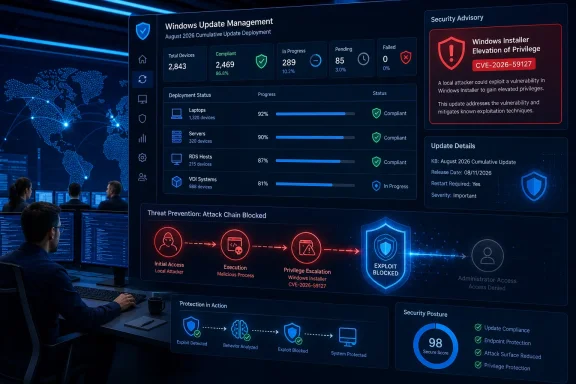 The public record stops short of the details administrators need
Microsoft published CVE-2026-59127 at 7:00 a.m. Pacific time on August 11, the normal Patch Tuesday disclosure window. The advisory establishes that Microsoft recognizes and has fixed a vulnerability, but the information available at publication does not publicly explain the root cause, identify an attack primitive, or provide a workaround separate from applying the security update.
Crucially, there is no public proof-of-concept, technical write-up, or independent exploitation report attached to the disclosure. Searches of the CVE and vulnerability-reporting record at release time did not surface a corresponding NVD entry or a public CVE record carrying technical enrichment for CVE-2026-59127. That lag is common on Patch Tuesday, especially for Microsoft-assigned CVEs, but it means security teams should avoid filling in the gaps with assumptions based on older Windows Installer bugs.
Microsoft has used the same component name for several very different classes of vulnerabilities over the years. A prior Windows Installer flaw might involve insecure file operations, weak authorization, a junction or symbolic-link race, mishandled rollback data, or an installer repair path. None of those mechanisms has been confirmed for CVE-2026-59127. Treating a historical exploit technique as a detection signature for this CVE would create noise, not coverage.
The user-supplied advisory material also describes Microsoft’s confidence metric in general terms, but does not establish a public exploitability assessment, active-exploitation status, or code-maturity finding for this particular CVE. In practical terms, there is no basis today to claim that the flaw is being exploited, publicly disclosed before patching, or backed by reliable exploit code. Those are distinct conditions, and Microsoft normally calls them out directly when they apply.
Why Windows Installer flaws are a local security problem with wide reach
Windows Installer is the Windows service and engine behind MSI installation packages, patches, repairs, uninstalls, and related maintenance actions. Its normal operation can cross a privilege boundary: a standard user may start an action that causes trusted installation infrastructure to modify protected locations, write registry data, install services, or execute deferred installation work under elevated context, depending on package design and policy.
That is why the component remains attractive to attackers despite requiring local access. The attacker does not need an exposed service if they already have a foothold through phishing, a browser exploit, stolen credentials, a malicious download, a remote-management tool, or a low-privilege account on a multi-user system. A successful elevation-of-privilege exploit can turn that foothold into administrative control, making it easier to disable security tooling, access protected credentials, persist across reboots, or spread further through an organization.
The risk is concentrated where untrusted or semi-trusted users can execute code and where privileged installation behavior is routine. Developers testing packages, help-desk staff using administrative tooling, software-distribution servers, kiosk fleets, shared RDS environments, and VDI pools deserve special attention. The same is true for endpoints with permissive local software-installation practices, because installer activity gives an attacker both an opportunity to trigger the vulnerable code path and plausible cover in logs.
This is also a reminder that “local” does not mean “harmless.” On a single-user laptop with well-managed application controls and no initial compromise, an elevation-of-privilege flaw has fewer opportunities. On an RDS host shared by many users, or a build machine that processes externally supplied source and dependencies, the local boundary can be the boundary separating ordinary code execution from full machine control.
Patch the operating system, not individual MSI packages
The remediation belongs in the Windows servicing cycle. CVE-2026-59127 is a vulnerability in Windows Installer, not a warning that every application distributed as an MSI file must be repackaged or replaced. Administrators should apply the August 2026 security update offered for each supported Windows client and server release in their environment, then verify that the device reports the expected current cumulative-update level.
Because Windows cumulative updates are cumulative, organizations that miss the August 11 release will receive the security fix through a later supported cumulative update as well. That does not make deferral cost-free: it leaves the Windows Installer component at its prior vulnerable state until the later package is installed. For Windows 10 devices outside ordinary support, the distinction is especially important. Only editions and devices covered by an applicable support lifecycle or Extended Security Updates program will receive the fix through normal channels.
Do not attempt to mitigate CVE-2026-59127 by disabling the Windows Installer service fleet-wide without a tested business case. That move can break software deployment, repairs, patches, and application maintenance while offering no assurance that it blocks the undisclosed vulnerable path. Microsoft has not published a configuration workaround for this CVE, and an improvised service shutdown is a blunt operational control, not a verified mitigation.
A sensible deployment plan is:
- Apply the August 11, 2026 security update to representative Windows client and server pilot groups, including systems that use software deployment, MSI repair, and line-of-business applications with installer dependencies.
- Confirm successful installation and reboot state through the organization’s endpoint-management platform rather than relying only on whether an update was offered.
- Review software-distribution, RDS, VDI, build, and administrative jump-host populations separately, because their exposure to locally run installers and their consequences after elevation are higher.
- Continue to enforce least privilege, application control, and restrictions on arbitrary installer execution, which reduce the number of local footholds that can be converted into elevated access.
What remains unresolved after Patch Tuesday
Microsoft’s disclosure confirms the issue and provides a fix, but it leaves three questions unanswered for defenders: the affected Windows versions and exact update mappings, the underlying weakness category, and whether any meaningful exploitation telemetry exists outside Microsoft. Those omissions are not proof of a hidden emergency. They are a reason to keep the assessment narrow.
For now, CVE-2026-59127 should be handled as a patched, locally exploitable Windows privilege-escalation issue with no publicly established exploit chain. Put it into the August deployment wave, move faster on shared and high-value Windows systems, and resist the urge to infer an attack method from old Windows Installer vulnerabilities. The concrete security improvement arrives when the August cumulative update is installed—not when the advisory is read.