
That gap is the news here. A CVE attached to “AMD Zen” can imply anything from a narrowly scoped issue in a particular platform’s firmware to a broader processor-behavior problem affecting consumer Ryzen PCs, EPYC servers, embedded Ryzen systems, virtual-machine hosts, and Windows endpoints. Microsoft’s entry establishes that a vulnerability has been tracked; it does not yet establish which of those deployment classes are affected.
For IT teams, this is not a “patch Tuesday, install the KB” item until Microsoft or AMD provides a product mapping and remediation path.
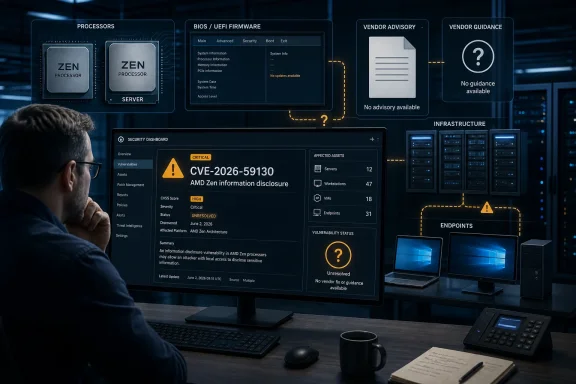 The MSRC record is an alert, not actionable guidance
The submitted MSRC page identifies CVE-2026-59130 as an information-disclosure vulnerability involving AMD Zen. It does not, in the material currently available, identify affected Zen generations, AMD product families, Windows releases, virtualization scenarios, required privileges, or whether a security update is available.
Those omissions are substantial. “Zen” is an architectural umbrella covering multiple generations of Ryzen desktop and mobile processors, Ryzen Pro systems, Threadripper workstations, EPYC server platforms, embedded chips, and semi-custom hardware. An administrator cannot turn that label into an inventory query without a concrete processor-family or CPUID range.
The public wording also does not say whether the weakness is reachable by unprivileged local code, requires a malicious kernel driver, depends on a virtualized workload, or can cross a process, VM, or privilege boundary. Those are the facts that determine whether this becomes an ordinary firmware-maintenance task or an urgent containment issue for multi-tenant servers and shared developer systems.
Microsoft has not publicly tied CVE-2026-59130 to a Windows KB number in the information provided. That means there is no basis to tell users that installing the August 2026 Windows cumulative update resolves it. In processor and platform security cases, Windows can sometimes deliver a mitigation through the operating system, but microcode and firmware fixes often arrive through an OEM BIOS or UEFI update instead. The difference matters: endpoint patch compliance reports can show a fully current Windows installation while the machine remains on an older vulnerable firmware revision.
A definition of exploit maturity is not an exploitability result
The text accompanying the submission describes a metric that measures confidence that a vulnerability exists and the credibility of the available technical details. That language is consistent with exploit maturity or exploit-code-maturity assessment material: it explains how confidence and public technical knowledge affect urgency.
It is important not to read that description as evidence that a working exploit exists, that exploitation has been observed, or that Microsoft has assigned a particular exploitation rating to CVE-2026-59130. The supplied material contains the metric’s definition, but not a value, CVSS vector, severity score, proof-of-concept reference, or active-exploitation designation.
That distinction is especially important for CPU information-disclosure issues. The most damaging processor flaws often require carefully shaped local workloads and specialized knowledge, while others can become broadly practical when they are combined with browser code execution, a malicious application, or access to a cloud host. Without an attack vector or prerequisites, either conclusion would be speculation.
The absence of public exploit reporting is reassuring only in a narrow sense: there is no independently surfaced evidence, as of August 11, 2026, that CVE-2026-59130 is being exploited in the wild. It is not evidence that the flaw is harmless or that it cannot be weaponized. Microsoft’s publication date should be treated as the beginning of a monitoring period, rather than a signal that defenders have already received enough information to close the issue.
AMD’s missing advisory leaves the critical questions unanswered
AMD is the source that needs to answer the operational questions for a Zen-specific flaw: exactly which CPU models are affected, whether the fix is microcode, firmware, software mitigation, or a combination, and whether old platforms will receive updates.
No matching AMD public advisory appeared in the available search results when this article was published. No public release notes or OEM firmware bulletin was found that maps CVE-2026-59130 to an AGESA version, a server-platform firmware bundle, an EPYC System ROM release, or a Ryzen laptop BIOS version.
That lack of a vendor bulletin is more consequential than the missing CVSS score. A score ranks a vulnerability; a hardware applicability matrix tells an organization whether its Windows fleet actually needs action. For a company with hundreds of Windows PCs across Lenovo, Dell, HP, and custom-built systems, an AMD advisory normally supplies the bridge from a CVE number to the OEM update catalogs that administrators must use.
It also leaves server operators in a holding pattern. EPYC systems are often updated through vendor-specific BMC, BIOS, and firmware workflows that require maintenance windows and, frequently, reboots. A vague “AMD Zen” label is insufficient for deciding whether to schedule those outages, especially where hosts run Hyper-V, VMware, Linux KVM, Windows Server workloads, or confidential customer environments.
Microsoft may have published the entry before AMD’s coordinated disclosure materials were broadly indexed or before a supporting advisory became public. That is plausible, but it is not stated in the current record. Until AMD publishes the technical notice, enterprises should avoid treating generic AMD driver updates, chipset packages, or Windows Update catalog scans as proof of remediation.
Windows administrators should inventory first, patch only when a fix is named
The immediate task is to establish exposure candidates without claiming that every AMD-based Windows device is vulnerable. Security and asset-management teams should identify systems using AMD processors and separate workstation hardware from servers, virtual-machine hosts, and high-value developer or build systems.
Useful inventory data includes the processor model, BIOS version, BIOS release date, motherboard or OEM platform model, Windows version, virtualization role, and whether third-party applications can execute locally. For Windows fleets, the processor identity can be collected through hardware inventory tools or PowerShell’s
Win32_Processordata; firmware versioning should come from the OEM’s supported management tooling or device inventory, not from Windows patch status alone.
Prioritize review of systems where a local information-disclosure flaw would have wider consequences:
- Hyper-V hosts and other virtualization servers deserve early attention because an information-disclosure issue can have a different risk profile when untrusted or separately administered workloads share physical hardware.
- Shared workstations, developer machines, CI build agents, and systems that run untrusted code should be reviewed ahead of tightly controlled single-purpose devices.
- Ryzen Pro and enterprise laptop fleets should be mapped to their OEM BIOS channels, because a future fix may arrive through Dell Command, HP Image Assistant, Lenovo Commercial Vantage, Windows Update firmware delivery, or a manual UEFI package depending on the model.
- Custom-built desktops should be associated with their motherboard vendor and current BIOS revision now, before a vendor advisory creates a rush for AGESA-based firmware updates.
Do not deploy unrelated BIOS updates merely because they are newer. Firmware updates carry operational risk, and the available record does not identify a fixed version. The practical response today is preparation: obtain accurate model and firmware data, make sure standard BIOS deployment and rollback procedures work, and monitor AMD, Microsoft, and the relevant hardware vendor for a CVE-specific fix statement.
The next public record must contain a remediation boundary
CVE-2026-59130 is a legitimate tracking identifier in Microsoft’s Security Update Guide, but it is currently a notification without a remediation boundary. The missing boundary is the most important fact for Windows users: there is no confirmed list of Zen processors or platform firmware versions that lets an administrator declare a device vulnerable, patched, or unaffected.
A useful follow-up from AMD or Microsoft should name the affected architecture generations and products, state the attacker prerequisites, distinguish bare-metal from virtualized exposure where relevant, provide a CVSS vector or equivalent risk assessment, and identify the update mechanism. OEMs will then need to map that fix to specific BIOS and UEFI releases for their Windows hardware.
Until that happens, organizations should track CVE-2026-59130 in their vulnerability-management systems as an unresolved AMD platform item, preserve their processor and firmware inventories, and resist closing it on the strength of ordinary Windows update compliance.
