
Microsoft describes the defect as “missing authentication for critical function” in Windows Remote Desktop Services, classified as CWE-306. The company says an authorized attacker can elevate privileges locally. The National Vulnerability Database independently shows the Microsoft CNA record, assigns the same 7.8 High CVSS 3.1 score, and records CISA’s SSVC assessment as exploitation none, automation no, and technical impact total as of August 11.
That combination calls for prompt patching, but it does not support treating this as an internet-wide Remote Desktop emergency. It is a post-compromise privilege-escalation vulnerability: useful to an attacker who already has a foothold, whether through a standard local account, a malicious installer, a phishing-led execution chain, or another initial-access route. Successful exploitation would give that attacker full confidentiality, integrity, and availability impact on the vulnerable host.
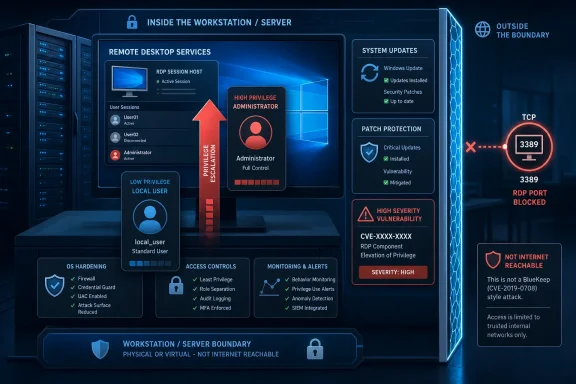 The advisory’s title overstates the relevance of exposed RDP
“Windows Remote Desktop Services” carries real baggage for administrators. Previous flaws in the component family have included remotely exploitable defects, most notably CVE-2019-0708, the BlueKeep bug that led Microsoft to issue patches even for unsupported Windows versions because of its wormable potential.
CVE-2026-61367 is materially different. Microsoft’s published vector is AV:L/AC:L/PR:L/UI:N/S:U/C:H/I:H/A:H: local attack vector, low complexity, low privileges required, no user interaction, unchanged scope, and complete impact on the affected system. An external attacker cannot use the published vulnerability description to walk up to an RDP listener and gain administrator or SYSTEM privileges without first clearing the local-access and authentication requirements.
The wording “authorized attacker” can also confuse response teams. It does not mean the attacker needs an RDP session specifically, and it does not mean the attacker must hold administrator rights. In Microsoft’s vulnerability terminology, it means the attacker must have already authenticated or otherwise established a valid low-privilege execution context on the target Windows installation.
That makes CVE-2026-61367 especially relevant in environments where users can run software locally, help-desk or contractor accounts have interactive access, virtual desktop tenants share hosts or management planes, or endpoint compromise is part of the organization’s realistic threat model. Remote Desktop Services is often present on systems that serve multiple users, so a reliable local escalation can turn a limited user compromise into control of a workstation or server.
Microsoft has disclosed the impact, not the vulnerable function
The published technical record establishes the vulnerability’s existence and the class of error: a critical RDS function fails to enforce authentication. It does not identify the affected service, executable, API, named pipe, RPC endpoint, session-management operation, or privilege boundary involved. Microsoft has also not published a proof of concept, workaround, or mitigation short of installing the security update.
That withholding is normal on patch day, but it has a practical consequence. Administrators should not assume that disabling inbound Remote Desktop connections eliminates exposure. The advisory does not say that Remote Desktop must be enabled, that an RDP session must be active, or that the vulnerable functionality is limited to externally accessible RDP. Disabling unneeded Remote Desktop Services remains sensible hardening, especially on servers, but it is not a vendor-confirmed substitute for patching this flaw.
No independent exploit report or public proof of concept was available in the records reviewed at publication time. NVD’s current enrichment status is also incomplete: it carries Microsoft’s CVSS 3.1 assessment but no NIST-authored CVSS score or CVSS 4.0 assessment. That is a routine early-record condition, not evidence that the flaw is lower risk than Microsoft’s High rating.
There is a minor timing mismatch worth noting. Microsoft’s advisory lists the release as August 11, 2026, with the submitted publication time of 7:00 a.m. Pacific. NVD’s change history shows Microsoft’s CNA record arriving at 1:18 p.m. Eastern, or 10:18 a.m. Pacific. The three-hour gap appears to reflect CVE-record ingestion rather than competing publication dates, but it illustrates why inventory and patch decisions should track Microsoft’s Security Update Guide rather than wait for third-party vulnerability databases to finish enrichment.
Every supported Windows generation is in scope, along with several that need special attention
Microsoft’s affected-product data spans client and server releases from Windows Server 2012 through Windows Server 2025, plus Windows 10 and Windows 11 builds. The fixed-build thresholds are more useful than the vulnerability title when validating compliance:
- Windows 11 24H2 must be at build 26100.9168 or later, and Windows 11 25H2 must be at build 26200.9168 or later.
- Windows 11 26H1 must be at build 28000.2704 or later.
- Windows 11 23H2 must be at build 22631.7517 or later.
- Windows 10 22H2 must be at build 19045.7663 or later, while Windows 10 21H2 must be at build 19044.7663 or later.
- Windows Server 2025 must be at build 26100.33296 or later; Windows Server 2022 must be at build 20348.5499 or later.
- Windows Server 2019 and Windows 10 version 1809 must be at build 17763.9115 or later.
- Windows Server 2016 and Windows 10 version 1607 must be at build 14393.9418 or later.
- Windows Server 2012 and Windows Server 2012 R2 require their respective August servicing levels, identified by Microsoft as builds 6.2.9200.26279 and 6.3.9600.23337.
The Server Core variants of Windows Server 2012, 2012 R2, 2016, 2019, and 2025 are explicitly listed as affected. Core installations do not get a pass simply because they lack the full desktop shell; RDS-related servicing components remain part of the operating system.
The legacy entries deserve the closest review. Windows Server 2012 and Windows Server 2012 R2 left extended support on October 10, 2023. Microsoft’s Extended Security Updates program lasts through October 13, 2026, so organizations that still run those servers need active ESU entitlement and a working update-delivery path to receive this fix. A server that appears in the affected list but is outside its organization’s ESU coverage is a remediation exception, not a successfully patched asset.
Windows 10 adds another inventory trap. General Windows 10 22H2 support ended on October 14, 2025, although Microsoft offers Extended Security Updates through October 13, 2026. Older version numbers in the advisory can also refer to LTSC and LTSB servicing branches, rather than broadly supported consumer editions. Administrators should validate the edition, servicing channel, and update entitlement, instead of treating the presence of a build number in the CVE record as proof that Windows Update will deliver the fix.
Patch the escalation route, then investigate the foothold
For managed estates, the immediate action is straightforward: deploy the August 11 cumulative security update or a later cumulative update to every affected Windows client and server, including Server Core and long-lived LTSC systems. Validate the resulting OS build rather than relying solely on a deployment tool’s “successful” status; cumulative-update supersedence means a newer supported build also contains the fix.
Prioritization should favor shared systems and systems where low-privilege code execution is plausible: Remote Desktop Session Hosts, jump servers, application servers with interactive support access, VDI images, developer workstations, and endpoints used by administrators. Domain controllers are not singled out in the advisory, but any domain controller running an affected build should remain in the highest routine patch tier because a local administrative escalation there has broader consequences.
This CVE also strengthens the case for separating initial-access controls from containment controls. Application allowlisting, endpoint detection and response, least-privilege user accounts, Local Administrator Password Solution, credential-guarding measures, and restrictions on interactive server logons reduce the number of ways an attacker could reach the low-privilege starting position that CVE-2026-61367 requires. None replaces the update, but all limit the value of the flaw in an attack chain.
The record currently supports a measured conclusion: CVE-2026-61367 is a high-impact local elevation-of-privilege defect across a broad range of Windows releases, with no public exploitation or proof of concept identified on August 11. Patch it in the normal accelerated security cycle, do not confuse it with a remotely exploitable RDP listener flaw, and audit legacy Windows systems now—before Windows Server 2012 and 2012 R2 lose their final ESU coverage on October 13, 2026.