
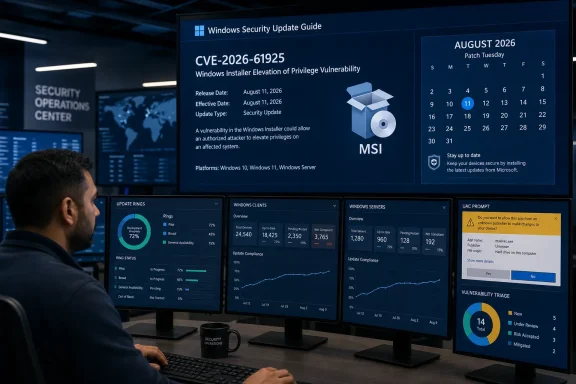
The advisory was published at 7:00 a.m. Pacific time on Tuesday, August 11, placing it in Microsoft’s regular Patch Tuesday release window. Microsoft’s classification establishes that the affected component is Windows Installer, the MSI engine used by Windows and third-party software for per-machine installation, repair, update, and removal operations. An elevation-of-privilege flaw in that component is inherently relevant to endpoints where users or low-privilege processes can trigger installer activity.
At publication, however, CVE-2026-61925 is a confirmed but thinly described vulnerability. The Microsoft entry identifies the vulnerability and its impact category, but it does not publicly provide a technical description explaining what Windows Installer operation is flawed or what privilege boundary is crossed. Searches of the National Vulnerability Database and major vulnerability-research coverage did not produce an independent record or analysis for this CVE at the time of writing.
That gap is important. It means IT teams should not turn the generic “elevation of privilege” label into claims Microsoft has not made—such as local-only exploitation, SYSTEM-level code execution, a specific CVSS rating, public proof-of-concept availability, or active exploitation. Those are common characteristics of Windows Installer issues, but they are not verified facts for CVE-2026-61925.
 What Microsoft has confirmed—and what it has not
Microsoft’s Security Update Guide is the primary record for this CVE, so its publication confirms that Microsoft recognizes CVE-2026-61925 as a Windows Installer elevation-of-privilege vulnerability. That is enough to put the issue into a vulnerability-management workflow and to begin correlating it with the August 2026 cumulative updates approved for Windows clients and servers.
The current public entry does not establish which releases are affected. There is no verified list yet for Windows 11 versions such as 24H2 or 25H2, Windows 10 servicing branches, Windows Server 2016, Windows Server 2019, Windows Server 2022, or Windows Server 2025. Microsoft also has not publicly identified whether the issue affects particular architectures, installation modes, MSI APIs, or enterprise deployment paths.
The advisory similarly does not provide a CVSS score or vector. Without an attack vector, complexity, privileges-required, user-interaction, and scope assessment, “elevation of privilege” says what an attacker could achieve after successful exploitation but not how practical the attack is. A flaw requiring an attacker to already run code as a standard user on a device has a very different response profile from one reachable through a routine application workflow with minimal interaction.
Microsoft has also not stated whether exploitation has been detected, whether vulnerability details are public, or whether a functional exploit exists. The absence of those fields in the available record should be treated as missing information, not evidence that exploitation is impossible or that it is occurring.
Windows Installer makes this an endpoint-management concern
Windows Installer is a privileged Windows service and installation framework, not merely a setup-file format. MSI packages are commonly used for desktop software deployment, repair actions, self-healing components, application updates, advertised shortcuts, and enterprise deployment through tools including Microsoft Configuration Manager and third-party management platforms. The component sits at the point where a user-context request can lead to file operations, registry changes, service configuration, and elevated installation activity.
That makes Installer flaws attractive after initial access. A threat actor who has already obtained code execution as a constrained local user often seeks an elevation-of-privilege bug to disable defenses, access credentials, create administrative accounts, tamper with security tooling, or move toward domain-level access. CVE-2026-61925 should therefore be viewed as a potential post-compromise accelerator, pending Microsoft’s disclosure of the actual attack conditions.
There is also a practical reason to watch the remediation closely: changes to Windows Installer security behavior can affect application repair and deployment workflows. Microsoft’s hardening for the separate Windows Installer vulnerability CVE-2025-50173 produced unexpected User Account Control prompts and failures for some non-admin MSI repair scenarios in 2025, including silent repairs and some application installation paths. Microsoft later refined that behavior while retaining the underlying security protection.
CVE-2026-61925 is not evidence of a repeat of that incident, and Microsoft has not announced any known issue tied to this month’s fix. Still, the history means administrators should validate installer-dependent workflows after deploying the August 2026 Windows updates rather than treating the cumulative update as an invisible background change.
Do not confuse the CVE record with a deployment plan
The missing link in the public advisory is the remediation mapping. A CVE entry alone does not tell an administrator which package to install, whether the fix is delivered through the monthly cumulative update, whether it appears in a security-only update for older systems, or whether it is included in a servicing stack, .NET, or out-of-band package. In practice, that mapping belongs in Microsoft’s August 2026 Security Update Guide deployment data and the individual Windows support articles.
For organizations with ordinary cumulative-update servicing, the sensible near-term action is to identify the August 11 security update applicable to every supported Windows release in use, test it against core applications, and deploy it through the established update ring. Teams should record CVE-2026-61925 as covered only after confirming the relevant August package explicitly lists the CVE in Microsoft’s deployment information or in their endpoint-management vulnerability feed.
Do not use a search result, a third-party CVE dashboard, or the advisory’s generic title as proof that every Windows build is affected or remediated. Microsoft frequently ships different update packages, builds, and support paths across Windows client releases, Windows Server editions, long-term servicing channels, and hotpatch-enabled systems. Unsupported Windows versions deserve a separate risk decision; they should not be marked fixed merely because a supported successor received an August cumulative update.
For managed fleets, the short validation list is focused:
- Confirm that the August 11, 2026 Windows security cumulative update is installed on supported client and server rings.
- Test MSI-based install, repair, uninstall, and self-update paths for business-critical applications, especially where standard users trigger repairs or where software runs elevated installation actions.
- Review help-desk and endpoint telemetry for new UAC prompts, Windows Installer error codes, failed self-repair events, and unexpected application reinstall loops after deployment.
- Keep the CVE’s status provisional in internal reporting until Microsoft publishes affected-product and remediation mappings or the organization verifies them through its patch catalog.
Why the lack of technical detail changes prioritization
Many vulnerability-management programs automatically prioritize elevation-of-privilege issues as “high” because the likely payoff is administrative control. That heuristic is reasonable for triage, but it is not a substitute for the information Microsoft has not supplied here. CVE-2026-61925 cannot yet be distinguished publicly from a flaw requiring substantial local access and a narrowly defined installer state, or from one that is broadly reachable by a standard authenticated user.
The right response is neither dismissal nor panic. Treat the issue as an actionable August patch dependency for Windows systems that use Windows Installer, place it in the normal expedited testing lane for privilege-escalation fixes, and avoid escalating it to an emergency incident solely from the advisory title. If Microsoft later adds an exploitation assessment, public-disclosure status, CVSS vector, or a known-exploited designation, that should trigger a fresh prioritization decision.
Microsoft’s published record gives defenders one durable fact today: CVE-2026-61925 exists and Windows Installer is the affected security boundary. Until the company supplies the missing technical and deployment detail, the concrete task is to verify August cumulative-update coverage and watch the installer workflows most likely to reveal a security hardening regression.