
The advisory’s title can be misleading. This is not described as a vulnerability in a malicious .mid file, Windows Media Player, or a music application parsing a downloaded song. Microsoft has identified the affected area as the Windows MIDI Service Module: a privileged component of the newer Windows MIDI Services architecture. An attacker would need an existing foothold and the ability to execute code locally before an elevation-of-privilege flaw becomes useful.
That does not make it a low-priority issue. Local privilege escalation is the step attackers use after phishing, stolen credentials, browser exploitation, an untrusted installer, or a compromised standard user account has already placed code on a PC. A successful exploit could turn a constrained user-level compromise into administrative or system-level control, depending on the service boundary involved and the privileges granted by the flaw.
Microsoft’s Security Update Guide published the record at 7:00 a.m. Pacific time on Tuesday, August 11. As of publication, Microsoft has not publicly supplied a technical root-cause description, proof-of-concept code, a detailed attack chain, or a standalone mitigation for CVE-2026-62693. The practical remedy is the security update.
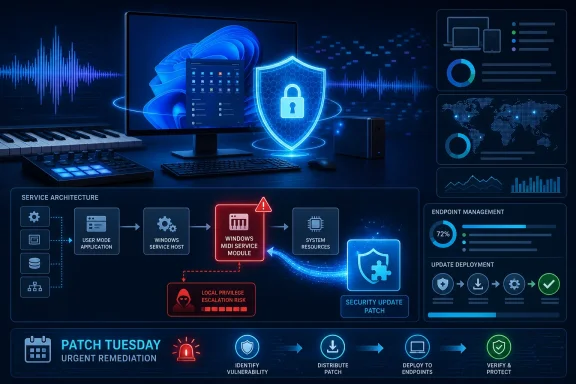 The vulnerable component is newer than the name suggests
Windows MIDI Services is Microsoft’s substantial replacement for the aging MIDI infrastructure that has long been embedded in Windows. Microsoft’s Windows MIDI and Music developer materials describe it as a new API, service, and SDK intended to modernize MIDI support, including newer MIDI capabilities and improvements that legacy applications can use through compatibility layers.
The key operational point is that this is not confined to workstations used for recording, live performance, studio control, or electronic instruments. Microsoft’s MIDI Services rollout documentation says the new service is present on updated consumer Windows 11 installations running versions 24H2, 25H2, and 26H1. The service sits below applications, meaning an endpoint can have the relevant Windows component even if nobody on that PC has knowingly installed a digital audio workstation or connected a MIDI controller.
That changes the asset-identification exercise. Searching software inventories for Ableton Live, Cubase, FL Studio, Pro Tools, or MIDI driver packages will not identify the whole exposure. This is a Windows servicing issue for the applicable Windows 11 release families, not a niche application update for musicians.
It also explains why Windows 10 fleets should not be assumed to be in scope merely because they can play or create MIDI content. Microsoft’s rollout documentation specifically distinguishes the newer in-box Windows MIDI Services implementation from the older stack, and says the new service is not available on older retail Windows releases. Administrators should still use Microsoft’s Security Update Guide and their endpoint-management inventory as the authority for affected-product decisions, but the service’s rollout boundary provides useful triage context.
A second month of MIDI service privilege fixes deserves attention
CVE-2026-62693 is not the first Windows MIDI Service Module elevation-of-privilege entry this summer. Microsoft’s July 2026 release included CVE-2026-56183 and CVE-2026-56187, both described in the National Vulnerability Database as use-after-free vulnerabilities in the Windows MIDI Service Module that could allow an authorized local attacker to elevate privileges.
Those July records were rated High at CVSS 7.0 and applied to Windows 11 versions 24H2, 25H2, and 26H1. NVD’s published entries identify the patched build thresholds as 26100.8875 for 24H2, 26200.8875 for 25H2, and differing 26H1 build thresholds for the two CVEs. In other words, this is already an area where Microsoft has been fixing privileged-service defects across the current Windows 11 branch families.
There is no public evidence that CVE-2026-62693 shares a root cause, exploit primitive, or patch with the July vulnerabilities. It would be irresponsible to call this a continuation of the same bug based on a component name alone. But the consecutive monthly fixes establish a concrete operational fact: Windows MIDI Services is now a component administrators should include in their security-update validation rather than treat as an optional media feature.
The larger lesson is about rollout velocity. Microsoft began broad deployment of Windows MIDI Services to supported Windows 11 releases in early 2026, and the service has since accumulated compatibility notices for some virtual MIDI ports and older third-party driver stacks. Now it has also received multiple elevation-of-privilege fixes. New foundational services often need a period of hardening under production use; enterprises should avoid exempting audio-related Windows updates from normal security deployment simply because the business does not consider itself a “music” environment.
What CVE-2026-62693 does — and does not — change in incident response
The term elevation of privilege should shape the incident-response priority. It does not by itself establish an initial-access path from the internet. A remote, unauthenticated attacker is not shown by Microsoft’s public advisory to be able to send a MIDI file, scan a port, or directly compromise a device through CVE-2026-62693.
Instead, defenders should view the vulnerability as a potential post-compromise accelerator. If endpoint telemetry already shows suspicious activity under a standard user account — a malicious browser child process, a fake software installer, a scripted payload launched from a user profile, or a remote-access tool running without administrator rights — an unpatched local privilege escalation can materially improve an attacker’s ability to disable defenses, access protected credentials, establish persistence, or move laterally.
That makes patch status relevant to incident scoping. For a suspected compromise on a Windows 11 24H2, 25H2, or 26H1 device, responders should record whether the August 2026 cumulative update is installed and when it was applied. It should not be treated as proof that CVE-2026-62693 was exploited; Microsoft has not publicly reported exploitation, and no independent outlet had published an exploit analysis at the time of this advisory. It is, however, a meaningful environmental risk factor when assessing what a local attacker may have been able to do.
The lack of public technical detail is useful in a narrow sense: it limits the amount of ready-made exploit guidance available to opportunistic attackers on the day of disclosure. It is not a compensating control. Security researchers and attackers can compare patched and unpatched binaries once the update is broadly available, so the protective value of obscurity declines quickly after Patch Tuesday.
Patch validation should include Windows servicing, not MIDI software
Organizations should deploy the August 11, 2026 Windows security updates through Windows Update for Business, Windows Server Update Services, Microsoft Intune, Configuration Manager, or their established patch-management platform. The proper validation target is the cumulative Windows update and resulting OS build, not an update to a DAW, MIDI utility, USB controller driver, or Store application.
A practical validation sequence is:
- Confirm which managed endpoints run Windows 11 versions 24H2, 25H2, or 26H1 and have received the Windows MIDI Services rollout.
- Approve and deploy the August 2026 cumulative security update to those devices under the organization’s normal expedited-security process.
- Verify update installation and post-reboot OS build compliance through endpoint-management reporting rather than relying on users to run a MIDI-related application.
- Test a representative set of systems that use virtual MIDI ports, legacy MIDI drivers, audio interfaces, or control-surface software, because Windows MIDI Services has had documented third-party compatibility issues independent of this CVE.
- Preserve patch-status evidence for endpoints involved in active security investigations, especially where an attacker began with standard-user access.
The compatibility check belongs in the plan, but it should not become an open-ended reason to defer the update. Microsoft’s own rollout documentation has already acknowledged issues affecting some older drivers and virtual-port tools. That history means a pilot ring containing musicians, broadcast systems, lab instruments, production-control machines, and audio workstations is sensible. It does not mean that ordinary office PCs should wait for audio-specific testing before receiving a local privilege-escalation fix.
The missing technical detail is the story administrators should watch
Microsoft’s August advisory confirms the existence of CVE-2026-62693 and the availability of a patch, but the public record presently leaves several questions unanswered: the precise vulnerability class, the exact affected module, whether the flaw crosses from a user process into a service identity, and whether a low-privilege attacker needs any special MIDI device, application, or interface to reach the vulnerable code.
Those omissions matter more than the CVE’s unusually specialized title. If exploitation requires a particular MIDI API call or device configuration, exposure may be concentrated in a smaller subset of systems. If ordinary local code can reach the service without a connected device or active audio application, the impact is broader across Windows 11 devices carrying the new stack. Microsoft has not provided enough detail to make that distinction publicly.
For now, the defensible conclusion is narrower and more actionable: CVE-2026-62693 is a newly patched local privilege-escalation flaw in a Windows 11 service that Microsoft has rolled out well beyond professional music users. Treat the August cumulative update as the fix, verify it across Windows 11 24H2, 25H2, and 26H1 where applicable, and do not mistake “MIDI” in the advisory title for a reason to exclude ordinary endpoints from the patching queue.
