

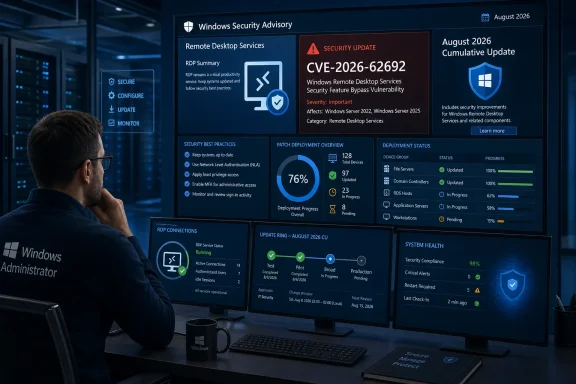
The advisory went live at 7:00 a.m. Pacific time, or 14:00 UTC, according to Microsoft’s Security Update Guide. Microsoft is the assigning CNA and the authoritative record for the vulnerability’s existence. But several operational details that administrators normally need to prioritize an elevation-of-privilege flaw — the CVSS vector and score, affected Windows versions, associated KB articles, exploitability assessment, weakness classification, and mitigation or workaround status — were not available in the submitted advisory material.
That lack of detail changes the response. This is a patch-first Windows vulnerability announcement, not evidence of a remotely reachable RDP compromise such as BlueKeep. Treat it as an elevation-of-privilege issue until Microsoft publishes a technical description that supports a stronger conclusion.
The CVE name does not establish a network attack path
“Windows Remote Desktop Services” is a broad product-area label. It can encompass the Remote Desktop Protocol stack, host-side services, session management, Remote Desktop Gateway-adjacent components, and code used by interactive or virtual desktop sessions. The title says the outcome is elevation of privilege; it does not say an unauthenticated attacker can reach the vulnerable code across TCP port 3389.
That distinction is essential. An elevation-of-privilege vulnerability generally turns a foothold into greater control: a standard user, a compromised account, malware running in an ordinary user context, or an operator inside a remote session may be able to obtain privileges they should not have. The practical risk can still be severe on shared systems, Remote Desktop Session Host servers, jump boxes, administrative workstations, VDI hosts, and endpoints where RDP is used after initial access.
It is not responsible, however, to infer that CVE-2026-62692 is local-only, requires an RDP session, yields SYSTEM, affects only servers, or can be triggered by a malicious RDP client or server. None of those facts appears in the submitted Microsoft record. The same restraint applies in the other direction: the advisory title alone does not justify telling organizations to take all RDP listeners offline or to treat the issue as wormable.
Microsoft’s older Remote Desktop vulnerabilities demonstrate why the product name is insufficient for triage. CVE-2019-0708, widely known as BlueKeep, was a pre-authentication remote-code-execution flaw in Remote Desktop Services and created a perimeter-exposure problem. An elevation-of-privilege bug with the same general product branding belongs in a different incident chain: it is more likely to increase the value of an already-compromised machine or user session. Administrators should not let the historical association with BlueKeep create urgency for the wrong control.
Microsoft has confirmed the flaw, but the technical record is still thin
Microsoft’s Security Update Guide is the primary record for the release. Its publication of CVE-2026-62692 confirms that Microsoft has issued a security item under that identifier. The accompanying text supplied with the alert explains Microsoft’s Report Confidence metric: it measures confidence in the vulnerability’s existence and the credibility of available technical details.
But the material does not state the actual value selected for CVE-2026-62692. That is a meaningful omission, not a cosmetic one. “Confirmed,” “Reasonable,” and “Unknown” report-confidence ratings carry different implications for how much technical knowledge is publicly available to researchers and attackers. The paragraph explaining the metric is generic Security Update Guide boilerplate; it should not be read as proof that Microsoft assigned this specific flaw a Confirmed rating.
The same problem applies to exploitation status. Microsoft’s standard advisory layout normally identifies whether a vulnerability was publicly disclosed, exploited in the wild, and assessed as exploitation more or less likely. No such result was included in the supplied record. As of the evening of August 11, no separate independent reporting located for this CVE established public exploitation, a proof of concept, or a specific attack method.
The National Vulnerability Database and the CVE Program are useful secondary records once a new CVE has propagated through their processing pipelines, but neither produced a searchable public entry for CVE-2026-62692 at the time of this review. That should not be mistaken for a contradiction of Microsoft’s advisory. The CVE was published only hours earlier, and downstream databases commonly lag a vendor’s Patch Tuesday release. It does mean there is no independent, publicly indexed technical account to fill the gaps in Microsoft’s sparse listing yet.
Patch by operating system and build, not by the word “RDP”
The correct remediation is the security update Microsoft maps to the specific operating system and servicing channel. For most supported Windows installations, that will be the August 2026 cumulative update or security-only update offered through Windows Update, Windows Update for Business, Windows Server Update Services, Microsoft Configuration Manager, or the Microsoft Update Catalog.
Do not search the catalog for an imagined standalone “Remote Desktop Services” patch, and do not assume an RDP client update alone protects a Remote Desktop host. Microsoft’s Windows security fixes are frequently delivered through cumulative packages that cover multiple components. The applicable KB number and post-install build will differ across Windows 11 releases, Windows 10 editions still receiving support or paid Extended Security Updates, and Windows Server releases.
For enterprise patch teams, the useful immediate workflow is straightforward:
- Inventory systems that run Remote Desktop Session Host, expose RDP internally or externally, host privileged administration sessions, or provide jump-box and VDI functions.
- Match each device to its installed Windows version, servicing channel, architecture, and current cumulative-update level before approving the August package.
- Prioritize servers where many users share sessions or where help-desk, infrastructure, or domain administration occurs through RDP, since a privilege boundary failure there can have disproportionate consequences.
- Validate RDP logons, reconnect behavior, RemoteApp publishing, printer and drive redirection, smart-card workflows, and session broker functionality in a representative staging group before broad deployment.
- Confirm successful installation by checking the installed KB and operating-system build rather than relying only on an update-management console’s “deployed” status.
The underlying security fix may require a restart. On RDS farms, that makes drain mode, connection broker coordination, load-balancer behavior, and maintenance windows part of the security response. A patch can be technically installed while users are still routed to an unpatched session host if the farm is not drained and updated node by node.
Exposure reduction still matters while details are missing
Because Microsoft has not published a workaround in the material available here, administrators should not disable Remote Desktop Services indiscriminately and call that mitigation. RDP is often a production dependency, and the unknown preconditions for CVE-2026-62692 mean that blindly removing a service could cause an outage without addressing the actual attacker prerequisite.
There are still sensible controls that reduce the impact of the class of attack. Limit RDP access to approved administrative networks or a properly secured gateway; require Network Level Authentication where it is supported; use multifactor authentication for remote administrative access; keep privileged and ordinary user accounts separate; and avoid making broad local-administrator rights available in shared RDS and VDI environments. These are defense-in-depth measures, not substitutes for Microsoft’s update.
Organizations with security telemetry should also review unusual child processes from Remote Desktop-related sessions, unexpected creation of local administrators, new services or scheduled tasks, changes to group membership, and privilege escalation alerts on session hosts. Those detections are useful for an elevation-of-privilege scenario, but they are not signatures for CVE-2026-62692. Until Microsoft discloses a weakness type or exploitation mechanics, claims of CVE-specific detection logic would be guesswork.
The missing deployment mapping is the real short-term problem
CVE-2026-62692 is a confirmed Microsoft security release item, and it warrants normal high-priority patch handling wherever Windows Remote Desktop Services are deployed. What is unavailable today is the information needed to rank it above other August fixes: there is no verified evidence in the public record of active exploitation, no confirmed affected-build list, no CVSS score, and no disclosed attack chain.
Microsoft’s next revision to the Security Update Guide is the key milestone. Administrators should watch for the deployment table linking CVE-2026-62692 to specific KB packages and builds, plus any addition of CVSS, exploitability, mitigation, workaround, or acknowledgment details. Until then, the defensible conclusion is narrower but clear: deploy the applicable August 11 Windows security update, verify it reached the systems that host Remote Desktop workloads, and do not confuse an elevation-of-privilege advisory with a confirmed internet-facing RDP remote-code-execution event.