
That is not a reason to disregard the vulnerability. It is a reason to avoid pretending that the CVE title alone tells an IT team which machines are exposed, how urgent the issue is relative to other August fixes, or whether a storage-specific configuration change is required. Microsoft’s designation confirms the affected component family and the impact category; it does not, on its own, establish a remote attack path, a network service exposure, or a known route to SYSTEM.
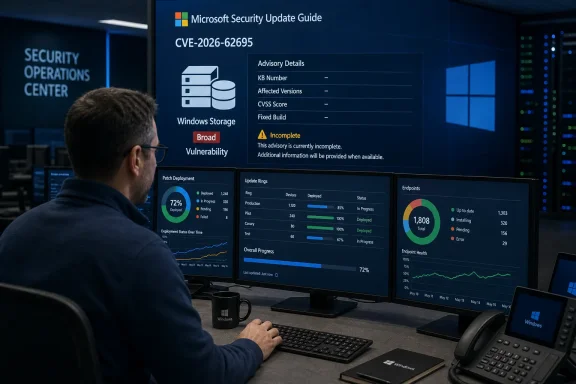 The advisory exists, but the actionable fields are missing
Microsoft’s Security Update Guide lists CVE-2026-62695 as published at 7:00 a.m. Pacific time on August 11, 2026. The accompanying advisory content describes the CVSS report confidence metric in general terms, explaining how vendors rate confidence in a vulnerability’s existence and technical detail. The supplied record, however, does not provide the actual metric value for this CVE.
That distinction is material. A generic explanation of report confidence is not an assertion that the issue is publicly disclosed, under active exploitation, backed by a functional proof of concept, or technically confirmed beyond Microsoft’s own acknowledgement. The information visible in the current record therefore supports only a narrow conclusion: Microsoft has assigned and published a Windows Storage elevation-of-privilege CVE.
Searches conducted after publication did not turn up an indexed NVD entry, a CVE.org record, or independent technical reporting that adds a vulnerability description, severity score, affected-product list, or exploit analysis for CVE-2026-62695. No other outlet has reported the technical mechanism or patch mapping at the time of publication. That can happen in the first hours after Patch Tuesday, particularly when Microsoft’s web interface publishes an advisory before downstream databases and security vendors ingest the complete data set.
The omission also creates a practical visibility problem. Vulnerability-management products that depend on NVD enrichment, CPE mappings, or third-party severity feeds may initially show no useful result for this identifier even though Microsoft has published it. Teams should not interpret an empty scanner enrichment page as evidence that the CVE is irrelevant to their Windows estate.
“Windows Storage” is a component label, not an exposure assessment
The phrase “Windows Storage” is broad enough to cover code involved in local disk, volume, file-system, storage-management, or related operating-system functions. Microsoft has not publicly narrowed CVE-2026-62695 to a specific driver, service, API, filesystem, hardware class, or feature set in the material presently available.
For security teams, that means there is no basis yet to limit the investigation to Storage Spaces deployments, SAN-attached servers, BitLocker devices, ReFS volumes, VHDX workloads, Windows Server file servers, or a particular OEM storage controller. Each of those may be relevant to Windows storage administration, but none can be tied to this CVE from the published advisory title.
An elevation-of-privilege finding usually describes what an attacker gains after obtaining some level of execution or access; it does not automatically mean a device can be compromised remotely by an unauthenticated attacker. But “usually” is not a severity rating. Microsoft’s missing vector string, privileges-required value, user-interaction requirement, and impact metrics are precisely the fields that would distinguish a routine local escalation bug from a flaw that materially changes an incident-response priority.
Administrators should therefore treat CVE-2026-62695 as part of the August Windows security-update scope, rather than build an emergency response around speculative storage scenarios. If the relevant cumulative update is already approved for a device’s supported servicing channel, deployment remains the right remediation path. If it is held in a pilot ring, the record currently gives no evidence-based reason to create an exception solely for this CVE — nor enough information to justify excluding storage-heavy systems from the ring.
Patch verification must follow the update package, not the CVE page
Microsoft security advisories normally provide a product-and-update table that maps a vulnerability to the monthly cumulative update or security-only package for each supported Windows branch. That mapping is the operational record that matters: it identifies which devices need the update and the post-install build expected after deployment.
CVE-2026-62695’s currently available details do not expose that mapping. As a result, administrators cannot yet reliably query an estate for “patched for CVE-2026-62695” by KB number or build floor. Trying to manufacture that relationship from similarly named older Windows Storage CVEs would be unsafe; Windows components can receive fixes through different cumulative packages across Windows 11, Windows Server, Windows 10 ESU, and long-term servicing channels.
The immediate control is to verify that the August 11, 2026 Windows security update is deploying successfully across every supported branch in scope. Managed environments should check their normal Windows Update for Business, Windows Autopatch, WSUS, Configuration Manager, or Intune reporting for update-installation failures and restart-pending devices. Organizations with a patch-validation process should include storage-dependent workloads — file servers, clustered systems, virtual-host infrastructure, backup servers, and high-I/O application hosts — in their standard pilot telemetry review, but should not attribute any observed storage behavior to CVE-2026-62695 without evidence.
Windows 10 deserves separate attention. Microsoft ended ordinary Windows 10 support on October 14, 2025, so devices still running Windows 10 require an eligible Extended Security Updates arrangement to receive monthly security remediation. A Windows Storage vulnerability with an as-yet-unpublished product matrix is another reminder that “still functioning” and “still receiving security fixes” are different operational states.
What to monitor as Microsoft fills in the record
The next meaningful update is not another restatement of the CVE title. It is Microsoft publishing the fields that turn the advisory into a deployable instruction: severity, CVSS vector, exploitability assessment, known-exploitation and public-disclosure status, affected products, KB articles, and fixed builds. A revision date on the Security Update Guide entry will matter because it may indicate that Microsoft has added those details after the initial release.
Until then, security teams should record the identifier in their August 2026 patch review, confirm that the applicable monthly Windows quality update reaches supported endpoints, and flag systems outside a supported servicing path. The evidence does not presently support claims of active exploitation, a storage outage risk, or a particular exposed Windows configuration. It does support completing the August security-update rollout and watching the Microsoft record for the missing patch and severity data.