
Microsoft’s Security Update Guide identifies the vulnerable component as the Windows Bind Filter Driver, bindflt.sys, and classifies the impact as elevation of privilege. A successful elevation-of-privilege attack normally turns foothold access—such as an ordinary local user account, a compromised application, or malware already executing on the endpoint—into rights that can alter protected system resources or operate at a much higher trust level. It is not, from the description alone, a remote initial-access flaw.
The most important detail in the material published with the new record is actually what it does not provide. The text explains the meaning of CVSS “Report Confidence,” but it does not state a report-confidence value, a CVSS score or vector, a weakness category, affected Windows versions, a KB-to-build mapping, a public-disclosure status, or whether Microsoft knows of exploitation. That generic metric definition should not be read as confirmation that a proof of concept exists, that attackers are using the bug, or that it carries a particular severity rating.
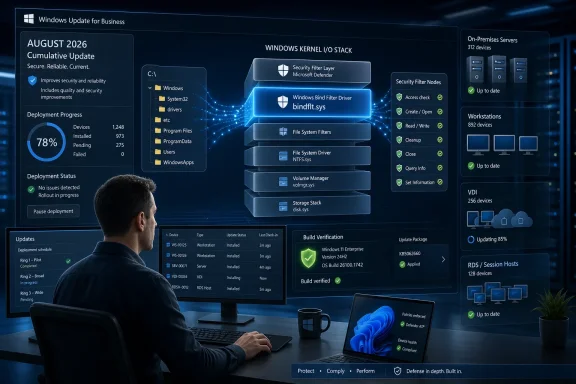 BindFlt is a file-system component, not a network “bind” driver
The name is easy to misread. The Windows Bind Filter Driver is not an NDIS networking component concerned with TCP or adapter bindings; it is a Microsoft file-system minifilter, installed as bindflt.sys. Microsoft’s driver documentation places it in the high “FSFilter Top” altitude range, above many other filters in the file I/O stack.
Microsoft also documents bind links as a capability that maps a file-system namespace to a local virtual path through BindFlt. Its documentation says this capability is available beginning with Windows 11, version 24H2. That puts the driver in a part of Windows where path handling, redirection, reparse behavior, and interactions with security products can carry security consequences well beyond the application that initiated an operation.
A filter at this layer sees operations other software may assume are ordinary file opens, directory accesses, or path checks. Any flaw that lets a less-privileged caller confuse the driver’s assumptions about those operations could potentially cross a Windows access boundary. Microsoft has not publicly described the defect mechanism for CVE-2026-62722, so administrators should resist filling that gap with guesses about a buffer overflow, symbolic-link issue, race condition, or container escape.
There is a practical reason for that restraint. “Elevation of privilege” describes the result of a successful exploit, not the preconditions. A local kernel-related flaw can range from a difficult bug requiring specific privileges and environment preparation to something reachable by a low-privileged user with little interaction. Until Microsoft publishes the vector and prerequisites—or independent research reproduces the issue—those cases are materially different for triage.
The August patch is the mitigation; the advisory is not a detection rule
Microsoft’s August 11 update is the vendor’s remediation path for CVE-2026-62722. For most organizations, the correct response is to identify supported Windows releases in scope, deploy the corresponding quality update under existing rings, and check that endpoints completed the required reboot. A device merely showing an available update is not the same as a device running the fixed build.
This distinction matters especially in environments with deferred Windows servicing. Windows 10 systems outside their normal support period, LTSC installations, Windows Server fleets, virtual desktop images, and devices held on a feature-update baseline may receive different update packages, Extended Security Updates, or no security update at all depending on their servicing entitlement. Microsoft’s title alone does not tell administrators which of those branches are affected.
The absence of a named standalone package is also normal for modern Windows servicing. Kernel and driver fixes commonly arrive inside cumulative updates rather than as a separately deployed bindflt.sys hotfix. That means endpoint teams should not search for a “Bind Filter Driver update” in isolation; they should use Microsoft’s update catalog and Security Update Guide product entries to map the CVE to their installed Windows release and build.
For managed fleets, the verification work should include more than a compliance percentage in an update dashboard:
- Confirm that devices have installed the August 11, 2026 cumulative update appropriate to their Windows version, architecture, and servicing channel.
- Check post-install OS build numbers rather than relying only on an update’s download or approval state.
- Review held-back devices, disconnected systems, golden images, and recovery environments, since these routinely escape normal monthly deployment reporting.
- Test core file-system security tooling after the update, particularly endpoint protection, backup agents, data-loss prevention products, and any software that installs its own minifilter driver.
That final check is operationally significant. BindFlt sits in a crowded portion of the file-system filter stack, and Microsoft explicitly allows other minifilters to examine and veto certain bind-link operations. Security products and storage tools that monitor files are often sensitive to filter ordering and path semantics. There is no published indication that the August fix causes compatibility problems, but organizations with custom filter drivers should include file-access and application-launch validation in the pilot ring rather than treating this as a purely invisible kernel change.
Do not promote it to a zero-day without evidence
As of Microsoft’s August 11 publication, the record confirms that Microsoft has issued a fix for a Bind Filter Driver elevation-of-privilege vulnerability. It does not, based on the public detail currently available with the entry, establish that the flaw was publicly disclosed before patching, exploited in the wild, or accompanied by exploit code.
That is more than a wording issue. Windows privilege-escalation vulnerabilities are frequently used after attackers have already obtained access through phishing, stolen credentials, malicious software, or a separate remote-access weakness. They deserve timely patching because they can turn a constrained compromise into broad device control. But treating every local privilege-escalation CVE as an emergency internet-exposure event dilutes attention from vulnerabilities Microsoft specifically flags as exploited or publicly known.
The record also needs to be separated from earlier Bind Filter Driver CVEs. Microsoft and NVD have published similarly named vulnerabilities in prior years, including CVE-2023-21733. The repeated component name does not establish that CVE-2026-62722 is a regression, a bypass of an older patch, or the same root cause resurfacing. No public technical analysis currently ties the August 2026 identifier to a previous BindFlt issue.
Patch now, but keep the incident claim proportional
CVE-2026-62722 belongs in the August Windows patch cycle with priority appropriate to any privilege-boundary flaw on systems where untrusted code or non-administrative users can run. Shared workstations, developer endpoints, RDS hosts, VDI pools, jump boxes, build systems, and servers hosting applications with local execution paths deserve particular attention because a successful local escalation can collapse the separation those environments rely on.
The public record remains thin. Microsoft has named the component and impact, but has not supplied enough published technical detail to support claims about exploitability, affected build breadth, attack complexity, or active abuse. Administrators should patch the supported Windows releases Microsoft maps to this CVE, validate file-system-dependent controls in the pilot ring, and avoid turning a confirmed security update into an unverified incident narrative.