
Microsoft’s Security Update Guide identifies the issue as “Windows Telephony Service Elevation of Privilege Vulnerability” and timestamps publication at 7:00 a.m. Pacific time on August 11. It does not, in the material presently available, provide a CVSS base score, vulnerability class, affected product-and-build table, exploitability assessment, mitigation, workaround, technical description, or acknowledgement of the reporting researcher. Searches of the public CVE.org and National Vulnerability Database records did not return a corresponding indexed record at publication time.
That gap is important. A CVE number and an “elevation of privilege” label tell administrators that successful exploitation could move an attacker from a lower-privileged foothold to more powerful rights on the same system. They do not establish whether the attack is local, adjacent-network, or remotely reachable; whether it requires authentication; whether it requires user interaction; or whether a working exploit has been disclosed. None of those questions can be answered responsibly from Microsoft’s currently sparse listing.
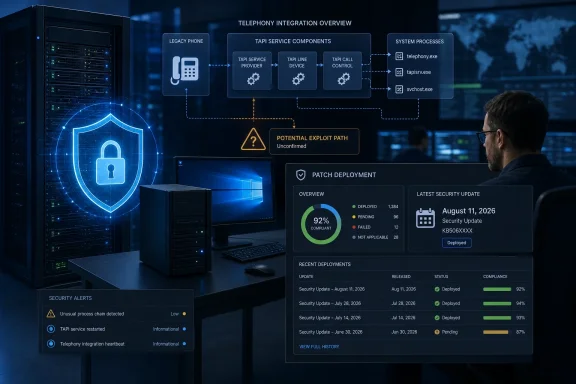 The Telephony service remains a privileged compatibility component
Windows Telephony is the service behind the Telephony Application Programming Interface, or TAPI. Microsoft’s developer documentation describes the TAPI Server, commonly associated with the TapiSrv service, as the process that tracks local and remote telephony resources and mediates between applications and telephony service providers.
This is old Windows infrastructure, but it is not necessarily dead infrastructure. TAPI supports traditional modem and phone functions as well as IP telephony integrations, PBX-oriented features, conferencing controls, call handling, fax-related workflows, and software that communicates through vendor-specific telephony service providers. The service can therefore still be present in enterprises with legacy communications software, specialist hardware, line-of-business applications, or third-party unified communications integrations.
The security consequence is less about whether employees still use desk phones. TAPI is a broker layer: an application makes a request, Windows marshals it to the Telephony service, and the service communicates with a telephony service provider. Microsoft’s documentation says those providers execute in the TAPISRV process. A defect in that privileged boundary can have value to an attacker already running code as a standard user, even on endpoints with no active telephone hardware.
CVE-2026-62723’s title alone does not prove that this is the vulnerable boundary. Microsoft has not published a flaw class or attack description, and administrators should not fill in the blanks with assumptions drawn from earlier Telephony bugs. Still, the service’s role explains why an elevation-of-privilege classification deserves patching attention: it is an intermediary with access to system-managed communications resources and legacy extensibility points.
Microsoft has confirmed the vulnerability, but not the attack conditions
The supplied Microsoft record includes explanatory text for CVSS Report Confidence, a temporal metric that describes confidence in a vulnerability’s existence and in the available technical details. That text is a definition of the metric; it is not itself a disclosed Report Confidence value for CVE-2026-62723.
That distinction is easy to miss when a newly published MSRC page is thin or its data is still moving through public indexes. It would be wrong to characterize the vulnerability as “confirmed,” “publicly disclosed,” “exploited,” “proof-of-concept available,” or “exploitation more likely” solely because the page includes Microsoft’s generic explanation of what those terms mean.
Microsoft’s decision to assign and publish the CVE is, of course, confirmation that the company recognizes and is addressing a security defect. But the operational questions remain unanswered:
- Microsoft has not publicly stated whether exploitation requires an existing local account or whether a remote path exists.
- Microsoft has not identified the affected Windows client, Windows Server, LTSC, or Server Core releases in the available entry.
- Microsoft has not published a CVSS vector, so there is no defensible severity score to compare with other August fixes.
- Microsoft has not said whether it has detected exploitation in the wild or public disclosure before patch release.
- Microsoft has not published a configuration-based mitigation or workaround.
For vulnerability-management teams, this means the CVE should be treated as a patching item, not as a basis for emergency configuration changes. Disabling a Windows service because its name looks obsolete can break dependent software and may not mitigate the actual flaw anyway.
Do not disable TapiSrv blindly
Historic Microsoft guidance for Telephony vulnerabilities has sometimes included stopping and disabling the Telephony service as a temporary workaround. That advice was tied to specific flaws, operating-system generations, and exposure conditions. It cannot be carried forward automatically to CVE-2026-62723.
TAPI-related components may be dormant on a typical modern endpoint, but a dormant-looking service can still be activated on demand by software that uses it. Disabling Telephony can affect modem support, Remote Access Service scenarios, fax functions, and applications that rely on TAPI or a vendor-installed telephony provider. In a managed environment, an untested blanket disablement creates a realistic chance of an avoidable support incident while offering an unproven reduction in risk.
The appropriate interim measure is inventory, not service removal. Administrators with a legitimate need to triage exposure can identify systems where the Telephony service is present, review its startup state, and correlate those devices with software inventories for PBX clients, call-center tooling, fax integrations, dial-up or serial-modem dependencies, and third-party TAPI service providers. That creates a targeted validation set for the monthly update rollout.
This is especially relevant for shared workstations and servers running older communications workloads. A standard office PC with no identified TAPI consumers may be low operational risk to patch. A call-center workstation, contact-center server, or device-management station with vendor telephony components deserves a maintenance-window test before broad deployment—while still receiving the update as quickly as that validation allows.
The missing affected-build list limits targeted response
Microsoft normally uses the Security Update Guide to connect a CVE to affected products, KB articles, download links, and build numbers. As of August 11, the visible material for CVE-2026-62723 does not expose that mapping. As a result, there is no reliable basis to say that a particular cumulative update, Windows 11 release, Windows Server edition, or ESU-covered product fixes this specific issue.
That omission changes the practical response. Teams should not create a one-off deployment package based on an unverified KB number circulated in social posts or third-party dashboards. They should use the August 11 security updates offered for each supported Windows release, then verify compliance through their established Windows Update for Business, Windows Server Update Services, Microsoft Configuration Manager, Intune, Autopatch, or endpoint-management reporting.
For organizations that stage cumulative updates, CVE-2026-62723 belongs in the normal August security-release approval workflow with a focused check for telephony-dependent applications. It does not currently warrant treating every device with a TapiSrv entry as an actively exploitable emergency.
The absence of a public build table also creates a documentation problem for regulated environments. Security teams can record Microsoft’s August 11 publication date, the CVE identifier, the product component, and the fact that the official entry had not yet exposed granular technical data at the time of review. They should update that record once Microsoft publishes the affected-product list or revises the advisory.
Patch first, then watch for a fuller advisory
The evidence supports a measured conclusion: CVE-2026-62723 is a real Microsoft-published Windows privilege-escalation fix, and supported Windows systems should receive the August 11, 2026 security updates. The record does not support claims that it is a zero-day, a remote compromise path, a critical vulnerability, or a known target of attackers.
Microsoft may expand the Security Update Guide entry with severity, CVSS, product scope, KB mappings, exploitability assessment, and revision history as the August release propagates through its systems and external databases. Until then, the concrete consequence for administrators is to patch normally, preserve compatibility testing for TAPI-dependent workloads, and avoid substituting service-disabling folklore for the vendor’s actual remediation.