
The harder part is prioritization. Microsoft’s Security Update Guide identifies the component and impact, but at publication it does not publicly provide the information administrators normally use to distinguish an urgent privilege-escalation fix from routine monthly hygiene: a CVSS score and vector, a weakness classification, the affected Windows versions and build ranges, a named KB mapping, exploitability assessment, public-disclosure status, or evidence of active exploitation. The CVE Program and NIST’s National Vulnerability Database also had not surfaced independently searchable records for CVE-2026-62758 as of August 12.
That absence is material. It means the correct operational conclusion is “patch the supported Windows fleet,” not “treat every machine running RasMan as confirmed high-risk.” Microsoft has confirmed the vulnerability exists and released a fix, but the public record does not yet establish whether an attacker needs a local account, whether a standard user can reach the vulnerable code path, or what privilege level successful exploitation delivers.
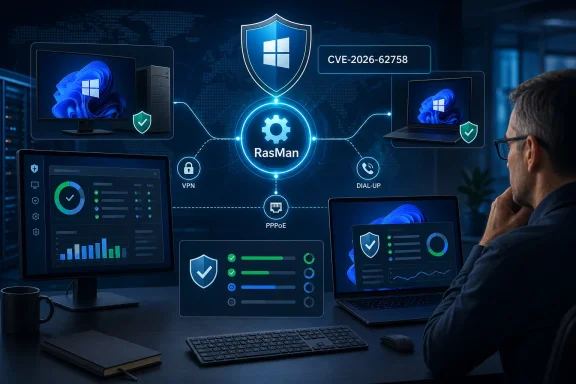 RasMan is a client-side connection service, not the RRAS server role
Windows Remote Access Connection Manager manages the mechanics of remote-access connections and returns connection status to the client. Microsoft’s own Remote Access Service documentation places it underneath APIs and tools used to create and manage remote connections, connection profiles, phone-book entries, and RAS-capable devices. In practical terms, it is relevant to Windows VPN and legacy remote-access workflows, including environments that deploy Microsoft Connection Manager packages.
It should not be conflated with the Windows Server Routing and Remote Access Service role, whose service name is RemoteAccess. The two are related parts of Windows’ remote-access stack, but they are not interchangeable services and are not necessarily exposed in the same way. A server configured as a VPN or routing endpoint needs separate assessment of its RemoteAccess role; CVE-2026-62758 is specifically named for Windows Remote Access Connection Manager, not RRAS.
That distinction narrows the likely exposure. The CVE’s designation is elevation of privilege rather than remote code execution, and Microsoft has not said that a network-reachable VPN gateway can be compromised remotely through this flaw. Until Microsoft publishes the attack vector, administrators should avoid treating the advisory as proof of a pre-authentication VPN-server vulnerability.
The missing exploitability data changes the triage order
Microsoft’s August 11 publication establishes that a patch is available, but it leaves several critical questions unanswered. In a typical MSRC advisory, security teams would expect to see whether exploitation is considered more likely or less likely, whether the issue is publicly known, and whether Microsoft has detected exploitation in the wild. None of those determinations is presently public for CVE-2026-62758.
There is also no public proof of concept or independent technical analysis tied to this CVE. Searches of the CVE Program’s public database, NVD, and security reporting indexed by August 12 did not return a matching record with technical detail. That is not evidence the flaw is harmless; it is evidence that the technical record remains thin one day after disclosure.
For patch managers, this should place CVE-2026-62758 in the standard expedited Windows patching queue, rather than ahead of a confirmed actively exploited flaw or a remote, unauthenticated vulnerability. Organizations that have delayed August cumulative updates should not wait for a score to appear. But teams should also resist assigning a severity, exploit path, or SYSTEM-level outcome that Microsoft has not announced.
VPN-heavy endpoints deserve the first verification pass
The most sensible deployment order follows where RasMan is operationally important. Start with managed Windows endpoints that routinely establish user VPN connections, Always On VPN deployments, laptops using enterprise connection packages, and devices that use PPPoE or other RAS-managed connection types. These machines are not proven to be more exploitable, but they are the systems most likely to exercise the affected service in normal operation.
The second priority is privileged-user workstations. A local elevation-of-privilege flaw can become more consequential after an attacker already has a foothold through phishing, a browser exploit, stolen credentials, or a malicious installer. Administrators, help-desk staff, developers with local administrative duties, and users who access sensitive management planes should therefore receive the August security update promptly even if they do not use VPN daily.
A limited change-control review is warranted for environments with custom connection packages or legacy remote-access tooling. Microsoft documents Connection Manager as a managed remote-access client that can be used with custom dialers and connection-specific actions. The vulnerability advisory does not say that those packages are implicated, but the service’s role means organizations should test their normal connection, authentication, reconnection, and device-tunnel workflows after installing the cumulative update.
Disabling RasMan is a containment option, not a general fix
Windows administrators will find older Microsoft security guidance recommending that RasMan be stopped and disabled when a Remote Access Connection Manager flaw has no patch. That history explains why the service can be a meaningful security boundary, but it should not be mechanically applied here.
Disabling RasMan can break VPN, dial-up, and PPPoE connectivity, and can disrupt enterprise remote-access profiles. Microsoft has already issued a security update for CVE-2026-62758, so disabling the service across a fleet would be a poor substitute for patching and could strand remote users precisely when they need corporate access.
A temporary service restriction may still be defensible on a narrowly defined unpatchable device, particularly if it does not require remote-access connectivity. That is a risk-acceptance decision, however, not a Microsoft-published workaround for this CVE. Document the business impact before making it, and restore the service only after the appropriate security update is installed and validated.
What to check after deployment
Administrators should confirm both patch compliance and service behavior rather than relying solely on a successful software-distribution status. Windows cumulative updates are cumulative: once the relevant August 2026 update is installed, there should be no separate standalone RasMan package to hunt down.
A focused post-deployment check should include the following:
- Confirm that the August 2026 cumulative security update is installed on each supported Windows release in scope, using the KB and build number Microsoft assigns to that release.
- Confirm that normal VPN and remote-access connections still authenticate, connect, reconnect, and disconnect as expected.
- Review Event Viewer for new RasMan, RemoteAccess, or connection-profile failures after the update reaches pilot devices.
- Keep the RasMan service enabled where users or managed profiles require it; do not disable a production remote-access dependency merely because the service appears in the CVE title.
- Continue monitoring Microsoft’s CVE-2026-62758 record for a CVSS vector, affected-product list, exploitability assessment, revision history, and any update to exploitation status.
The key fact today is narrower than the CVE title may suggest: Microsoft has patched a privilege-escalation issue in a Windows service used to manage remote connections, but it has not yet published enough technical detail to demonstrate a remote attack path, active abuse, or the exact systems at highest risk. Install the August 2026 Windows security updates, validate the VPN estate, and avoid filling Microsoft’s unanswered fields with assumptions.
