
The disclosure is unusually thin. Microsoft’s Security Update Guide identifies the affected component and the impact category—elevation of privilege—but, as of August 12, does not publicly describe the underlying flaw, its CWE classification, CVSS score, attack prerequisites, affected Windows editions, or a separate workaround. Microsoft also has not marked the issue as publicly disclosed or exploited in the material available with the advisory.
That leaves a meaningful distinction for defenders: this is a patch-now local escalation issue, not evidence of a remotely exploitable Windows activation-service bug. Nothing Microsoft has published establishes a network attack path, unauthenticated exploitation, or a route from an external attacker directly to SYSTEM. An attacker would need an initial foothold or a way to run code locally before an elevation-of-privilege flaw could become useful.
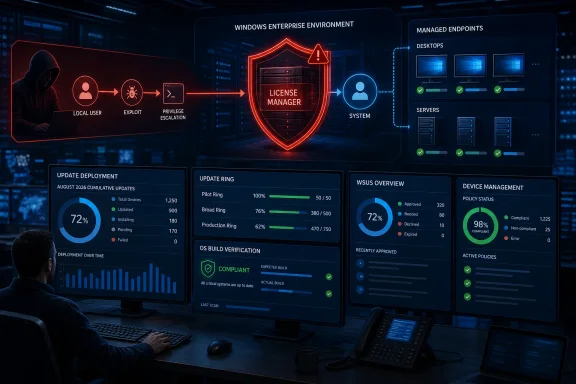 Microsoft has confirmed the flaw, but not the route to exploitation
The Microsoft Security Response Center published CVE-2026-62777 at 7:00 a.m. Pacific time on Tuesday, August 11, placing it in the regular August Patch Tuesday release. Microsoft’s classification is enough to establish the existence of a Windows License Manager security defect capable of increasing an attacker’s privileges.
What is absent matters just as much. Microsoft’s public entry does not explain whether the vulnerable behavior is a permission problem, improper file or registry handling, an installation or servicing path, a COM interface issue, or a defect in a privileged License Manager process. It also does not say whether exploitation results in administrative privileges, LocalSystem, access to another user context, or some narrower security-boundary bypass.
The supplied MSRC material includes generic CVSS language explaining the report confidence metric, but that language is not a CVSS assessment for CVE-2026-62777 itself. In other words, readers should not mistake the description of what “Confirmed” means in Microsoft’s scoring glossary for a published confirmation that this particular flaw has a proof of concept, a public exploit, or detailed technical disclosure.
Searches of the National Vulnerability Database and the CVE Program’s public record did not return an independently indexed entry for CVE-2026-62777 at publication time. No independent security outlet had published technical reporting on this exact CVE either. That is normal for a newly released Microsoft vulnerability, but it means the current public record is effectively Microsoft’s advisory alone.
License Manager should not be dismissed as an activation-only concern
Windows License Manager is associated with licensing and activation functions, which can make it appear peripheral to enterprise security operations. In practice, any Windows component that runs with elevated rights, processes requests from less-privileged contexts, or writes into protected locations can become a useful post-compromise target if it mishandles access controls or input.
The important operational point is that elevation-of-privilege bugs are frequently chained with another weakness. Malware, a malicious insider, an attacker who has obtained a standard user session, or a threat actor who exploited a separate application bug may already be limited by Windows privilege boundaries. A reliable local escalation changes the nature of that intrusion: it can allow security controls to be disabled, credential material to be targeted, persistence to be installed more deeply, or machine-wide settings to be changed.
CVE-2026-62777 should therefore be prioritized according to the systems on which it could improve an attacker’s position. Shared workstations, jump hosts, Remote Desktop Session Host servers, developer desktops, kiosks with locally accessible applications, and servers where lower-privileged users or service accounts can execute code deserve particular attention. The available advisory does not establish that every one of those scenarios is vulnerable; it establishes why an unpatched local escalation in a Windows component should be treated as more than a licensing-management footnote.
Microsoft also has not published a configuration-based mitigation. There is no stated service-disablement guidance, registry adjustment, policy setting, or feature removal that administrators can rely on while awaiting normal patch deployment. Disabling or modifying licensing-related services without Microsoft guidance is a poor substitute for patching and could create activation, Store, subscription, or compliance problems without eliminating the vulnerable code path.
The missing KB and build mapping complicates fleet verification
For a routine Windows cumulative-update vulnerability, the most useful information for administrators is normally a clean mapping between the CVE, supported product versions, the relevant KB articles, and fixed build numbers. That lets operations teams ask a defensible question: “Which machines are still exposed?”
Microsoft’s public CVE entry had not supplied that mapping in the submitted disclosure. It does not identify a standalone KB article for CVE-2026-62777, and it does not say whether the issue affects Windows 11, Windows 10 under Extended Security Updates, Windows Server releases, Azure Local, or only a limited subset of supported products. The omission is material because “Windows License Manager” is a component label, not a deployment list.
Administrators should avoid inventing a vulnerable-product list from the component name. A system running a License Manager service is not necessarily affected, and a product family absent from an early advisory summary is not necessarily excluded. The proper verification path is Microsoft’s August 2026 Security Update Guide deployment table and the individual August 11 cumulative-update release notes as they populate and stabilize.
There is another consequence: a general statement that a machine is “fully patched” is not enough when rollout rings, update deferrals, hotpatch eligibility, servicing-stack prerequisites, and reboot state differ across a fleet. Security teams should validate the installation of the applicable August security cumulative update and confirm that the device has completed the required restart, rather than relying solely on an update having been offered or downloaded.
What to do while technical details are sparse
This is not a case for emergency service shutdowns or speculative registry changes. It is a case for disciplined monthly patch deployment with an eye on systems that offer attackers a local execution foothold.
- Deploy the applicable August 11, 2026 Windows security cumulative updates to supported client and server systems through the organization’s standard update channel.
- Confirm installation using the applicable KB and OS build information in Microsoft’s release notes once the CVE deployment mapping is available, rather than treating a successful download as proof of remediation.
- Prioritize systems exposed to untrusted local users, shared administrator workflows, remote desktop users, build agents, and applications that execute content or code supplied by other users.
- Investigate unexpected privilege changes, new local administrator memberships, suspicious service creation, or security-tool tampering on devices that remained unpatched after the August release.
- Do not disable Windows licensing components as an improvised mitigation unless Microsoft publishes specific guidance; the advisory currently offers no evidence that doing so prevents exploitation.
Microsoft may revise CVE-2026-62777 with a CVSS vector, affected-product list, acknowledgements, exploitability assessment, or additional deployment details in the days after release. Until then, the defensible reading is narrow: Microsoft has fixed a Windows License Manager local elevation-of-privilege vulnerability, but has not provided enough public detail to rank it as an active incident driver or to justify anything beyond prompt installation and verified compliance with the August 11 security updates.
