

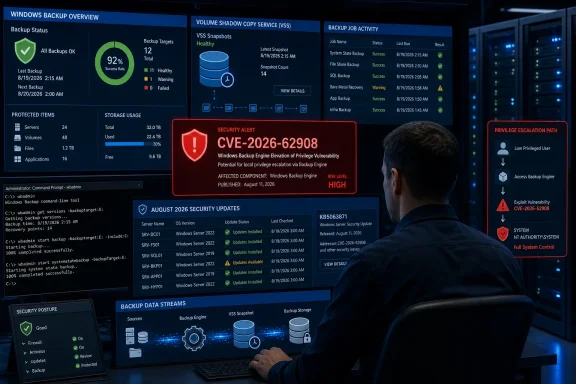
wbadmin, system-image jobs, or software that depends on Windows’ backup infrastructure—but do not pretend the public record currently provides enough detail to rank the flaw more precisely.The Microsoft Security Response Center identifies the issue only as a “Windows Backup Engine Elevation of Privilege Vulnerability.” As of August 12, Microsoft’s public entry, the CVE’s presence in the Security Update Guide is the authoritative confirmation that the flaw exists, but no independently reported technical analysis, proof of concept, or exploitation claim has surfaced alongside it. The gap matters because “Backup Engine” is a broad component label, not a description of the vulnerable code path or a reliable indicator of which machines are exposed.
The supplied confidence text is a glossary entry, not a risk rating
The explanatory paragraph accompanying CVE-2026-62908 describes the CVSS Report Confidence metric: a scale intended to express how certain a vulnerability’s existence and technical details are. It does not itself state the Report Confidence value Microsoft assigned to this CVE.
That distinction is easy to miss because the prose sounds like an assessment. It is not. The text says that vulnerabilities can range from initially unconfirmed reports to vendor-acknowledged flaws, but it does not say where CVE-2026-62908 falls on that scale, whether public technical details exist, or whether an exploit has been demonstrated.
Microsoft’s publication of the CVE settles the narrowest and most important question: this is not an unassigned rumor. It does not settle the operational questions security teams need for prioritization, including whether exploitation requires an already authenticated local user, access to backup targets, a specific backup configuration, or interaction with a privileged service.
No public CVSS vector, weakness classification, affected-build list, exploitation status, or workaround was included in the material supplied with the advisory. Those omissions mean administrators should avoid filling in the blanks with assumptions based on older Windows Backup Engine bugs.
Why a backup component can become a privilege boundary
Windows backup operations are inherently privileged. Microsoft’s own wbadmin documentation says backup scheduling requires administrator membership, while other backup and recovery operations require Backup Operators, Administrators, or delegated permissions; the tool itself runs from an elevated command prompt.
The Windows backup stack also works with system-wide storage features. Volume Shadow Copy Service, or VSS, is used to create stable copies of volumes while applications continue writing data. Windows Server Backup is one of Microsoft’s documented VSS requesters, and third-party backup products frequently use VSS requesters, providers, or writers as part of their own jobs.
That architecture makes an elevation-of-privilege flaw significant even when it is not a remote code-execution vulnerability. A threat actor who already has a foothold as a standard user, a service account, or a constrained application identity may be able to convert limited local access into administrative or SYSTEM-level control if the vulnerable path crosses a privileged boundary incorrectly.
That is the reasonable impact model for this class of issue. It is not yet a confirmed exploit path for CVE-2026-62908. Microsoft has not publicly said whether the vulnerability is triggered through wbadmin, a backup service, VSS interaction, restore handling, crafted backup metadata, file-system paths, or another interface entirely.
“Windows Backup Engine” does not mean every backup product is affected
The name creates a risk of both overreaction and false reassurance.
It would be wrong to declare every third-party backup product vulnerable merely because it runs on Windows or uses VSS. Microsoft has not identified a third-party product, a VSS provider, a VSS writer, or a particular backup workload as affected. A product calling into a Windows service is not automatically exposed to a flaw in every service component.
It would also be wrong to dismiss the CVE because an organization does not use the consumer-facing Windows Backup application. Microsoft’s current command reference lists wbadmin support across Windows 10, Windows 11, Windows Server 2016 through Windows Server 2025, and Azure Local. Server administrators should therefore check actual use rather than application branding: scheduled Windows Server Backup jobs, system-state backups, bare-metal recovery workflows, and backup scripts may all matter more than whether a user sees a “Windows Backup” icon.
The practical question is whether an endpoint or server has the relevant Windows backup functionality installed, enabled, or invoked in routine operations. Until Microsoft publishes the exact affected-product mapping, that inventory should guide validation and monitoring, not a blanket assumption that only dedicated backup servers are in scope.
The missing update mapping is the real deployment problem
Microsoft normally connects a security advisory to affected products and applicable security updates. The material now available for CVE-2026-62908 does not identify a KB article, cumulative-update build number, servicing channel, or edition-specific patch relationship.
That leaves IT teams with a familiar but uncomfortable deployment problem: they can patch broadly through the August 11 security release, but cannot yet prove from the public CVE record which installed update remediates this particular flaw on a given Windows release. For managed estates, “current on monthly cumulative updates” is a useful control state; it is not the same thing as a documented CVE-to-KB mapping.
The lack of a disclosed workaround is also meaningful. Administrators should not disable VSS, Windows Server Backup, or backup services speculatively. Those changes can break recovery readiness, application-consistent backups, restore procedures, and ransomware resilience—while potentially doing nothing to mitigate the actual vulnerable interface.
A cautious response is appropriate:
- Apply the August 2026 Windows security updates through the organization’s normal expedited security process, beginning with representative systems that run backup or recovery jobs.
- Confirm that backup schedules, VSS snapshots, application-consistent backups, and recovery catalogs still function after patching before expanding deployment.
- Inventory systems using
wbadmin, Windows Server Backup, system-state backups, and privileged backup service accounts so that any later Microsoft scope clarification can be acted on quickly. - Watch for abnormal child processes, unexpected writes to backup catalogs or image locations, and unusual privilege changes on backup servers, management servers, and shared recovery infrastructure.
- Keep backup operators and backup-service accounts narrowly scoped; an elevation-of-privilege vulnerability is more dangerous when low-privilege access is easy to obtain in the first place.
Do not confuse patching with proof of exposure
CVE-2026-62908 deserves attention because backup workflows sit close to high-value data, recovery controls, and elevated permissions. It does not yet support claims that attackers can exploit the flaw remotely, that it is being used in the wild, that it affects every Windows build, or that it compromises third-party backup tools.
Microsoft’s disclosure confirms the vulnerability’s existence, while leaving the risk mechanics largely unpublicized. Until the Security Update Guide adds affected-build and update information—or Microsoft publishes a fuller advisory—administrators should patch the August release, validate their backup estate, and preserve evidence that their endpoints and servers received the applicable cumulative updates.