

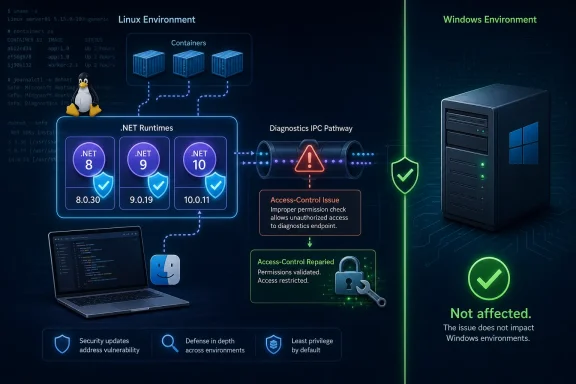
The advisory, published by Microsoft on August 11, identifies a missing error check in .NET diagnostics interprocess communication. Under the right conditions, that unchecked failure causes .NET to apply an improper access-control list to a shared resource, creating a path for local privilege elevation. Microsoft credits Kevin Gosse with reporting the issue and rates it Medium, with a CVSS 3.1 score of 6.7.
The immediate remediation is to move affected runtime deployments to .NET 10.0.11, .NET 9.0.19, or .NET 8.0.30. That includes applications built as self-contained deployments, which will remain vulnerable until they are rebuilt and redeployed with a patched runtime. Updating a system-wide runtime alone does not repair a self-contained application image.
Diagnostics IPC Is the Vulnerable Surface
The flaw sits in .NET diagnostics IPC, the local communication mechanism used by tooling and runtime diagnostics features. This is not an ASP.NET Core request-handling bug, a Kestrel issue, or a remotely reachable service endpoint by itself. Microsoft describes it as a local elevation-of-privilege vulnerability caused when an error condition is not checked and permissions on a shared diagnostics-related resource are set incorrectly.
The CVSS vector puts several meaningful limits around the risk. Exploitation requires local access, low-level privileges, high attack complexity, and user interaction; Microsoft’s score still assigns high confidentiality, integrity, and availability impact if the exploit succeeds. In practical terms, this looks like a post-access problem: an attacker or untrusted local workload that already has a foothold could potentially turn access to a diagnostics resource into access beyond its intended permissions.
That makes the bug especially relevant on multi-user Linux machines, shared build agents, developer workstations, and hosts where .NET applications run under more privileged accounts than the users or processes around them. It also deserves attention in container platforms when a service runs with an overly broad user identity, host-mounted diagnostics paths, or permissive volume arrangements. The advisory does not state that containers are an exploit prerequisite or that container isolation is bypassed; it does establish that the vulnerable code is present in the Linux runtime packages commonly embedded in container images.
Microsoft’s public advisory provides the root cause at a high level but does not publish a proof of concept, a triggering configuration, or a list of specific diagnostics commands that expose the bad ACL. As of August 12, no independent technical analysis or public exploit writeup surfaced for CVE-2026-62909. That absence should not be read as a guarantee that exploitation is impossible: Microsoft has confirmed the vulnerability and shipped fixes. It does mean administrators should avoid inventing a remote attack scenario from a CVSS label that explicitly says local access is required.
The Package List Excludes Windows
Microsoft’s package matrix is unusually clear here. Affected packages are the platform-specific Microsoft.NETCore.App.Runtime distributions for:
- Linux on ARM, ARM64, x64, musl ARM, musl ARM64, and musl x64.
- macOS on ARM64 and x64.
There are no Windows runtime packages in the affected list. There is also no listing for .NET Framework 3.5, 4.6.2, 4.7.x, 4.8, or 4.8.1. That is a substantive scope boundary, not an omission that Windows admins should paper over with a blanket Patch Tuesday deployment.
For WindowsForum readers, the operational catch is that the operating system is not always the whole deployment boundary. A Windows Server host may run a Linux Kubernetes node pool elsewhere, publish Linux-targeted self-contained artifacts from Azure DevOps, or build and distribute Linux container images from Windows-based CI. In each of those cases, Windows Update can be fully current while the application artifact remains vulnerable.
The affected versions begin with the first releases of each supported major train:
| .NET release | Affected versions | Patched version |
|---|---|---|
| .NET 10 | 10.0.0 through 10.0.10 | 10.0.11 |
| .NET 9 | 9.0.0 through 9.0.18 | 9.0.19 |
| .NET 8 | 8.0.0 through 8.0.29 | 8.0.30 |
This is not a “latest patch only” issue in the narrow sense. Every listed patch release in those supported trains is covered, so an estate that intentionally pins to an older .NET 8 runtime for stability is still exposed on Linux or macOS until it moves to 8.0.30.
Self-Contained Deployments Are the Patching Trap
Microsoft explicitly calls out self-contained applications as vulnerable if they target the affected versions. This is the material consequence many runtime-update advisories leave buried: self-contained publishing copies the runtime into the application output. A patched runtime installed through a package manager, Visual Studio, or an operating-system image update does not replace the runtime already bundled beside the executable.
For framework-dependent applications, patching the installed runtime and restarting the service is normally sufficient. For self-contained applications, the correct sequence is to update the SDK or runtime used for publishing, rebuild the artifact, redeploy it, and restart or roll out the workload. For containers, that means rebuilding the image from a patched .NET base image or publishing a new self-contained layer, then replacing running pods, tasks, or containers.
Teams should also check the distinction between an SDK installed on a build machine and a runtime embedded in a production artifact. dotnet --info is useful for identifying installed SDKs and runtimes on a host, as Microsoft notes, but it does not prove that every deployed self-contained binary or container was republished. Artifact inventories, container registries, CI release metadata, and software-bill-of-materials records are better evidence of what is actually in production.
A practical response should include all of the following:
- Update Linux and macOS deployments to .NET 10.0.11, 9.0.19, or 8.0.30 as appropriate.
- Rebuild and redeploy every self-contained application using an affected runtime line.
- Rebuild Linux container images rather than assuming the host runtime update changes application layers.
- Restart framework-dependent services after the patched runtime is installed, because a running .NET process does not swap its runtime files in place.
- Review service identities and local access on shared systems while the patch rollout is underway, since the advisory concerns permissions on a local shared resource.
Why the Medium Rating Should Not Delay Routine Patching
A 6.7 Medium score is appropriate for a bug with local access, user-interaction, and high-complexity requirements, but it should not send it to the bottom of a normal .NET maintenance queue. Privilege-escalation vulnerabilities often matter after another control has failed: a compromised low-privilege account, a malicious package in a build environment, or an untrusted user on a shared developer system can turn a supposedly constrained foothold into a much more serious incident.
The bug also touches diagnostics infrastructure, which tends to operate close to running processes and can expose sensitive operational information when permissions are wrong. Microsoft’s CVSS impact assessment assigns high potential impact to confidentiality, integrity, and availability, even though the attack conditions reduce the likelihood of broad opportunistic exploitation.
There is one final scope point worth keeping straight: CVE-2026-62909 is a .NET runtime issue for Linux and macOS. It is not a Windows .NET Framework patching event. Windows-only estates can document the CVE as not applicable after confirming they do not distribute affected Linux or macOS runtime packages. Mixed estates should treat the August servicing releases as an application and container rebuild task, with .NET 8.0.30, 9.0.19, and 10.0.11 as the concrete closure point.