

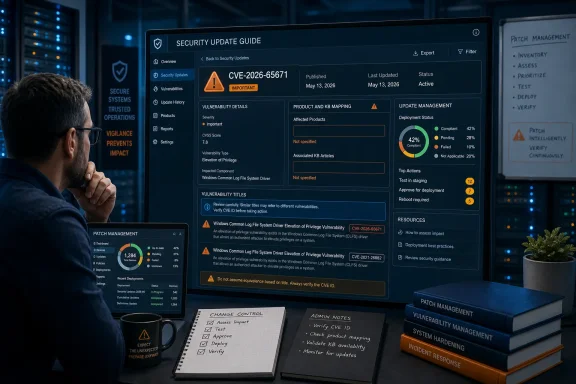
That makes this a vulnerability record to track rather than one an IT team can responsibly declare remediated. Administrators should avoid treating the generic title as evidence that every Remote Access, RDP, VPN, or remote-management deployment is affected.
The advisory was published at 7:00 a.m. Pacific time on August 11, 2026, as part of Microsoft’s August security release. Microsoft’s Security Update Guide is the primary record for the CVE, but its publicly rendered entry presently provides little beyond the identifier, title, release date, and the standard explanatory language for the CVSS report confidence metric. That boilerplate describes how confidence ratings work; it is not a technical description of CVE-2026-65671 and does not disclose an exploit path.
The missing product and update mapping is the real issue
For an elevation-of-privilege advisory to be actionable, Microsoft normally needs to provide a product scope and an update mapping. A Windows administrator should be able to answer straightforward questions: Which supported Windows client and Server versions are vulnerable? Does the flaw reside in a service, API endpoint, driver, library, or management tool? Which cumulative update, servicing update, or standalone package contains the fix?
CVE-2026-65671 does not yet answer those questions in the public record reviewed for this report. The omission matters because “Remote Access API” is not a product name. It could refer to a Windows subsystem, a management interface, an API used by a service, or a product capability that is not exposed on most endpoints. There is no sound basis, at this stage, for equating it with Remote Desktop Protocol, Remote Desktop Services, Routing and Remote Access, Windows Remote Management, Quick Assist, or a third-party remote-support tool.
The difference is operationally important. A local elevation-of-privilege flaw in a management API has a very different patching and detection priority from a network-reachable service that allows an unauthenticated internet attacker to become an administrator. Microsoft’s title confirms only the impact category—a successful attacker can obtain greater privileges than intended. It does not state what access the attacker needs beforehand, whether user interaction is required, whether exploitation is local or remote, or whether the resulting privileges are administrative or SYSTEM-level.
Until Microsoft supplies a CVSS vector and affected-product table, assumptions about those conditions would be speculation.
This title has already caused an identifier trap
The most concrete finding is that “Remote Access API Elevation of Privilege Vulnerability” is also the title of CVE-2021-26882, a separate Microsoft Windows flaw published in March 2021. The National Vulnerability Database and Rapid7’s vulnerability database identify that older CVE as a Windows elevation-of-privilege issue with a CVSS 3.1 score of 7.8 and a vector indicating local attack access and low privileges required.
Those 2021 details must not be copied onto CVE-2026-65671.
The shared wording is enough to pollute searches, vulnerability-management tickets, and automated enrichment feeds. An analyst searching only for the advisory title rather than the full identifier can easily land on CVE-2021-26882 and conclude that CVE-2026-65671 is local, high severity, fixed by a historical March 2021 patch set, or related to Windows 10 and Windows Server versions from that period. None of those conclusions is supported by Microsoft’s new advisory.
This is more than a documentation nuisance. Security teams that normalize alerts by title, rather than CVE ID plus vendor product mapping, can accidentally close the new finding against old KB records. That produces the worst kind of compliance result: an apparently resolved vulnerability with no evidence that the current issue was ever patched.
Microsoft has used generic vulnerability titles before, especially where a broad service or interface name is enough to describe an impact category but not the underlying flaw. The responsibility is therefore on asset-management and vulnerability-management teams to preserve the complete identifier. In this case, CVE-2026-65671 is the only stable key; the title is demonstrably ambiguous.
No public exploitation or workaround has been established
Microsoft’s currently available material does not identify CVE-2026-65671 as publicly disclosed, actively exploited, or accompanied by proof-of-concept code. It also does not list a workaround or mitigation. The absence of those details should not be read as a clean bill of health; it means Microsoft has not supplied evidence one way or the other in the public advisory material currently available.
There is likewise no independently reported technical analysis of CVE-2026-65671 available at publication time. The NVD has not yet surfaced a corresponding indexed record, and neither CISA nor the major security outlets reviewed for this report has published an advisory, exploitation notice, or affected-product breakdown for this identifier. That lag is common immediately after Patch Tuesday, particularly when the vendor’s own record is thin, but it means there is no second source that can fill Microsoft’s gaps.
The advisory’s “report confidence” text should be read carefully. Microsoft’s page includes an explanation that a confirmed rating means a vendor or researcher has verified the issue, but the excerpt does not state the actual confidence value assigned to CVE-2026-65671. The presence of an explanation is not the same thing as a confirmed rating. Teams should not enter “confirmed,” “proof of concept unavailable,” or “no exploitation” into their risk register unless the advisory’s metrics section explicitly provides those values.
What Windows administrators should do now
The immediate task is record hygiene and patch validation, not emergency configuration changes. Security teams should create or retain a distinct tracking item for CVE-2026-65671 and mark the affected product, vulnerable version range, remediation package, and exploitability fields as pending Microsoft clarification.
A defensible short-term approach is:
- Preserve the identifier exactly as CVE-2026-65671 and do not merge it with CVE-2021-26882, despite the identical advisory title.
- Review the August 11, 2026 Windows security updates through normal change control, but do not claim that a particular KB fixes this CVE unless Microsoft’s deployment mapping explicitly says so.
- Search vulnerability scanners, endpoint-management platforms, and SIEM enrichment rules for title-based deduplication that could associate the new CVE with the 2021 record.
- Watch Microsoft’s Security Update Guide revision history for an affected-software table, CVSS vector, security-update entry, mitigation, or FAQ that identifies the actual Remote Access API component.
- Treat any scanner finding that identifies a product or KB without a corresponding Microsoft mapping as vendor enrichment requiring verification, not as primary evidence.
Organizations with strict reporting obligations have a particular reason to keep the finding open. “Published by Microsoft, scope pending” is a more accurate status than “not applicable,” “mitigated,” or “patched.” The evidence required to move it out of that state has not yet been published.
The next revision needs to answer basic deployment questions
Microsoft’s August 11 publication gets the CVE into public tracking systems, but it has not yet made it operationally useful. The missing fields are not cosmetic: they determine whether CVE-2026-65671 belongs in a routine Windows cumulative-update deployment, a server-specific maintenance window, a remote-access service review, or a high-priority incident response queue.
For now, the defensible conclusion is narrow. CVE-2026-65671 is a newly published Microsoft elevation-of-privilege advisory with an ambiguous, recycled title and no publicly available product or KB mapping. Do not borrow the technical profile or patches of CVE-2021-26882, and do not close the new record until Microsoft identifies what actually receives the fix.