

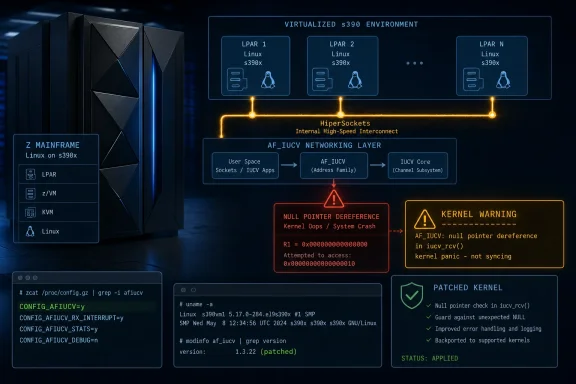
The CVE was published to the NVD on August 10, 2026, with kernel.org as the source. NVD has not assigned CVSS 3.x or CVSS 4.0 metrics, and the record provides neither an exploit scenario nor evidence of exploitation. What it does establish is a reliable denial-of-service condition: under a specific allocation-failure path, the kernel can dereference a null socket pointer and crash.
The important operational distinction is that this is a kernel stability flaw in a niche transport, rather than a newly documented remote-code-execution issue across Linux networking. The available record supports treating it as an availability fix for affected s390 HiperSockets deployments, while avoiding the common but misleading conclusion that every Linux server with a network interface is exposed.
The crash occurs after a failed child-socket allocation
The affected function, afiucv_hs_callback_syn(), handles an incoming SYN-style connection request for AF_IUCV’s HiperSockets transport. It tries to allocate a child socket with GFP_ATOMIC, an allocation mode used where the kernel cannot sleep waiting for memory. That allocation can fail under memory pressure, leaving the nsk child-socket pointer set to NULL.
The function has one common rejection path for three conditions: the parent socket is no longer listening, its accept queue is full, or the new child-socket allocation failed. In each case, the code sends a connection-refused response. The defect was that it then called iucv_sock_kill(nsk) unconditionally, even in the allocation-failure case where no child socket exists.
The pre-fix Linux source confirms the problem described in the CVE record. The rejection branch tests !nsk, but immediately afterward calls iucv_sock_kill(nsk). That cleanup function expects a valid struct sock and accesses socket state through sock_flag(). Passing a null pointer turns an ordinary rejected connection into a kernel null-pointer dereference.
The repair is intentionally small: call iucv_sock_kill() only if a child socket was successfully allocated. It does not alter AF_IUCV protocol semantics, connection admission rules, or backlog handling. It stops cleanup from trying to free an object that was never created.
That narrow code change is useful evidence when weighing risk. There is no indication in the CVE record of memory corruption, use-after-free behavior, or an attacker-controlled write primitive. The documented failure mode is a kernel oops or panic when the affected connection path coincides with allocation failure.
AF_IUCV is an s390 feature, and HiperSockets is the decisive qualifier
AF_IUCV is not a general-purpose Linux socket family such as TCP, UDP, Unix-domain sockets, or even AF_VSOCK. The Linux Kernel Driver Database identifies CONFIG_AFIUCV as AF_IUCV socket support for s390 z/VM and HiperSockets transport. The option depends on the s390 architecture and either QETH Layer 3 or IUCV support; the driver is built as the af_iucv module when configured modularly.
That architecture and configuration dependency changes the incident response substantially. A normal Intel- or AMD-based Linux server cannot enable the s390-only code path. Standard Windows systems and conventional WSL 2 deployments are likewise outside the affected architecture. A Windows administrator using Linux containers, Docker Desktop, Hyper-V, or WSL does not need to patch Windows itself for CVE-2026-68141.
The systems that do merit review are Linux on IBM Z environments that use AF_IUCV sockets and HiperSockets. In practice, that means organizations operating s390 Linux guests or partitions with specialized internal networking, especially where AF_IUCV-enabled applications accept HiperSockets connections.
Even on s390, a distribution kernel is not automatically exposed merely because its version falls in the affected range. The relevant questions are whether the kernel was built with CONFIG_AFIUCV, whether af_iucv is available or loaded, and whether the HiperSockets AF_IUCV transport is actually in use. The vulnerable routine is part of that transport’s incoming connection handling; a server without an AF_IUCV HiperSockets listener does not exercise the reported path.
Administrators can make the first determination locally:
grep -E 'CONFIG_(S390|AFIUCV|IUCV|QETH_L3)=' /boot/config-$(uname -r)
lsmod | grep af_iucv
A kernel configuration without CONFIG_AFIUCV does not include the affected feature. A modular configuration deserves closer review, because the module can be present even when it is not currently listed in lsmod; check how local applications and boot-time services use AF_IUCV before declaring the host unaffected.
The trigger is real, but it is not a generic network crash switch
The CVE description makes clear that an inbound connection request alone is insufficient. The child-socket allocation must fail, and that failure occurs in atomic allocation context. The same reject branch also handles normal operational conditions such as a full listen backlog and a socket that is no longer in the listening state, but those cases have a valid child socket or otherwise do not establish the null-pointer condition by themselves.
This matters for threat modeling. An authorized or reachable peer can initiate the relevant connection flow, but the documented crash requires the kernel to fail allocating the child socket at the right moment. A remote party may be able to increase connection activity or contribute to pressure on a listener, yet the published record does not demonstrate a dependable unauthenticated crash technique, a privilege boundary crossing, or code execution.
That is why NVD’s missing severity assessment should not be mistaken for either proof of harmlessness or proof of criticality. It is a newly published record whose technical description supports a denial-of-service classification in the applicable environment, but not a responsibly stated CVSS score or exploitability claim. Organizations with s390 HiperSockets services should prioritize the normal kernel-update process rather than making unsupported assumptions about active exploitation.
The bug also deserves attention from capacity-planning teams. Memory-pressure paths tend to be ignored because they are rare during steady-state operation, yet they often become relevant precisely when a system is overloaded. Before the fix, a stressed AF_IUCV listener could turn an allocation failure into a kernel crash instead of refusing the one connection cleanly. After the fix, that failed connection is refused while the kernel remains up.
NVD lists fixed stable releases, but distribution package versions still control deployment
The NVD record marks Linux kernels from version 3.2 onward as affected at the upstream source level, subject to the AF_IUCV configuration and use conditions described above. It identifies fixed release points in several maintained lines: 6.6.148, 6.12.101, 6.18.42, 7.1.6, and 7.2-rc5.
Those numbers are useful for upstream source tracking, but they are not enough to decide whether an enterprise host is patched. Red Hat Enterprise Linux, SUSE Linux Enterprise, Ubuntu, Debian, Oracle Linux, and IBM-oriented distributions commonly retain an older upstream version in the package name while backporting security fixes. Conversely, a locally built kernel based on an older branch may remain vulnerable even if its distribution has shipped an advisory for another build.
The NVD entry links five stable-kernel commits, one per corrected branch, and describes the fix as coming from kernel.org. It does not identify downstream package release numbers, affected distribution products, a vendor-specific advisory timetable, or whether live patching is available. That omission leaves the operational responsibility with the system owner: compare the installed vendor kernel package against that vendor’s changelog or security tracker, rather than comparing only uname -r to upstream release numbering.
For locally maintained s390 kernels, the safest test is commit-based. Confirm that the tree contains the AF_IUCV change that guards iucv_sock_kill(nsk) behind a successful allocation check. A version string alone can be ambiguous in forks and long-term support trees.
Patch affected IBM Z systems; do not widen the alert beyond the evidence
For an AF_IUCV HiperSockets deployment, this is a straightforward kernel maintenance item: install the distribution kernel carrying the upstream fix, reboot into it when required, and confirm the active kernel afterward. If a maintenance window cannot happen immediately, reducing unnecessary AF_IUCV listener exposure and ensuring adequate headroom during connection bursts can reduce the likelihood of encountering the allocation-failure path, but neither measure replaces the patch.
For ordinary Windows users, WSL users, and Linux administrators on x86_64 or Arm hardware, CVE-2026-68141 should be recorded as not applicable by architecture unless they manage an IBM Z environment elsewhere in the estate. Treating it as a universal Linux networking CVE would create noise, consume patching attention, and obscure the hosts that actually need action.
The concrete deadline is therefore not a fleet-wide Windows or Linux emergency. It is the next kernel-update cycle for s390 systems that have CONFIG_AFIUCV enabled and use AF_IUCV HiperSockets connections, with upstream fix points beginning at Linux 6.6.148, 6.12.101, 6.18.42, 7.1.6, and 7.2-rc5.