
The CVE title — “fscrypt: Add missing superblock check in find_or_insert_direct_key()” — understates a configuration-sensitive key setup problem. The upstream Linux change prevents fscrypt from reusing a cached DIRECT_KEY encryption object when the filesystem currently being opened expects a different encryption implementation than the filesystem that created that cached object.
Microsoft’s MSRC entry places the CVE publication on August 11, 2026. But the upstream Linux record shows the corrective patch entered Linus Torvalds’ mainline tree as part of Linux 7.2-rc5 on July 24, 2026, bundled with another fscrypt fix described by maintainer Eric Biggers as addressing “AI-detected bugs.” The vulnerability disclosure has therefore arrived after the mainline remedy, rather than serving as the first public warning that maintainers need to patch.
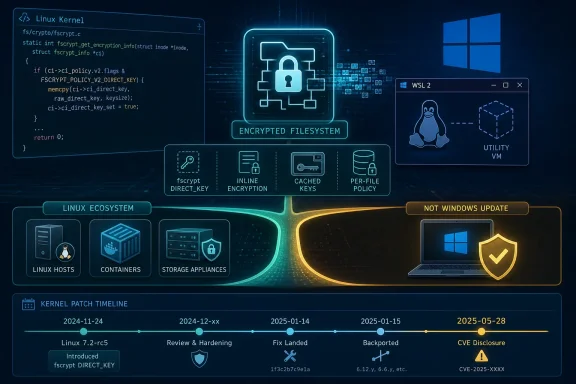 The bug sits in legacy fscrypt DIRECT_KEY handling
fscrypt is Linux’s filesystem-level encryption framework. It is used by supported filesystems including ext4, F2FS, UBIFS, and CephFS, allowing encrypted directories and files to coexist with ordinary unencrypted data on the same mounted filesystem. It is distinct from full-device encryption systems such as BitLocker, LUKS, or dm-crypt: fscrypt operates at the filesystem layer and manages encryption policy on directories and their contents.
CVE-2026-68148 concerns version 1 fscrypt policies using
FSCRYPT_POLICY_FLAG_DIRECT_KEY. In a DIRECT_KEY policy, fscrypt avoids deriving a distinct content-encryption key for every file. Instead, it uses a key directly for a mode, with a per-file nonce incorporated into the initialization vector. The kernel documentation describes that approach as useful for particular modes and inline-encryption scenarios, but it is a narrower deployment than ordinary encrypted-directory use.
The vulnerable code maintains a global table of reusable direct-key objects. Before the fix, the lookup considered the legacy key descriptor, encryption mode, and raw key material. Those comparisons make sense for avoiding duplicate cryptographic setup, but they did not establish whether the key object was prepared in the form required by the filesystem now requesting it.
That omission matters because fscrypt can encrypt file contents in two substantially different ways:
- It can use the regular Linux Crypto API in software.
- It can use inline encryption, where the storage path and compatible hardware perform encryption through the block layer.
A filesystem mounted with the
inlinecryptoption can use the latter route on supported ext4 and F2FS configurations. The same master key, mode, and legacy descriptor can consequently be encountered by filesystems that do not have the same encryption path active.
The missing check was about mount state, not key secrecy
The upstream patch is small — seven added lines and one removed line in
fs/crypto/keysetup_v1.c— but its effect is specific. It makes
find_or_insert_direct_key()verify that a previously cached key is actually prepared for the requesting inode’s selected encryption implementation before reusing it.
In the affected code path, a direct key prepared for software crypto contains a Crypto API transform. A direct key prepared for inline encryption instead contains a block-crypto key. The selection is tied to the inode’s filesystem and mount state, including whether inline encryption has been selected. Reusing an object prepared for the wrong path is therefore invalid even where the nominal master-key descriptor, cipher mode, and raw key bytes match.
The fix does not add a new encryption algorithm, rotate existing fscrypt keys, or alter on-disk ciphertext. It changes the cache-reuse decision so fscrypt allocates and prepares the suitable key object rather than accepting an incompatible existing one. Systems that are not using version 1 DIRECT_KEY policies do not enter this legacy direct-key lookup path.
This is also why treating the issue as a generic “Linux disk encryption vulnerability” would be misleading. The available upstream material does not describe a route to recover a key, decrypt another user’s files, or gain root privileges. It describes a kernel correctness failure in a specialized configuration involving direct-key policy reuse and differing filesystem encryption implementations.
Microsoft’s public record, as supplied with the CVE, does not publish a CVSS score, an affected-kernel list, exploit status, reproduction steps, or a list of distributor backports. No independent outlet appears to have reported an in-the-wild exploit or a demonstrated confidentiality breach as of August 11. Administrators should not fill those gaps with assumptions.
Linux 7.2-rc5 contains the upstream correction, but that is not a fleet answer
The fix was merged into mainline through the fscrypt pull request for Linux 7.2-rc5. Linux 7.2 is still in release-candidate testing; current release reporting points to a likely final release later in August rather than a completed stable release on August 11.
That timing creates an operational split. Developers tracking mainline or testing Linux 7.2 release candidates can identify the fixed code in the July 24 merge. Most enterprise fleets, cloud images, NAS appliances, Android-derived kernels, and long-term-support distributions do not run mainline release candidates. They carry vendor-maintained branches, often with selected backports rather than a wholesale move to a new upstream version.
The upstream merge record does not visibly mark this particular fscrypt patch for the stable kernel trees. That does not prove vendors will not backport it, but it means administrators should not infer that every maintained kernel line has received the correction merely because the CVE now exists or because Linux 7.2-rc5 includes it.
The correct verification question is not “Is our kernel newer than July?” It is whether the supplier’s advisory or source changelog identifies CVE-2026-68148 or the upstream fscrypt change titled “Add missing superblock check in find_or_insert_direct_key().” Kernel version strings alone are especially unreliable on enterprise distributions, where fixes are commonly backported into an older-looking release number.
Windows and WSL administrators should separate the host from the guest
For conventional Windows PCs, servers, and Hyper-V hosts that are not operating a Linux guest with fscrypt, CVE-2026-68148 requires no direct action. BitLocker volumes, Windows NTFS encryption, ReFS, and the Windows kernel are outside the code affected by this CVE.
WSL 2 deserves a more careful distinction. WSL 2 runs a real Linux kernel in a lightweight virtualized environment, so a Linux kernel fscrypt issue can theoretically matter inside a distribution running under WSL. But the exposed configuration remains narrow: the guest would need fscrypt support, a legacy version 1 encryption policy using DIRECT_KEY, and a situation involving the conflicting encryption implementations that the patch distinguishes.
That combination is not typical for ordinary WSL development setups. Most WSL users do not configure fscrypt at all, much less create v1 DIRECT_KEY policies across filesystems with mixed inline-encryption behavior. A developer using encrypted source trees or testing filesystem-encryption features inside WSL should still check the installed WSL kernel and Microsoft’s WSL release notes once Microsoft maps this CVE to a shipped kernel package. The MSRC entry currently does not provide that mapping.
For organizations using Linux virtual machines, Kubernetes nodes, storage appliances, or custom embedded images managed from Windows, the more immediate task is inventory. Identify systems that satisfy all of the following conditions:
- They run a Linux kernel with fscrypt enabled.
- They use fscrypt version 1 policies carrying the DIRECT_KEY flag.
- They use ext4 or F2FS with inline encryption on at least some applicable filesystems, or otherwise mix encryption implementation selection across mounts.
- They rely on a vendor kernel whose advisory has not yet documented a backport for CVE-2026-68148.
If that inventory produces no systems, this CVE is a recordkeeping item rather than an emergency patch event. If it does produce systems, update to the kernel package containing the vendor’s backport when available, or validate the upstream fix in the applicable custom kernel build.
The disclosure is useful, but incomplete for patch management
The strongest finding from the record is the disclosure-to-fix sequencing: Linux mainline carried the fix on July 24, while Microsoft’s CVE record was published on August 11. That is useful for teams already testing Linux 7.2-rc5 or maintaining custom kernels, because they can validate the precise upstream change now rather than waiting for a generalized security bulletin.
But the public material still leaves the operational details that matter most to managed fleets unanswered. There is no listed vulnerable version range, no severity assessment, no exploitability statement, and no confirmed backport matrix for major distributions or Microsoft’s WSL kernel.
For now, CVE-2026-68148 should be handled as a targeted fscrypt configuration fix. Track vendor kernel advisories, verify the backport by commit title or CVE identifier rather than relying on a kernel version string, and do not mistake the appearance of an MSRC CVE entry for evidence that Windows itself needs an emergency update.
