

The NVD entry was published on August 11, 2026, but NVD was returning a Cloudflare 502 Bad Gateway error when checked shortly after publication. That outage matters because it leaves scanners and administrators without NVD’s normal enrichment—such as a CVSS score, mapped affected versions, and references—at the point when a new identifier begins feeding into vulnerability-management systems. The primary kernel record and the upstream patch are sufficient to establish the technical issue, but they do not yet establish a distribution-by-distribution affected-package list.
The flaw was reported by Xiang Mei, with Weiming Shi submitting the repair. Linux 7.2-rc5’s change list independently confirms that the patch was accepted into the mainline release candidate rather than remaining only a mailing-list proposal.
The race is in a specialized TIPC UDP path
TIPC, or Transparent Inter-Process Communication, is a Linux networking subsystem intended for clustered and distributed systems. Most Windows desktops, and most ordinary Linux desktop and server deployments, do not use it. CVE-2026-68323 goes further: it is tied to TIPC’s UDP replicast implementation, a feature introduced by upstream commit ef20cd4dd163, titled “tipc: introduce UDP replicast.”
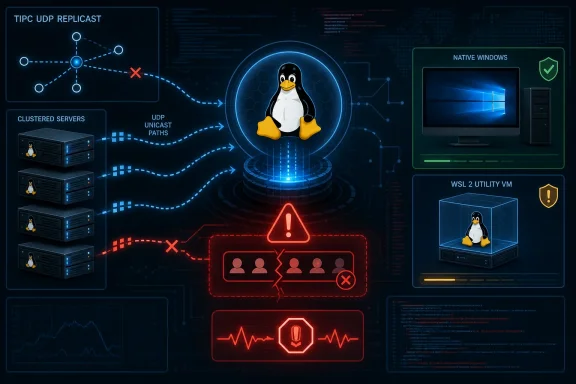
Replicast exists to let TIPC emulate multicast where IP multicast is unavailable—particularly in cloud networks. Instead of emitting one multicast packet, the kernel keeps a list of configured UDP peers and sends a separate unicast copy to each. The feature is operationally useful for clustered software deployed across networks that suppress multicast, but it also added a new shared peer list inside net/tipc/udp_media.c.
The vulnerable code has two independent writers to that list. One path adds a replicast peer after receiving TIPC UDP encapsulation traffic; the other removes all peers while a TIPC bearer is being cleaned up. Both use RCU-aware list operations, but the patch description makes the missing protection explicit: nothing serialized the two writers.
That is a consequential distinction. RCU makes it possible for readers to traverse structures while updates occur, but it does not itself make two concurrent list mutations safe. If an add and teardown delete interleave at the wrong moment, kernel list pointers can be corrupted. The reported failure is a list_del consistency check that becomes a kernel BUG during the bearer-cleanup workqueue path—an availability failure, not a demonstrated information-disclosure or code-execution condition.
Upstream’s fix is small, but the scope is not “every TIPC user”
The accepted fix adds a spinlock, rcast_lock, to the UDP bearer structure. It takes that lock around the RCU list insertion in tipc_udp_rcast_add() and around the deletion loop in cleanup_bearer(). It also changes a read-only traversal from the deletion-safe list iterator to the RCU iterator that better reflects how the code is used.
Eleven lines changed in one source file. That should not be mistaken for a trivial operational issue: kernel list corruption can crash the host or force a restart. But it does sharply bound the trigger conditions.
An affected system needs all of the following:
- It must run a kernel containing UDP replicast, meaning the TIPC change introduced by upstream commit
ef20cd4dd163is present. - TIPC’s UDP media support must be built and available to the running system.
- A UDP TIPC bearer using replicast must be enabled or otherwise reachable in the relevant network namespace.
- A peer-add operation must race with teardown of that bearer.
The upstream report adds an important privilege detail: TIPC version 2 generic-netlink operations lack GENL_ADMIN_PERM, and the bearer can be enabled from an unprivileged user namespace. In a system where unprivileged user namespaces are allowed, that potentially lowers the barrier from “host network administrator” to a local unprivileged user or container workload capable of creating the required namespace and TIPC configuration.
That is the part administrators should investigate rather than relying on the common assumption that TIPC is only an administrator-controlled cluster facility. The bug report does not provide a public exploit, remote attack sequence, CVSS assessment, or evidence of privilege escalation. The substantiated impact is kernel list corruption and a crash in a configuration that uses UDP replicast.
Linux 7.2-rc5 contains the repair; stable backports remain the missing record
Linus Torvalds’ Linux 7.2-rc5 announcement, dated July 26, lists “tipc: serialize udp bearer replicast list updates” among the included changes. The current upstream tree has since advanced through Linux 7.2-rc7, so a fresh build from the mainline tree includes the repair.
What is not available in the published material is more significant for production fleets: there is no confirmed list of stable-series backports, no vendor advisory, and no mapping to Ubuntu, Red Hat Enterprise Linux, SUSE, Debian, Oracle Linux, Amazon Linux, Android, or appliance kernels. A CVE publication on August 11 does not mean those vendors received a fixed package that day—or that their older kernel branches are necessarily vulnerable.
Enterprise Linux vendors routinely backport focused fixes without changing the visible upstream major version. A kernel release string alone is therefore inadequate for closing a finding. A hypothetical vendor kernel based on an older upstream branch may be fixed if it carries the patch; conversely, an apparently newer custom kernel can remain exposed if it omitted the patch.
For Linux teams, the practical verification order is:
- Determine whether the running kernel has
CONFIG_TIPCandCONFIG_TIPC_MEDIA_UDPenabled or available as modules. - Determine whether TIPC is loaded and whether a UDP bearer has been configured.
- Determine whether that bearer uses replicast peers rather than conventional multicast.
- Check the vendor’s kernel changelog or source package for the accepted locking fix, rather than comparing only
uname -rwith Linux 7.2-rc5. - Restrict unprivileged user namespaces where that is compatible with the workload, especially on multi-tenant systems, until the distribution’s patched kernel is deployed.
WSL 2 deserves a separate check, but Windows itself does not need a Windows patch
Windows systems running WSL 1 do not run a full Linux kernel and are outside the scope of this Linux kernel flaw. WSL 2 is different: Microsoft documents that it runs a real Linux kernel inside a managed utility VM, maintained and serviced separately from the Linux user-space distribution installed in WSL.
That means apt upgrade inside Ubuntu, Debian, or another WSL 2 distribution does not by itself prove the WSL kernel is current. Microsoft’s supported servicing command is wsl.exe --update, while wsl.exe --status and uname -r can identify the installed WSL and kernel versions.
Still, an update should not be reported as a confirmed CVE-2026-68323 remediation until Microsoft says it has incorporated this change. Microsoft’s WSL kernel branches can track long-term-support Linux bases and carry their own configuration and backports; the newly published CVE record does not identify a Microsoft WSL kernel version, and no Microsoft advisory has yet tied a WSL build to this issue.
The exposure case is also unusually specific on WSL 2. A default developer distro would need TIPC support, UDP media, an enabled TIPC bearer, and configured replicast peers to reach the vulnerable code. That makes this a poor match for generic “patch every Windows PC now” guidance. It is a better fit for engineering workstations that run container orchestration, clustered middleware, custom network namespaces, or development builds with non-default kernel networking enabled.
The real administrative problem is delayed vulnerability metadata
The NVD page’s 502 error exposes a recurring operational weakness in kernel CVE handling: the identifier can become public before the surrounding ecosystem has answered the questions vulnerability scanners are expected to answer automatically. At publication, the available upstream record identifies the bug mechanism and the mainline fix, while affected release ranges, CVSS data, and distributor status remain absent or inaccessible.
For now, treat CVE-2026-68323 as a targeted Linux availability issue in TIPC UDP replicast deployments, not as a Windows vulnerability. Administrators operating that feature should move to a kernel carrying the locking fix or disable the affected TIPC configuration; administrators who do not use TIPC replicast should document that fact and avoid spending an emergency maintenance window on a component their systems do not expose.