

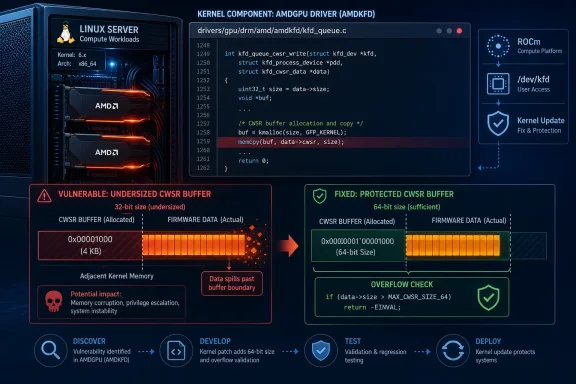
This is a Linux kernel issue, not a vulnerability in the Windows AMD display driver stack. Windows desktop users do not need to replace an Adrenalin driver because of CVE-2026-68257. The Windows-adjacent population that should pay attention is organizations running ROCm workloads on Linux, Linux VMs with AMD GPU passthrough, or custom WSL 2 kernels that expose the relevant AMD KFD code.
The vulnerable calculation can allocate too little memory
The faulty code sits in drivers/gpu/drm/amd/amdkfd/kfd_queue.c, where the kernel prepares buffers for a GPU compute queue. KFD is the kernel-side component used for AMD’s Heterogeneous System Architecture and ROCm-style compute workloads; ordinary desktop graphics can use the broader amdgpu driver without exercising KFD’s queue-management path.
The relevant buffer is the CWSR area, short for compute wave store and resume. AMDGPU’s documentation describes CWSR as the mechanism that lets the GPU preempt work in the middle of a compute wave and later resume it. To do that safely, the driver needs enough memory to retain state for the queued workload.
Before the patch, total_cwsr_size was held in a 32-bit unsigned integer. The kernel calculates it by adding the requested context save-and-restore area to device debug memory, then multiplying the result by the number of XCCs — Accelerator Core Complexes — enabled on the GPU. Large inputs can exceed the maximum 32-bit value, wrap around to a smaller number, and cause the kernel to pin or allocate an undersized buffer.
The dangerous part comes after that allocation decision. Firmware later uses the real, larger CWSR requirement. The kernel patch description states plainly that firmware can overrun the undersized save area. This is therefore more consequential than an incorrect accounting value or a failed allocation: it is a kernel-and-firmware memory-boundary failure during GPU compute queue setup.
The patch changes the total from u32 to u64, explicitly widens the first operand before the addition, and checks the multiplication for overflow. If the multiplication cannot be represented, KFD now rejects queue setup with -EINVAL rather than proceeding with an invalid allocation size. The same correction is applied to both the acquisition and release paths, ensuring the kernel calculates the buffer extent consistently when it pins and later unpins the userspace-backed memory.
The CVE description lags the reviewed patch
There is a small but worthwhile discrepancy between the wording in the newly published CVE and the code that received review on the AMD graphics list. NVD’s description says the fix uses both check_add_overflow() and check_mul_overflow() in kfd_queue_acquire_buffers() and kfd_queue_release_buffers().
That was true of the first version of the patch circulated on July 6. AMD reviewer Philip Yang flagged that the add-overflow check was ineffective once the destination had been made 64-bit: the two source values are 32-bit, so their sum cannot overflow a 64-bit result. The revised patch, posted July 8 and acknowledged by AMDGPU maintainer Alex Deucher, removes the unnecessary addition check, explicitly promotes the addition to u64, and retains the multiplication check.
In practical terms, the final logic is stronger and simpler than the CVE prose suggests. The meaningful risk was the old 32-bit intermediate result; widening the addition prevents that wrap, while the remaining checked multiplication ensures the expanded total still cannot overflow a 64-bit allocation calculation. Administrators should use the final kernel commit or the fixed stable releases as the remediation test, rather than trying to match the CVE text mechanically.
This matters to vulnerability-management teams because CVE descriptions are often copied into scanner rules, ticket summaries, and customer advisories. Here, the flaw description is sound, but the implementation detail is a snapshot of an earlier patch revision. It does not change the patch requirement, but it does mean the CVE entry should not be treated as a line-for-line representation of the code eventually accepted upstream.
The published version range needs careful interpretation
NVD lists three stable-version remediation points: Linux 6.12.101, 6.18.42, and 7.1.6. It also identifies Linux 7.2-rc4 as the upstream development point containing the original fix. The record provides four stable commit references, which is consistent with the fix having been carried into maintained branches rather than landing solely in a future mainline release.
The entry’s semantic-version fields say versions below each fixed point are affected. That shorthand is useful for finding kernels that need review, but it should not be read as proof that every old Linux kernel is exposed. The raw affected Git ranges begin at the generic Linux repository baseline commit, an artifact that appears in kernel CVE records even when a specific driver and vulnerable calculation did not exist in early kernel generations.
The actual scope is narrower:
- Systems need the AMDGPU KFD code present and enabled, because the vulnerable file is
kfd_queue.c. - Systems need a workload that creates the affected compute queues and supplies a sufficiently large context-save area in combination with the GPU’s debug-memory requirement and XCC count.
- Hardware and software using ROCm, HSA queues, accelerator workloads, or virtualized AMD GPU compute are the relevant operational population.
A laptop running a normal Linux desktop on Radeon graphics is therefore not automatically in the same risk category as a multi-accelerator ROCm server. It may have the amdgpu module loaded, but that fact alone does not establish that KFD compute queues are enabled or that the overflow condition is reachable. Conversely, a compute node should not dismiss the CVE merely because the triggering values appear unusually large: high-end and partitioned accelerator configurations are exactly where multiplying per-device requirements by multiple compute complexes stops being theoretical.
NVD has not assigned a CVSS score, vector, or CWE classification as of August 11. There is also no public exploit report or downstream vendor bulletin specifically describing exploitation of CVE-2026-68257. That absence should prevent exaggerated claims about privilege escalation or data exposure; the public record establishes an undersized firmware-accessed buffer, not a demonstrated end-to-end exploit chain.
What Linux and WSL administrators should do now
First, check kernel versions on systems that run AMD compute jobs. uname -r establishes the running kernel release, but package versions and vendor backports matter more than a simple upstream comparison on enterprise distributions. A vendor kernel with a lower-looking release number may already include the stable commit, while a custom image based on a nominally newer tree may lack it.
Second, determine whether the affected subsystem is in use. On Linux hosts, inspect whether the amdgpu and amdkfd functionality is enabled, whether /dev/kfd is available, and whether the machine runs ROCm, HSA applications, GPU compute containers, or virtual machines with AMD GPU passthrough. A workload inventory is more useful than a broad “all AMD graphics systems” alert.
Third, update through the distribution or appliance vendor once a package containing the relevant backport is available. For self-managed kernels, take the stable patch identified by the kernel project and verify that the final version uses a 64-bit total_cwsr_size plus checked multiplication in both kfd_queue_acquire_buffers() and kfd_queue_release_buffers().
WSL 2 deserves a separate check rather than an assumption. Microsoft maintains a distinct WSL Linux kernel branch, currently based on the 6.18 series, and its source repository confirms that WSL uses its own kernel configuration and release process. NVD marks 6.18.42 as fixed upstream, but that does not by itself prove that a particular Microsoft WSL kernel build includes the backport or enables the AMD KFD path. Administrators using a stock WSL kernel should watch Microsoft’s WSL kernel servicing; administrators using kernel= in .wslconfig must patch their custom image themselves.
The practical consequence is straightforward: patch Linux AMD compute hosts promptly, validate vendor backports by commit rather than only by version strings, and keep this CVE out of Windows GPU-driver remediation queues. The technical defect is real, but its exposure is concentrated in AMD KFD compute deployments—not the ordinary Windows desktop graphics stack.