

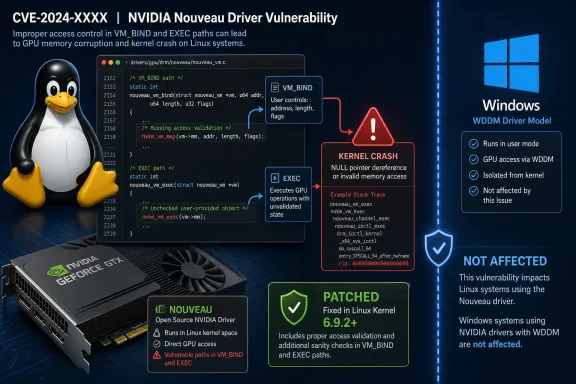
drivers/gpu/drm/nouveau/nouveau_uvmm.c and nouveau_exec.c, and systems running Nouveau on Linux should move to a kernel release that includes the correction: 6.6.148, 6.12.101, 6.18.42, 7.1.6, or Linux 7.2-rc1 and later.The CVE was added to the NVD on August 10, 2026, nearly seven weeks after the patch entered the DRM fixes pull request for Linux 7.2. The NVD record draws from kernel.org’s CVE data and does not yet assign CVSS v3 or v4 scores. There is also no published exploit and no evidence in the public record, as of August 11, of exploitation in the wild.
For administrators, the practical action is straightforward: update a Linux system that uses Nouveau if it is on an affected kernel branch. The more important qualification is that this is a narrow Nouveau userspace API error path, not a defect triggered by ordinary desktop rendering, an NVIDIA proprietary driver update, or Windows’ WDDM stack.
The error path freed an error pointer as memory
The bug sits in two functions that copy synchronization-object arrays supplied by a userspace graphics client: nouveau_uvmm_vm_bind_ucopy() for DRM_NOUVEAU_VM_BIND, and nouveau_exec_ucopy() for DRM_NOUVEAU_EXEC.
Both interfaces are part of Nouveau’s modern GPU virtual-memory and command-submission API. VM_BIND lets a userspace driver establish mappings in GPU virtual address space, while EXEC submits GPU work; both can take synchronization objects so applications can express dependencies between jobs. The Linux kernel’s Nouveau uAPI documentation describes these ioctls as asynchronous-capable paths intended to coordinate mappings and execution through sync objects.
The vulnerable code allocates memory for the input-sync object array and then for another structure. Its cleanup labels were placed in the same order as allocation rather than in reverse. That sounds cosmetic, but C error handling based on goto labels depends on the fall-through sequence being exact.
On a failed u_memcpya() call while copying the in_sync.s data, the code jumped to a label that freed an earlier allocation, then fell through to a second cleanup operation. At that point, args->in_sync.s still held Linux’s encoded ERR_PTR() failure value rather than a valid allocation or a null pointer. The subsequent u_free() reaches kvfree(), which does not treat that encoded error pointer as null. The kernel can then dereference it and trigger an oops.
The converse failure path was wrong too. If copying out_sync.s failed, the function headed directly to a later cleanup label, skipping a prior allocation and leaking memory. The fix is small—four changed lines across the two source files in the DRM pull request—but it repairs two materially different outcomes: one can crash the kernel, while the other slowly loses memory whenever that specific failure path is exercised.
A kernel oops is the established impact; privilege escalation is not
The NVD wording confirms that the bad cleanup can “result in a kernel oops.” That supports treating the issue as a local availability and stability concern on an affected Nouveau machine. It does not establish arbitrary code execution, data disclosure, or privilege escalation.
That difference is important because the CVE identifier alone may cause vulnerability scanners to classify this alongside broader Linux graphics vulnerabilities. The underlying defect is reachable from an ioctl-facing code path, but the published description ties the crash to failure handling during userspace-array copying. Neither the CVE record nor the original DRM fixes pull request supplies a proof of concept, attack prerequisites, or an exploitability analysis. NVD has deliberately left severity unassessed rather than assigning even a preliminary vector.
The record also does not say that a normal application can reliably force the needed allocation or copy failure under ordinary conditions. Security teams should patch it, but should not overstate the evidence as a confirmed local-root flaw. At present, the defensible assessment is an unscored kernel crash condition in a specific Nouveau submission path, plus a separate memory leak.
The affected range begins with Linux 6.6
The NVD’s kernel.org-supplied affected-version data identifies Linux 6.6 as the first affected upstream release. Kernels earlier than 6.6 are listed as unaffected, which is a useful constraint: this is not a decades-old flaw in every Nouveau deployment.
The listed fixed releases are:
- Linux 6.6.148 fixes the long-term 6.6 branch.
- Linux 6.12.101 fixes the 6.12 stable branch.
- Linux 6.18.42 fixes the 6.18 stable branch.
- Linux 7.1.6 fixes the 7.1 stable branch.
- Linux 7.2-rc1 contains the upstream/mainline correction.
The patch was included in the June 25 DRM miscellaneous fixes request sent for Linux 7.2, where maintainer Maarten Lankhorst summarized it as fixing “error handling paths in nouveau.” That understated summary is typical of kernel pull requests, but the source-level explanation attached to the CVE makes clear why the change later received a CVE: a failed copy could pass an invalid error-encoded pointer into a freeing function.
There is a timing wrinkle worth noting for inventory teams. The patch landed upstream in late June, while the CVE record was published on August 10. A distribution kernel can therefore be protected even if its security tracker has not yet surfaced CVE-2026-68271, provided the vendor backported the relevant commit. Conversely, a version number alone is not sufficient for custom kernels: downstream maintainers may have backported the patch outside the exact upstream stable release that NVD lists.
Check the running kernel, not just the distribution name
Administrators managing Linux endpoints, VDI hosts, developer workstations, or GPU-capable build systems should verify the actual kernel version with:
uname -r
A system on an affected upstream branch needs its distribution’s kernel update if it is below the relevant fixed point. For a custom-built kernel, image, appliance, or immutable host, the reliable check is whether the source includes the fix for drm/nouveau: fix reversed error cleanup order in ucopy functions, originally authored by Junrui Luo.
Nouveau’s presence also matters. This CVE concerns the open-source Nouveau DRM driver, not NVIDIA’s proprietary Linux kernel module. A Linux host using the proprietary NVIDIA driver does not execute these Nouveau functions. Likewise, systems with Nouveau disabled or blacklisted do not expose this particular driver path, though leaving an old vulnerable kernel in place is still poor patch hygiene if configurations can change.
The affected interfaces are also newer and more specialized than the basic display stack. The Nouveau documentation identifies VM_BIND and EXEC as the interfaces through which a userspace driver manages GPU virtual-address mappings and submits work. This makes GPU-enabled developer machines, testing environments, and systems using a compatible modern userspace stack more relevant than a generic Linux server with an unused NVIDIA adapter.
Windows and ordinary WSL installations are outside the direct scope
Windows itself is not affected by CVE-2026-68271. The flaw is Linux kernel code in Nouveau, whereas Windows uses the DirectX graphics kernel subsystem and vendor WDDM drivers. Updating NVIDIA’s Windows driver will not address this CVE because it is not the component that contains the bug.
A standard WSL GPU-compute setup is also not the normal Nouveau scenario. Microsoft’s WSL documentation describes GPU acceleration through its WSL graphics integration and the Windows-host GPU driver, including NVIDIA’s CUDA-enabled WSL driver path. That is distinct from booting Linux on hardware and loading Nouveau against an NVIDIA GPU.
There are edge cases: a WSL instance using a custom kernel, a nested Linux virtual machine with GPU passthrough, or a dual-boot workstation can certainly have a Linux Nouveau exposure alongside Windows. In those cases, patch the Linux kernel where Nouveau actually runs. But an enterprise endpoint team should not create a Windows Update response plan for this CVE; the remediation belongs with Linux kernel maintenance.
The concrete threshold is now clear: Linux systems using Nouveau should be on 6.6.148, 6.12.101, 6.18.42, 7.1.6, a patched vendor kernel, or newer mainline code. For Windows-only fleets, CVE-2026-68271 is an inventory note rather than an actionable Windows security incident.