
The change affects
drivers/gpu/drm/bridge/cadence/cdns-dsi-core.c, the driver behind
CONFIG_DRM_CDNS_DSI. Its practical audience is narrow: embedded Linux systems with a Cadence Display Serial Interface controller wired to a MIPI DSI panel, including platforms using the
cdns,dsior
ti,j721e-dsidevice-tree bindings. It is not a Windows security update, and it does not describe a flaw in Windows graphics drivers, typical x86 laptop panels, or a standard WSL installation.
NVD published the record on August 10, 2026, based on Linux kernel project data. The important detail missing from a superficial CVE scan is that the reported failure is a kernel warning caused by a duplicated power-down operation. The record does not claim code execution, information disclosure, privilege escalation, memory corruption, or a denial-of-service condition reachable by an untrusted local or remote user.
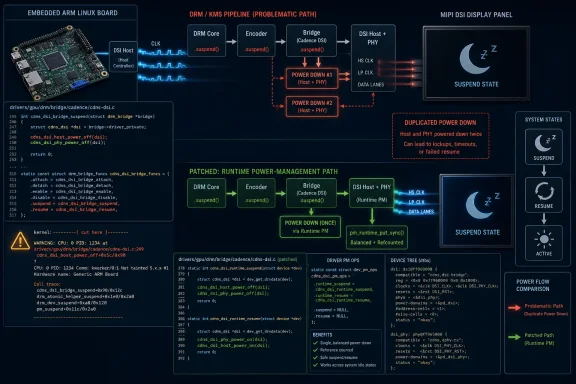 The bug is a duplicate clock shutdown during suspend
The Cadence DSI driver formerly used
UNIVERSAL_DEV_PM_OPS(), a deprecated kernel macro that attaches the same callbacks to both runtime power management and system sleep. That sounds harmless until the DRM subsystem’s own shutdown sequence is considered.
When Linux enters system suspend, the DRM display pipeline disables the bridge through its normal bridge hooks. Those hooks release the device’s runtime-PM usage, which can run the Cadence driver’s runtime suspend routine and turn off its clocks. Because the old macro also registered that routine for system sleep, the device-power-management path later invoked the same clock shutdown again.
The resulting trace is explicit: the kernel’s clock framework reports that a clock is “already disabled,” and the stack leads through
cdns_dsi_suspend()during
dpm_suspend(). The NVD description calls this a WARN condition, which is a diagnostic signal for kernel developers and system integrators. It is not, on the published record, evidence that the second disable produces a display compromise or a security boundary bypass.
Linux DRM mailing-list discussion shows why the patch ended up smaller than an early proposed replacement. Vitor Soares initially suggested moving to runtime PM helpers that also coordinate system suspend and resume. Tomi Valkeinen, a DRM maintainer and reviewer, pushed back on retaining system-sleep callbacks in a bridge driver at all: the normal DRM pipeline already disables bridges before the generic system suspend phase, and an additional driver-level suspend path can conflict with that ordering.
The accepted approach therefore replaces
UNIVERSAL_DEV_PM_OPS()with
RUNTIME_PM_OPS(). That change leaves the Cadence driver responsible for runtime power management while leaving whole-system display shutdown to the DRM framework’s bridge enable and disable flow. The fix removes duplicated ownership of the same hardware clocks rather than adding a second layer of suspend protection.
That distinction should govern incident handling. A log entry from an affected kernel may be noisy and may indicate an imperfect suspend sequence, but the published material does not support treating this CVE as an exploited security flaw.
Cadence DSI hardware, not every Linux graphics stack, is in scope
The affected driver is a MIPI DSI bridge implementation intended to be embedded in system-on-chip designs. The Linux Kernel Driver Database identifies it as the “Cadence DPI/DSI bridge” and shows that it depends on Open Firmware device-tree support. It is associated with the generic
cdns,dsicompatible and, in the newer split driver arrangement, TI’s J721E DSI wrapper.
That hardware profile sharply limits exposure. MIPI DSI is common in phones, tablets, single-board computers, industrial panels, automotive systems, and embedded ARM products. It is not the display transport normally used by a conventional Windows desktop, an x86 workstation, or a laptop GPU driving an eDP or HDMI panel.
Administrators should also avoid treating the word “Cadence” as a complete hardware inventory. A system can contain Cadence intellectual property or a Cadence-related component without loading
cdns-dsi. Conversely, an embedded Linux appliance can be exposed even if its product documentation never mentions Cadence, because the relevant evidence is in the kernel configuration and device tree.
The driver first appeared in mainline Linux 4.18, which explains NVD’s broad affected starting point. But the code has been reorganized over time: older kernels place it under
drivers/gpu/drm/bridge/cdns-dsi.c, while newer trees use the
drivers/gpu/drm/bridge/cadence/directory named in CVE-2026-68280. That file move matters for downstream maintainers comparing vendor kernels against the CVE record. Searching only for the current path can incorrectly suggest an older long-term-support image is unaffected.
For WindowsForum readers, the immediate practical implication is straightforward. A Windows machine that merely runs WSL does not gain a physical Cadence DSI bridge by running a Linux userspace. A dual-boot or embedded Windows/Linux project built around a TI or similar ARM SoC can have the relevant hardware, but the remediation belongs in the Linux kernel supplied for that device, not in Windows Update.
NVD’s fixed-version record has one gap administrators should not ignore
The NVD record identifies Linux kernels beginning at 4.18 as affected, then marks fixed stable-series cutoffs at Linux 6.6.148, 6.12.101, 6.18.42, and 7.1.6, with the upstream fix present by Linux 7.2-rc1. Those versions are the cleanest upgrade targets for maintainers tracking kernel.org stable releases.
The record also includes five kernel.org stable commit references. That is useful for vendors whose kernel packages use custom version strings, because a distributor can backport the patch without changing its public kernel line to one of the NVD-listed versions. In that situation, package version alone is insufficient evidence; the decisive test is whether the downstream source contains the replacement of the universal PM macro with the runtime-only PM macro.
There is, however, a reporting discrepancy worth flagging. The patch discussion explicitly requested stable consideration for the 6.1 series, but NVD’s affected-version section does not provide a fixed 6.1.y release. That does not prove every 6.1-derived vendor kernel remains vulnerable—vendors may have backported it independently—but it does mean a 6.1 version number cannot be treated as cleared by the public CVE record.
This is exactly where automated vulnerability scanners can overstate or understate the operational problem. A scanner that sees “Linux kernel CVE” and an affected version range may elevate it alongside remotely reachable flaws. A scanner that sees a vendor kernel with an unfamiliar suffix may miss a backport. Neither result answers the engineering question: does this image build the Cadence DSI driver, does the deployed board expose the matching DSI hardware, and does the source include the PM-operations change?
What embedded Linux maintainers should check
Teams maintaining DSI-equipped products should first identify whether the driver is present.
CONFIG_DRM_CDNS_DSImay be built into the kernel or compiled as the
cdns-dsimodule, so
lsmodalone is not enough. Checking the running kernel configuration, the device tree’s compatible strings, and the installed module metadata will produce a more reliable answer.
A focused review should establish all of the following:
- The target’s kernel configuration enables
CONFIG_DRM_CDNS_DSI, either built-in or as a module. - The board device tree includes a Cadence DSI node such as
cdns,dsior the TI J721E-specific wrapper. - The deployed kernel incorporates the stable fix or changes the driver’s PM declaration to runtime-only callbacks.
- Suspend and resume testing no longer emits the “already disabled” clock warning through
cdns_dsi_suspend().
Do not use the absence of a visible warning as proof that the code is fixed. An affected driver only produces the warning along the relevant runtime-suspend-plus-system-suspend path, and an appliance that never enters system sleep may never expose it in logs. Source or package verification remains the stronger control.
CVE-2026-68280 should be tracked as a kernel reliability and power-management correction for a defined embedded display path. Organizations shipping Cadence DSI hardware should adopt a patched stable kernel or backport the small driver change, especially where suspend/resume is part of normal device operation. Everyone else should resist turning an unscored clock-framework WARN into a broader Windows or Linux desktop security emergency.