

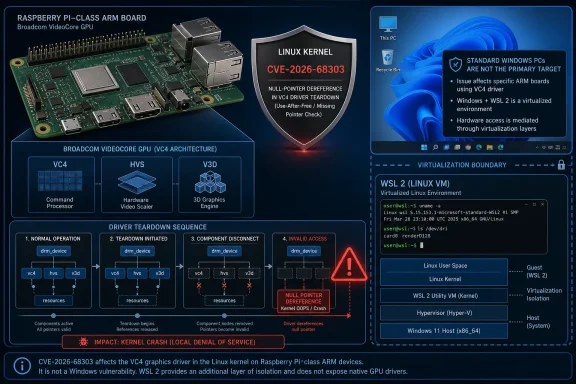
vc4-drm master driver is removed before its dependent vc4_hvs and vc4_v3d drivers—not a newly documented route to compromise ordinary Windows PCs.The NVD published the record on August 10, 2026, using the kernel.org description and two stable-kernel commit references. Its entry has no CVSS score, no CWE classification, and no documented exploitation scenario as of August 11. That absence is important: the public record confirms a real memory-lifetime defect, but it does not support treating the CVE as a remotely exploitable or broadly applicable Linux privilege-escalation issue.
For Windows users, the immediate exposure is narrower still. Microsoft’s WSL documentation confirms that WSL 2 runs a Microsoft-built Linux kernel in a managed virtual machine, but a normal WSL installation on an x86 Windows machine does not provide the Broadcom VC4 hardware and platform-driver arrangement involved here. Administrators should focus instead on physical Raspberry Pi deployments, ARM appliances using the upstream VC4 DRM stack, and custom kernels where the affected drivers are enabled and bound to matching hardware.
The crash happens during driver removal
The defect is in the Linux Direct Rendering Manager, or DRM, implementation for the VC4 graphics architecture. VC4 is the display driver, HVS is the Hardware Video Scaler component, and V3D covers the 3D GPU block. These components are linked through Linux’s component-driver framework, where a master driver coordinates dependent drivers during initialization and removal.
According to the kernel.org change summarized by NVD, the vc4_hvs_unbind() and vc4_v3d_unbind() functions previously called dev_get_drvdata(master) to recover the master driver’s private data during unbind. The order of removal makes that unsafe: vc4-drm can be removed before either dependent driver. By the time HVS or V3D executes its unbind path, the master’s driver data may already be gone.
The code then dereferences a null or stale pointer. In plain operational terms, the machine can hit an oops or panic while the graphics subsystem is being dismantled. The fix avoids reconstructing state from the master device altogether and uses the data pointer the component framework already passes into the unbind callback.
That is a small code change with a meaningful reliability consequence. A display driver teardown defect tends to surface during device removal, module unloading, power-management transitions, hardware reconfiguration, or shutdown paths—not while a system is simply rendering a desktop. The CVE language says the change avoids potentially freed memory, which is why it received a vulnerability identifier, but the record does not show an attacker-controlled trigger or a demonstrated information-disclosure, code-execution, or privilege-escalation outcome.
NVD’s version data is less clear than its description
The NVD record says Linux kernels from version 4.4 are affected, while marking versions before 4.4 as unaffected. It also lists Linux 7.1.6 and later 7.1 releases as unaffected, with Linux 7.2-rc5 identified as the original fixed mainline release.
That creates an awkward but common issue in Linux-kernel CVE tracking: the upstream version range is not a deployment-ready patch matrix. Kernel fixes are routinely backported into supported stable and vendor-maintained branches. A distribution may be protected with a kernel version number that looks “older” than the upstream fixed version, while another system carrying a newer-looking version may lack the specific backport.
NVD lists two stable-tree commits for CVE-2026-68303, rather than one universal package update. The record does not identify the corresponding released stable-kernel versions in the reference text, nor does it map the fix to Ubuntu, Debian, Fedora, Red Hat Enterprise Linux, SUSE, Raspberry Pi OS, or Microsoft’s WSL kernel packages. As of August 11, no distributor advisory or independent incident report was readily available to fill in those deployment details.
That gap should change the response. Do not use uname -r alone to declare a device safe or vulnerable. On managed Linux systems, the decisive question is whether the distribution’s kernel changelog, security tracker, or vendor advisory says that the VC4 unbind fix has been backported.
Raspberry Pi fleets deserve a targeted check
The relevant files named in the CVE record are drivers/gpu/drm/vc4/vc4_hvs.c and drivers/gpu/drm/vc4/vc4_v3d.c. Those files point directly at systems using the upstream VC4 graphics path. A headless Raspberry Pi may have the driver present without exercising every display feature, while a desktop, kiosk, signage player, or embedded device using HDMI, KMS, 3D acceleration, or a custom display configuration is more likely to have the VC4 stack active.
The most useful first check is whether the VC4 module is actually loaded:
lsmod | grep -E '^(vc4|v3d)\b'
A positive result does not prove a system is exploitable, and a negative result does not prove the driver is absent—it may be compiled into the kernel rather than loaded as a module. It does establish whether the device is using the driver family named by the CVE.
For fleet operations, the better process is straightforward:
- Confirm whether the kernel configuration includes
CONFIG_DRM_VC4,CONFIG_DRM_VC4_HDMI, or the V3D driver used by the device. - Check the distribution’s kernel package changelog for the upstream subject line, “drm/vc4: hvs/v3d: Fix null dereference in unbind,” or for CVE-2026-68303 itself.
- Apply the vendor-provided kernel update once available rather than attempting a manual patch on a production appliance.
- Reboot or otherwise load the updated kernel; installing a package alone does not replace the running kernel.
- Avoid treating ordinary graphics workloads as a reproduction test, because the reported failure belongs to the driver-removal path.
The last point is easy to miss. An unaffected-looking desktop session says very little about a bug that manifests after the master device has been removed and a dependent component begins cleanup.
WSL 2 is not the operational target
Windows administrators may see “Linux kernel CVE” in endpoint reporting and assume that WSL 2 needs urgent remediation. Microsoft confirms that WSL 2 uses a real Linux kernel in a lightweight VM, so a kernel CVE can sometimes matter to Windows estates. This one is hardware-specific enough that the distinction matters.
CVE-2026-68303 concerns the VC4 DRM master and its HVS/V3D component drivers. Standard WSL 2 instances on Windows PCs do not expose a Raspberry Pi’s Broadcom VideoCore display subsystem to that managed Linux VM. WSL’s virtualized graphics and device model are a different path from a physical VC4 platform driver being unbound.
That does not excuse organizations from maintaining WSL kernels generally. It means this CVE should not be elevated into a Windows endpoint emergency solely because WSL 2 contains Linux code. A custom WSL environment, an ARM development VM, or a Raspberry Pi used as a build runner deserves an inventory check; a conventional Windows 11 workstation running Ubuntu under WSL 2 does not match the affected hardware chain described by kernel.org.
Treat it as a patch-and-verify issue, not an incident
CVE-2026-68303 is a legitimate kernel bug in code that can touch freed state during driver teardown. The fix removes an unsafe lookup and replaces it with data already supplied by the framework, which is the correct lifetime boundary.
But the published evidence currently supports a constrained conclusion: this is primarily a VC4 graphics-stack stability and memory-safety fix for systems with relevant Broadcom hardware, with no NVD severity assessment and no public evidence of exploitation. Raspberry Pi and embedded-Linux operators should track their vendor’s kernel package for the backport; Windows and standard WSL 2 administrators can keep it in normal kernel-maintenance triage rather than treating it as a host compromise event.