
That missing data changes the immediate response. This is a Linux kernel driver issue, not a Windows vulnerability: Windows installations using Qualcomm Wi-Fi hardware are not affected by the ath11k module. The relevant Windows population is narrower—machines running Linux directly, Windows systems using a Linux VM with PCIe Wi-Fi passthrough, and a small number of advanced test environments where the guest owns a supported Qualcomm radio. Standard WSL 2 deployments ordinarily expose a virtual network adapter to Linux rather than loading the host’s ath11k Wi-Fi driver.
The CVE page was marked published at 1:07 a.m. Pacific time on August 11, or 08:07 UTC, roughly three and a half hours before the NVD request failed. A fresh record can take time to acquire enrichment data, but this one currently lacks even the primary details needed to determine whether a normal distribution update contains the fix. The correct operational position is to track it, not to declare systems vulnerable or patched based on the title alone.
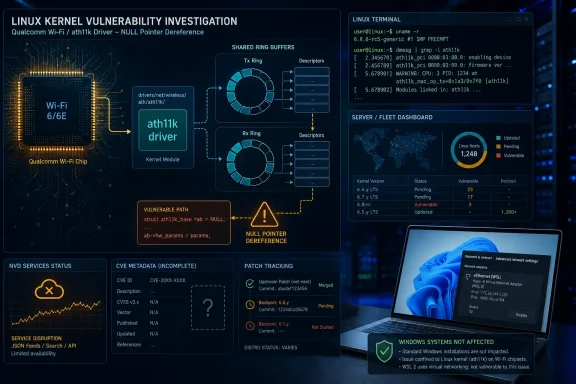 The vulnerable path is a hardware ring-access helper
ath11k_hal_srng_access_begin()is part of the Qualcomm ath11k Wi-Fi driver’s HAL layer. SRNG refers to the shared ring structures used to exchange descriptors and status information between the host driver and wireless hardware or firmware. Before ath11k reads or processes entries, this helper refreshes cached ring pointers and, for cached rings, may prefetch the next descriptor.
That location matters because it sits in packet-processing paths, not in a user-facing configuration interface. A NULL pointer dereference there is most likely to produce a kernel warning, driver reset, loss of wireless connectivity, or a system crash. It does not, by itself, establish remote code execution, privilege escalation, information disclosure, or an attacker-controlled crash.
The published title does not say which pointer can be NULL, what state leaves it uninitialized, or whether an attacker can drive the condition. Those distinctions are central. A NULL access caused only by malformed firmware initialization, device reset, suspend/resume timing, driver unload, or an unsupported hardware path is an availability and reliability defect with a very different response priority from one reachable by nearby Wi-Fi traffic.
No public proof of concept, exploit report, severity score, or attack prerequisites were available alongside the identifier at publication. Until the CVE record links a patch or the Linux wireless maintainers publish the underlying change, claims that this is remotely exploitable would be speculation.
Do not confuse this with earlier ath11k fixes in the same function
The function named in CVE-2026-68362 has appeared in several earlier ath11k investigations, but the matching function name does not make those fixes the same vulnerability.
Linux stable maintainers carried a 2025 change from Johan Hovold that added a memory barrier in
ath11k_hal_srng_access_begin(). That patch addressed stale descriptor reads on weakly ordered architectures such as Arm64 by ensuring destination-ring descriptors were read only after the corresponding head pointer had been observed. It was a ring-buffer ordering and corruption fix, not a NULL-dereference correction.
Another distinct issue, assigned CVE-2024-58096, added
srng->lockcoverage to ath11k monitor-mode paths. The Linux Wireless patch discussion described monitor-mode callers using SRNG helpers without the lock expected to protect ring state. That was a concurrency and lock-dependency problem, again separate from a pointer dereference in the helper itself.
There is also a much older ath11k crash trace in which
ath11k_hal_srng_access_begin()appeared in the call stack during module removal after firmware loading failed. The actual corrective change in that case switched the MHI power-up flow so errors were checked. A call stack identifies where a crash became visible; it does not necessarily identify the faulty line or the eventual fix.
This history is why mapping CVE-2026-68362 to an existing stable commit would be a mistake. The published title is close enough to prior ath11k work to invite false matches, but no primary record presently ties the new CVE to those patches.
The missing affected-version range blocks normal patch verification
For Linux kernel CVEs, “fixed” is rarely synonymous with “running the newest upstream kernel.” Enterprise and distribution kernels backport individual commits, sometimes carrying a security fix in a package whose headline version is years behind the upstream release that first received it. Ubuntu, Red Hat, SUSE, Debian, Android common-kernel trees, appliance vendors, and managed-device providers can all ship differently patched ath11k code.
CVE-2026-68362 presently provides none of the information a security team needs for an authoritative check:
- It does not identify the upstream commit that introduced the defect or the commit that fixes it.
- It does not state whether the flaw applies to PCIe, AHB, SDIO, USB, or platform-specific ath11k transport paths.
- It does not identify the Qualcomm chip families or firmware combinations involved.
- It does not specify whether monitor mode, suspend/resume, interface teardown, recovery, or ordinary receive traffic is required.
- It does not provide an upstream fixed version or any distribution package advisories.
That leaves vulnerability scanners in an awkward position. A scanner that simply matches the CVE title to the presence of
ath11kwill over-report. A scanner that ignores the issue until NVD adds CPE data could under-report later. The better temporary control is asset identification: determine where ath11k is actually loaded, preserve the exact kernel package and build information, and watch the distribution’s kernel-security notices for a package advisory that explicitly names CVE-2026-68362.
On a Linux endpoint,
lspci -nnk,
lsmod,
modinfo ath11k_pci, and the active kernel release can establish whether the driver is in play. On managed fleets, this is a targeted hardware-and-module inventory exercise—not a reason to push unrelated Windows updates or to broadly disable Qualcomm wireless adapters.
Windows and WSL administrators have limited exposure
For conventional Windows 10 and Windows 11 systems, the practical action is none. Microsoft’s Wi-Fi stack uses Windows drivers, and Linux’s ath11k source code is not part of the normal Windows networking path. An installed Qualcomm Wi-Fi adapter does not create exposure to a Linux ath11k CVE unless Linux is actually controlling that adapter.
WSL 2 deserves a precise distinction. Most WSL networking is virtualized through Hyper-V networking components, so a Linux distribution inside WSL sees a virtual Ethernet-style interface rather than direct ownership of a Qualcomm radio. The ath11k kernel module therefore is generally irrelevant to ordinary WSL use, including developer workstations that happen to have Qualcomm wireless hardware in the host.
The exception is direct hardware assignment. A Linux virtual machine with supported PCIe passthrough or another arrangement that gives the guest direct access to a compatible Qualcomm wireless device may load ath11k and should be included in the Linux review. Those configurations are uncommon on consumer Windows systems but can exist in lab, appliance, and specialized test environments.
Wait for the patch identifier, then verify by vendor package
The immediate consequence of CVE-2026-68362 is a tracking gap, not a proven emergency patching event. The NVD outage is real enough to prevent a normal detail-page lookup, but it does not supply the missing technical evidence. The authoritative next artifacts are the CVE Record entry, the upstream Linux Wireless or kernel commit naming the NULL check, and distribution advisories that translate the fix into installable kernel package versions.
Until then, teams should record the CVE against Linux assets that load ath11k, avoid assigning a severity based solely on the phrase “NULL pointer dereference,” and resist substituting earlier SRNG locking or memory-barrier patches for the unverified fix. The first vendor advisory that names both CVE-2026-68362 and a kernel package version will be the point at which this becomes an actionable patch-management item.
