
That gap is more consequential than it sounds. Windows Package Manager is the technology behind winget, but its footprint extends beyond an interactive command-line tool: Microsoft’s public WinGet repository describes a CLI, PowerShell modules, and a COM API. It is commonly delivered through the Microsoft.DesktopAppInstaller package and can be used by end users, endpoint-management systems, developer workstations, automation, and configuration-management flows. An elevation-of-privilege issue in that path is therefore a post-compromise concern: an attacker or untrusted process that already has a foothold could potentially seek greater local rights.
Microsoft has not said that CVE-2026-68821 is being exploited, publicly disclosed before patching, or remotely reachable. It has also not published proof-of-concept code or a technical description of the flaw. Those omissions mean defenders should avoid inflating the issue into a wormable or initial-access vulnerability. But they also should not dismiss it simply because it lacks a Windows cumulative-update KB number.
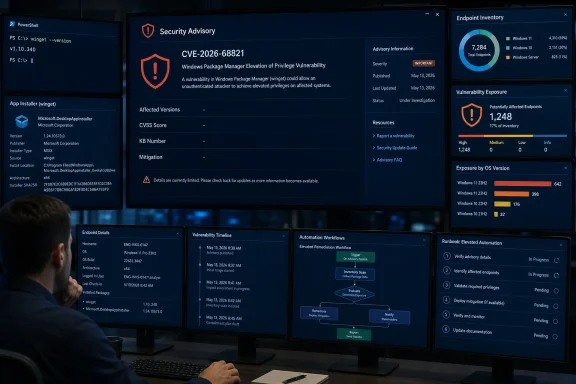 The advisory does not identify the remediation vehicle
The central operational problem is that Microsoft’s CVE page names the affected product as Windows Package Manager but does not publicly map the vulnerability to a version, an App Installer package update, or an operating-system security update. That is unusual enough to change the response plan.
Windows servicing teams are accustomed to matching a CVE with a monthly cumulative update, installing the relevant KB, and checking an OS build number. That approach does not work here because the advisory does not name a KB. A device can be fully current on Windows Update and still have an App Installer or WinGet servicing question that Windows Update reporting alone cannot answer.
Microsoft’s public winget-cli release history also does not provide a clean answer. The latest stable release shown there is Windows Package Manager 1.29.280, published June 24, 2026, weeks before the August 11 advisory. Its release notes list feature and bug-fix work, including changes around configuration elevation validation, but do not mention CVE-2026-68821. The timing does not establish that 1.29.280 fixes the vulnerability, nor does it establish that it is vulnerable. It establishes something narrower and important: the public release notes are not currently a remediation record for this CVE.
That leaves several possibilities: Microsoft may have addressed the flaw through a Microsoft Store-serviced App Installer update; it may have shipped a silent servicing change; the affected code may not be the public WinGet CLI release line; or the full affected-product and fixed-version information may simply not yet be exposed in the advisory. Microsoft has not distinguished among those possibilities.
A WinGet version check is useful, but it is not proof of safety
Administrators should inventory Windows Package Manager now, beginning with:
winget --version
That command is worth running across managed developer and power-user endpoints, but it must not be treated as a vulnerability scanner. The version it returns identifies the locally installed CLI, while CVE-2026-68821 could concern another component delivered with App Installer or a code path used through the PowerShell module or COM interfaces.
A more complete local review should record the installed App Installer package identity and version alongside the winget result. In environments where the Microsoft Store is disabled, app updates are deferred, or App Installer is provisioned through an enterprise image, administrators should pay particular attention to devices that do not automatically receive Store updates. Those systems are the likeliest to remain on a stale package after Microsoft clarifies the fixed build.
The practical issue is not merely whether winget is installed. It is where privileged package-management activity occurs. Build runners, shared admin workstations, software-deployment servers, self-service portals, and endpoint-management scripts may invoke package installation with elevated rights. A local privilege-escalation vulnerability has far more value to an attacker on those systems than on a lightly used personal device with no local administrative workflow.
Until Microsoft publishes affected versions and a fixed version, security teams should identify devices where Windows Package Manager is available and where it is called from elevated automation. That creates a defensible exposure list rather than an unsupported claim that every endpoint running winget is vulnerable.
The CVE record confirms existence, not exploit conditions
The text accompanying the MSRC record explains Microsoft’s confidence model for vulnerability existence and technical details, but the publicly available material does not supply the underlying values needed to judge exploit maturity for CVE-2026-68821. In plain terms, Microsoft has issued an identifier and classified the impact as elevation of privilege, but it has not publicly described the prerequisite access, user interaction, attack complexity, security boundary crossed, or privileges an attacker could gain.
That missing information matters for prioritization. A defect requiring an already-elevated process would be a very different operational problem from one reachable by a standard user through a routine winget install flow. Similarly, privilege escalation to an administrator context differs materially from escalation to SYSTEM. The advisory title alone does not settle either point.
No independent security outlet or researcher appears to have published technical analysis, exploitation evidence, a proof of concept, or an affected-version matrix for CVE-2026-68821 as of August 12. That does not weaken Microsoft’s confirmation that the vulnerability exists; it means the public record is presently limited to Microsoft’s classification and title.
This is precisely where vulnerability dashboards can mislead. They may assign an internal severity, mark the finding “patch available,” or infer broad Windows impact from the product name. Those conclusions are not supported by the published Microsoft details. Security teams should preserve the distinction between a confirmed CVE and a confirmed device-level finding.
Store governance is part of the patching story
For organizations that allow Microsoft Store updates, the immediate task is to verify whether App Installer is current and whether Store servicing is functioning on the endpoints that use WinGet. For organizations that block Store access, use private Store controls, or deploy App Installer manually, the task is harder: they need to know the package version installed everywhere and be prepared to distribute a corrected package once Microsoft identifies it.
The public WinGet troubleshooting documentation notes that updates can arrive through the Microsoft Store and that GitHub release packages are available for manual installation. That distribution model is convenient for users but complicates enterprise proof of remediation. Unlike a monthly Windows cumulative update, there may be no one KB number, no universally applicable OS build, and no assurance that a workstation’s package-management stack tracks the operating system’s patch level.
Administrators should also review whether standard users can invoke Windows Package Manager in ways that interact with elevated deployment processes. Disabling WinGet across the board is not a substitute for a vendor fix, and Microsoft has not issued that as mitigation. But temporarily constraining unneeded package-management access on shared administrative systems, build infrastructure, and high-value servers is a reasonable risk-reduction measure while the affected-version question remains unanswered.
What to watch for next
The next meaningful update needs to come from Microsoft, not from a guessed version threshold. A complete remediation notice should identify the vulnerable App Installer or Windows Package Manager builds, the first fixed build, the delivery channel, whether a Microsoft Store update is sufficient, and whether the issue affects the CLI, PowerShell module, COM API, or a shared component.
Until then, CVE-2026-68821 should be handled as a confirmed but not yet operationally scorable local escalation issue: inventory the Windows Package Manager and App Installer versions in use, verify Store or enterprise package-update paths, identify elevated automation that relies on WinGet, and avoid claiming closure solely because Windows cumulative updates are current.