

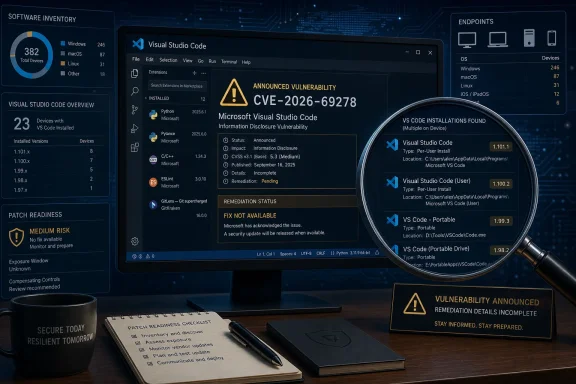
That absence changes the immediate response. This is not a case for guessing that a malicious extension can execute code, that Workspace Trust has been bypassed, or that a particular VS Code release is definitely exposed. Microsoft’s “security feature bypass” classification says a protection can be circumvented under some conditions; it does not by itself establish remote code execution, credential theft, elevation of privilege, or a compromise of the operating system.
Microsoft’s MSRC advisory is therefore the authoritative confirmation that CVE-2026-69278 exists. But the CVE record currently gives security teams far less deployment guidance than a typical Visual Studio Code advisory. No other outlet has reported technical details or a remediation timeline as of August 12.
Microsoft has confirmed the vulnerability, but not explained the boundary
The advisory’s title is precise only at the highest level: “Visual Studio Code Security Feature Bypass Vulnerability.” Microsoft assigns that impact category when an attacker can evade a security control intended to constrain a risky action or present a warning. The missing information is which control is involved and what the bypass enables after it succeeds.
Visual Studio Code has several security-relevant guardrails whose effects are materially different. Workspace Trust limits the automatic execution of certain workspace features in untrusted folders; extension controls govern what third-party code can be installed and run; terminal integration, task execution, debugging configurations, notebook content, and language tooling each create separate routes through which a workspace can influence a developer machine.
None of those mechanisms should be treated as confirmed vulnerable solely because the product is Visual Studio Code. A security feature bypass could be narrowly scoped—for example, requiring a local attacker and a crafted configuration—or it could involve a workflow relevant to developers opening repositories supplied by another person. Microsoft has not yet published enough information to make that distinction.
The practical consequence is that organizations should treat the advisory as a patch-management and exposure-inventory event, not as evidence of a known active compromise campaign.
The missing version and update information is the operational problem
For Windows administrators, the first question after a Visual Studio Code CVE is usually straightforward: which builds must be removed or updated? CVE-2026-69278 does not currently answer it publicly.
That is a bigger issue than it sounds. Visual Studio Code often exists in several installation forms inside the same organization: a per-user installation under an employee profile, a system-wide installation managed by endpoint software deployment, a ZIP or portable copy outside standard application inventory, a Remote Development server component, and, in some environments, separately administered code-server or VSCodium alternatives. A successful update to the centrally installed desktop package does not prove that every executable called “Code” on managed devices has been brought to the same security level.
The advisory also has not publicly identified a Knowledge Base article, a Visual Studio Code version number, a download-channel milestone, or a workaround. Microsoft’s normal security guidance can map a CVE to a specific product release or security update; until that mapping appears, defenders cannot reliably express compliance as “all endpoints are protected after version X.”
This is the discrepancy administrators should record in their vulnerability-management workflow: the CVE is confirmed by Microsoft, while the remediation boundary remains unpublished or not publicly accessible in the advisory details. Scanners may begin flagging the CVE before they can consistently determine whether an installed build is affected, especially where product-version telemetry is incomplete.
Do not confuse the CVE label with proof of exploitation
Microsoft’s advisory language on report confidence explains why a CVE can be credible even before the underlying technical details are made public. In this case, the vendor’s publication is confirmation that the issue was validated through its vulnerability-handling process. It is not proof that attackers have weaponized it, and it is not a claim that the flaw is being exploited in the wild.
No public proof-of-concept, exploit sample, attacker attribution, or incident report tied to CVE-2026-69278 had surfaced in independent reporting by August 12. That should restrain incident-response decisions. Hunting for arbitrary Visual Studio Code extensions, quarantining every repository with .vscode files, or disabling the editor enterprise-wide would be a response to a hypothetical attack path rather than to facts Microsoft has published.
At the same time, developers are privileged targets. An editor commonly has access to source code, local credentials, cloud command-line tooling, Git configuration, package registries, SSH keys, and authenticated browser sessions. A bypass that persuades VS Code to process untrusted workspace content outside its intended restrictions could become valuable even if it starts with local user interaction. The security significance depends on the guardrail involved and the next action an attacker can trigger—both details Microsoft has not disclosed.
What Windows and endpoint teams should do now
The right immediate action is disciplined preparation for a vendor update, with special attention to installations that conventional Windows patch reporting does not see.
- Inventory Visual Studio Code installations by executable version, install scope, channel, and device owner, including copies deployed outside standard software-distribution tooling.
- Preserve the distinction between Microsoft Visual Studio Code, VSCodium, browser-hosted editors, and code-server deployments. CVE-2026-69278 names Visual Studio Code; related products should not be marked vulnerable without their own vendor confirmation.
- Review whether developers can install extensions from unapproved sources and whether extension allowlists, publisher restrictions, or private marketplaces are enforced where they are needed.
- Remind users who work with external repositories to keep Workspace Trust enabled and to avoid treating unfamiliar folders as trusted merely to clear an editor prompt. This is sensible defense in depth, not a published workaround for CVE-2026-69278.
- Hold off on closing the finding as remediated until Microsoft identifies the corrected Visual Studio Code release or another definitive mitigation. “Latest installed” is an audit statement only when the organization can verify the actual deployed build.
Security teams should also watch for a revision to the MSRC entry. The supplied record was published on August 11, 2026 and did not list a modified date, which means the initial advisory may be expanded without a separate announcement. Version ranges, severity scoring, exploitability assessment, acknowledgements, and update links are all details Microsoft can add later.
For now, CVE-2026-69278 is a verified Visual Studio Code security advisory with an incomplete public remediation record. The concrete next step is to identify every managed and unmanaged VS Code build now, so that when Microsoft supplies the affected-version boundary, organizations can act on it immediately rather than discovering that their developer tooling sits outside the patch process.