

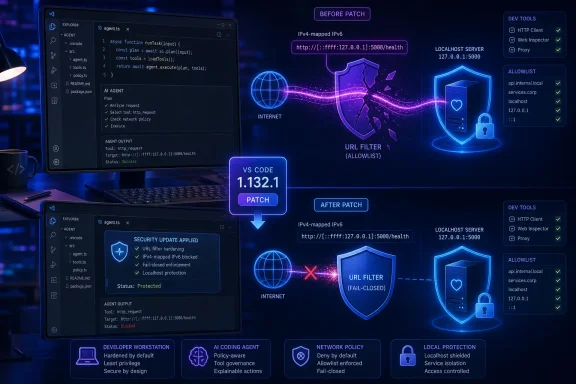
The flaw is not a generic “VS Code can reach the internet” problem. It affects deployments that had already enabled the agent network filter—the control intended to limit where built-in agent tools such as Fetch Page and the Integrated Browser can connect. Microsoft’s own issue disclosure says an attacker able to influence agent instructions or tool arguments could use an IPv4-mapped IPv6 URL to reach local HTTP services despite a deny-all policy or an allowlist.
That is a material distinction for administrators deploying Copilot and other agent workflows with network restrictions. The vulnerable code path sits in the enforcement mechanism designed to stop an agent from turning an untrusted prompt, repository instruction, or tool argument into a request against internal services. In other words, the security boundary was present, configured, and capable of being bypassed.
The Bug Is in URL Normalization, Not the Network Policy Itself
Microsoft’s VS Code engineering disclosure identifies the fault as handling of bracketed IPv6 literals in the URL authority matcher. When normalization failed, the matcher treated the request as allowed rather than rejecting it. That fail-open behavior is the core defect.
IPv4-mapped IPv6 notation is a legitimate compatibility format that represents an IPv4 address inside an IPv6 address. Network controls that compare raw host strings, rather than converting them to a consistent canonical form before applying policy, can end up treating two spellings of the same destination differently. In this case, that inconsistency created a path around agent network restrictions.
The affected destination class is especially important: local HTTP services. Many developer machines expose tools on loopback or private interfaces—debug dashboards, container services, development APIs, local model servers, source-control helpers, browser automation endpoints, and internal administrative applications. They are often assumed to be unreachable from arbitrary web content or untrusted agent actions because they are not Internet-facing.
CVE-2026-69306 did not make those services newly exist or turn a closed port into an open one. It weakened the decision point intended to prevent VS Code’s agent tools from reaching them. That narrows the exploit chain, but it also makes the bug directly relevant to organizations that adopted network filtering as a compensating control for autonomous or semi-autonomous coding agents.
Why Prompt Injection Changes the Risk Calculation
Microsoft says exploitation requires an attacker to influence agent instructions or tool arguments. That can occur through a malicious prompt, but it can also be introduced through material an agent is asked to read: repository documentation, an issue comment, a fetched web page, a pull-request description, or another untrusted artifact incorporated into an agent task.
The result is a familiar indirect prompt injection scenario. A user might tell an agent to inspect a project or retrieve a page, while malicious content attempts to steer the agent’s browser or fetch capability toward a prohibited internal target. The network filter is supposed to reduce the damage from exactly that kind of redirection by limiting reachable destinations.
This is why the advisory should not be read as a broad remote-code-execution flaw in every VS Code installation. Microsoft has not described CVE-2026-69306 as code execution, and the published issue ties it specifically to the agent network filter being enabled. But the affected protection is most valuable in higher-risk setups—where agents can inspect external content and are deliberately constrained from contacting arbitrary networks.
For an unmanaged personal installation that does not use agent browser features or network filtering, the immediate exposure is likely limited. For an enterprise that has enabled domain allowlists or deny rules to keep agents away from internal applications, the vulnerability strikes at a control that may have been central to its rollout decision.
VS Code 1.132.1 Changes the Failure Mode to “Fail Closed”
The fix arrived in VS Code 1.132.1, which Microsoft flagged in the August 5 VS Code 1.132 release notes as a security update. The associated engineering issue says the remediation performs URL-aware authority parsing, canonicalizes bracketed IPv6 addresses, and rejects HTTP or HTTPS authorities that cannot be normalized.
That final change deserves more attention than it will probably receive in a routine security bulletin. A policy gate that permits traffic when it cannot confidently parse the destination is not a policy gate; it is an exception path waiting to become an attack path. Rejecting ambiguous or invalid representations is the correct behavior for a boundary intended to contain agent activity.
Microsoft’s July 1 VS Code 1.127 release introduced enterprise controls for browser tools, including the ability to disable browser tools entirely and to restrict the domains agent tools can reach through agent network filtering. The company’s own documentation frames those controls as governance for agents that can open pages, read content, interact with web applications, and validate work inside the editor.
CVE-2026-69306 shows the operational limit of that design: policy configuration is only as dependable as the URL parser and matcher behind it. An allowlist should be treated as a meaningful reduction in exposure after version 1.132.1 is deployed, not as proof that earlier builds were isolated.
What Administrators Should Check Now
Administrators should identify VS Code 1.132.0 and older installations where built-in agent tools have access to web content or where agent network filtering has been configured. The normal desktop update path may be sufficient for consumer systems, but managed Windows fleets should verify the installed version rather than assuming gradual application updates have completed.
Priority should be highest for developer workstations that combine these conditions:
- They use VS Code agent features capable of fetching pages or interacting with the Integrated Browser.
- They have agent network filtering enabled through enterprise policy or domain allowlists.
- They can reach sensitive internal HTTP services from the developer workstation, including localhost-only services.
- They routinely let agents process repositories, tickets, web pages, or documentation that originates outside the organization’s trust boundary.
Until 1.132.1 is confirmed, the most defensible temporary mitigation is to disable the affected agent browser and fetch capabilities where that is operationally practical. Restricting user access to untrusted repositories and web inputs helps, but it is not a substitute for the update: the bypass exists precisely because the destination policy can be defeated after the agent is exposed to untrusted instructions.
Teams should also examine whether local services have unnecessary administrative actions, weak authentication, or overly broad cross-origin behavior. The VS Code patch fixes the route around the agent network policy. It does not harden a local development service that accepts dangerous requests from any process running under the user’s account.
The Disclosure Reveals a Larger Agent-Security Problem
Microsoft published several security fixes alongside VS Code 1.132.1, including flaws involving a malicious page’s ability to invoke operating-system protocol handlers, a workspace-trust bypass in terminal process creation, and a Copilot agent path that could register shell-executing hooks. Those are separate vulnerabilities with separate CVEs, but their simultaneous disclosure supplies useful context for CVE-2026-69306.
VS Code’s security model now has to mediate among editor workspaces, terminals, extension capabilities, agent permission modes, browser tools, fetched content, network policy, and local developer services. Each piece can be reasonable in isolation. The risk appears in the handoff from one piece to another—when an agent treats content as an instruction, when a tool interprets a URL, or when a policy engine receives a destination represented in an unexpected but valid format.
For CVE-2026-69306, Microsoft has provided a specific patch and a clear affected-version boundary: update to Visual Studio Code 1.132.1. The consequence for IT teams is equally clear: any pre-1.132.1 agent-network allowlist should be considered incomplete protection, particularly on machines where VS Code agents can reach services that were meant to remain local.