
afd.sys. The immediate action for administrators is to deploy the applicable August 11, 2026 Windows security update across supported endpoints and servers, but the record available on August 12 does not support claims of active exploitation, remote compromise, or a publicly available proof of concept.The advisory appeared in Microsoft’s Security Update Guide on August 11 at 7:00 a.m. Pacific time. Microsoft classifies the issue by impact—elevation of privilege—and names the affected component, but the public material presently available offers little technical substance beyond that. No independent security outlet had published a technical analysis of CVE-2026-70307 at the time of review, and searches of CVE.org, the National Vulnerability Database, and CISA’s Known Exploited Vulnerabilities catalog did not surface a corresponding indexed entry or exploitation notice.
That makes this a patch-now Windows flaw, but not an incident by itself.
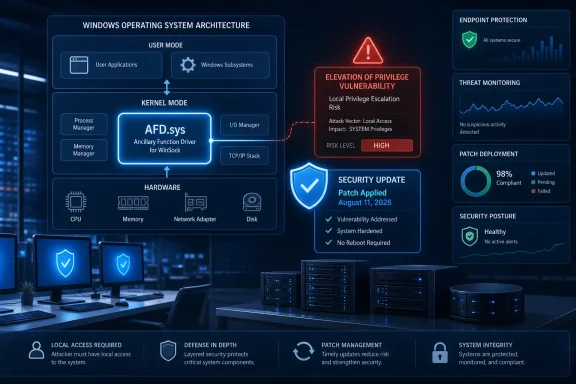 AFD.sys sits on a sensitive boundary
The Ancillary Function Driver for WinSock is not an optional networking add-on. It is a longstanding Windows kernel component that helps move socket-related operations between user-mode applications and the operating system’s networking implementation. Microsoft’s older technical documentation describes afd.sys as a kernel-mode driver responsible for managing Winsock TCP/IP communications.
That placement explains why an AFD elevation-of-privilege flaw matters. Applications routinely create and use sockets without running as administrators. If a security defect lets a process cross from that lower-privileged context into more powerful kernel-controlled operations, the outcome can be a local privilege escalation—potentially turning code execution as a standard user, service account, or constrained application identity into control with SYSTEM-level privileges.
But local is the operative word. CVE-2026-70307 is not described as a network-reachable Winsock bug, and Microsoft has not said that sending a specially crafted packet to a Windows machine can trigger it. An attacker would generally need a foothold on the target first: a malicious program executed by a user, an abused service account, a compromised line-of-business application, or another vulnerability that already enabled code execution.
For defenders, this is the second-stage risk that frequently turns an initial compromise into complete machine takeover. It is especially relevant on shared Windows systems, Remote Desktop Session Host deployments, development workstations, application servers running services under limited identities, and environments where users can run untrusted or loosely controlled software.
Microsoft has confirmed the issue, but not explained the mechanism
Microsoft’s Security Update Guide is authoritative confirmation that the vulnerability exists and has been addressed through the August security release. The advisory’s publication alone should be enough to put the relevant cumulative updates into an organization’s normal accelerated patch cycle.
What remains missing is the information that would let administrators distinguish a routine local elevation-of-privilege patch from a flaw requiring emergency containment. Microsoft has not publicly supplied, in the material reviewed, a vulnerability class such as use-after-free, race condition, type confusion, integer overflow, or improper input validation. It has not described the affected afd.sys function, a required socket configuration, a prerequisite Windows feature, or whether exploit reliability depends on a particular architecture or Windows release.
The absence of a technical root cause is not unusual on Patch Tuesday. Microsoft often withholds exploit-enabling detail while customers install updates. Still, it has a practical consequence: security teams cannot currently build a precise compensating control around CVE-2026-70307. There is no named service to disable, no documented port to block, no registry switch to apply, and no announced workaround that substitutes for patching.
The advisory’s generic explanation of the CVSS report-confidence metric should not be read as a technical finding about this particular CVE. That text explains how CVSS uses confidence in a vulnerability’s existence and technical details; it does not disclose whether an exploit is public or whether attacks are underway. Those are separate fields in Microsoft’s advisory process, and the supplied material does not establish either condition for CVE-2026-70307.
The patch is likely part of the monthly Windows package, not a standalone AFD update
AFD is an inbox Windows component, so organizations should not expect a separate “AFD.sys security update” download or a standalone installer with the CVE number in its name. Microsoft normally ships fixes for core kernel and networking components through the cumulative security updates assigned to each supported Windows release and servicing channel.
Administrators should therefore verify deployment at the operating-system update level:
- Install the August 11 security update applicable to each supported Windows client and server version in use.
- Use Windows Update for Business, Windows Autopatch, WSUS, Configuration Manager, Microsoft Intune, or the Microsoft Update Catalog according to the organization’s established deployment process.
- Confirm installation success and the expected post-update OS build rather than looking only for CVE-2026-70307 in the installed-updates list.
- Reboot systems when the applicable cumulative update requires it; a kernel networking-driver fix should not be assumed to take effect merely because the package downloaded.
Microsoft’s August release is unusually large, with the August 2026 Security Update Guide release notes cited by administrators as covering 421 Microsoft CVEs. That volume creates a familiar operational temptation: defer lower-profile elevation-of-privilege fixes while prioritizing remote code execution and known-exploited vulnerabilities. CVE-2026-70307 should not displace a confirmed in-the-wild zero-day from the front of the queue, but it should not be carved out of the monthly Windows deployment either.
The key operational point is simple: if the August cumulative update is already approved for a device’s Windows version, CVE-2026-70307 is a reason to complete that rollout, not a reason to create a separate emergency package that does not exist.
Treat endpoint access as the exposure condition
Because the advisory identifies elevation of privilege rather than remote code execution, teams should focus their immediate triage on systems where an attacker or untrusted user could already execute code. That includes multi-user devices, jump hosts, developer machines, kiosks with third-party software, virtual desktop infrastructure, build systems, and servers that host internet-facing applications.
A compromised web application or service account is often assumed to be limited by Windows permissions. A local kernel elevation-of-privilege vulnerability can weaken that containment model. The practical concern is not that every socket-using process is compromised; it is that a threat actor who lands in a restricted Windows context may have another route to seize the host.
Endpoint detection teams should retain and review telemetry around suspicious post-compromise behavior: unexpected executable launches from writable user or service directories, creation of scheduled tasks, service installation, token manipulation, security-tool tampering, and abrupt changes in process integrity level. None of those behaviors identifies CVE-2026-70307 specifically, and no public detection logic has been tied to this CVE. They are the likely downstream artifacts of a successful local privilege escalation generally.
Do not turn this into a blanket decision to disable Winsock, block ordinary socket activity, or remove networking components from endpoints. AFD is fundamental Windows infrastructure, and the public record does not identify a configuration-based mitigation. Patch deployment is the available control.
The public record needs a follow-up
Microsoft’s confirmation is sufficient to establish that CVE-2026-70307 is real and fixed, but the current public picture is incomplete. There is no independently reported exploit chain, no disclosed vulnerability mechanism, no confirmed affected-build list in the material reviewed, and no published workaround for organizations that cannot patch immediately.
That lack of detail is a reason to avoid inflated claims, not a reason to postpone remediation. Apply the August 11, 2026 Windows security update to every supported Windows system in scope, verify the resulting OS builds, and keep an eye on Microsoft, CISA, CVE.org, and NVD for subsequent scoring, affected-product data, or exploitation updates.