

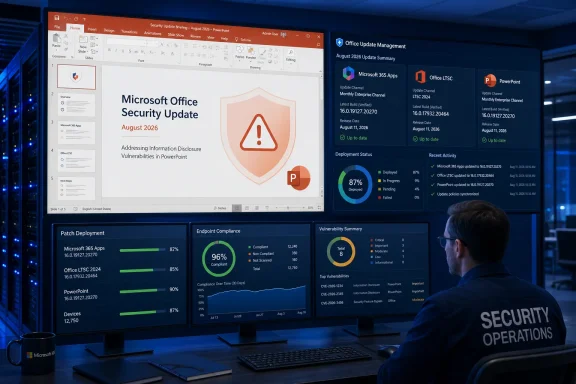
Microsoft’s Security Update Guide identifies the issue as a PowerPoint flaw with an information-disclosure impact. Its Office security release notes, however, place CVE-2026-70316 under the broader Office suite category rather than under the PowerPoint-specific list. That difference is more than a filing oddity: it indicates the remediation is being distributed through Office’s shared servicing channels, so patch verification needs to focus on the installed Office build, not whether an administrator sees a standalone PowerPoint package in their patch console.
The patch is in the August 11 Office release
Microsoft Learn’s August 11 Office security release notes list CVE-2026-70316 among the vulnerabilities resolved in the Office suite. The release covers Microsoft 365 Apps for enterprise and business, Office LTSC 2021 and 2024, Office 2021 and 2024 retail editions, and the remaining Office 2019 volume-license servicing line.
For Click-to-Run deployments, Microsoft identifies the following updated release lines:
- Current Channel is version 2607, build 20228.20190.
- Monthly Enterprise Channel is version 2607, build 20228.20188, with version 2606 also receiving build 20131.20206.
- Semi-Annual Enterprise Channel is version 2508, build 19127.20730; the Semi-Annual Enterprise Channel release that takes Monthly Enterprise builds is version 2607, build 20228.20186.
- Office LTSC 2024 is build 17932.20910, while Office LTSC 2021 is build 14334.20848.
Those builds are the useful operational marker. A workstation reporting that it is “up to date” is not enough if its management tooling has deferred the August 11 release, pinned it to an earlier channel build, or only patches Windows.
Microsoft’s documentation also lists Office 2024 and Office 2021 retail on build 20228.20190, and Office 2019 volume-licensed editions on build 10417.20197. Office 2019 reached end of support on October 14, 2025, though Microsoft says it may elect to issue particular updates afterward. Organizations still using it should treat this month’s inclusion as an exception, not evidence that the product has resumed normal support.
Microsoft’s public record leaves the attack path unspecified
The advisory’s title establishes the affected application and the security consequence: an attacker could disclose information through PowerPoint. It does not, at least in the public material accompanying this release, explain what information could be exposed, which PowerPoint feature is involved, whether a malicious presentation is required, or whether opening a document is sufficient to trigger the flaw.
That lack of detail changes the appropriate response. IT teams should not invent a defensive control around a presumed malicious .pptx attachment, external template, embedded object, preview-pane condition, or network location when Microsoft has not identified one. Restricting presentations received through email and collaboration platforms remains sensible general hygiene, but it is not a documented mitigation for CVE-2026-70316.
The limited disclosure also means the vulnerability should not be casually upgraded into a remote-code-execution story. “Information disclosure” describes a confidentiality failure, not the ability to run code or alter files. Such disclosures can still be valuable to an attacker—particularly when exposed material helps defeat other protections or reveals credentials, document contents, file paths, or application state—but the record does not say that CVE-2026-70316 does any of those things.
As of August 12, no independent technical write-up, proof of concept, or public exploitation report has surfaced for this specific CVE. The NVD and CVE Program records also had not emerged in search results alongside Microsoft’s release, a normal but inconvenient lag for a vulnerability disclosed only a day earlier. That leaves Microsoft’s advisory and its Office release notes as the primary records administrators can presently use.
“PowerPoint” and “Office suite” are not the same deployment instruction
Microsoft’s own classification creates a small but important deployment trap. CVE-2026-70316 is named as a PowerPoint vulnerability in the Security Update Guide, yet the August release notes put it in the Office suite section. An administrator filtering a vulnerability-management platform solely by product family may see different labels depending on whether that platform mirrors the Security Update Guide, the Office release notes, or Microsoft Update catalog metadata.
The practical interpretation is that the vulnerable code may be serviced through a component shared by Office applications, even if the observed security impact is specific to PowerPoint. Microsoft has not published enough technical detail to confirm the component boundary, so that conclusion remains an inference from its servicing classification rather than a confirmed root-cause statement.
For managed environments, the safe procedure is to verify the actual installed Office build after the update cycle completes. Do not wait for a package explicitly named “Security Update for PowerPoint” before closing the ticket. In Click-to-Run estates, that means checking the channel and build reported by the Office client or management platform. In MSI-based legacy estates, it means checking Microsoft Update, WSUS, Configuration Manager, or the organization’s third-party patching system for the August Office security content applicable to that edition.
This is also a reason to distinguish Office patch compliance from Windows patch compliance in reporting. A device may have installed the August 2026 Windows cumulative update and still be behind on Microsoft 365 Apps if Office updates are managed separately, disabled, or held for a pilot ring.
What administrators should do now
Patch deployment should be prioritized according to exposure, not speculation about an unconfirmed exploit chain. Systems that routinely open externally supplied presentations—sales, recruiting, marketing, investor relations, legal, training, help desk, and shared kiosk environments—deserve early rollout because they have the most frequent contact with untrusted PowerPoint files.
A sensible deployment sequence is to update a pilot population first, confirm Office startup and add-in behavior, and then push the August 11 build through the relevant channel. Organizations that have deliberately frozen Office at an older Monthly Enterprise or Semi-Annual Enterprise build need to determine whether their selected servicing cadence has received the patched build and whether their deferral policy is still holding it back.
The release arrives while many IT departments are already processing August Patch Tuesday changes, which makes it easy for Office-specific fixes to disappear inside a larger Windows deployment. CVE-2026-70316 is a reminder that the Windows update dashboard is not a complete Office security dashboard: the remediation is delivered by Office servicing, and the evidence of protection is an updated Office build.