

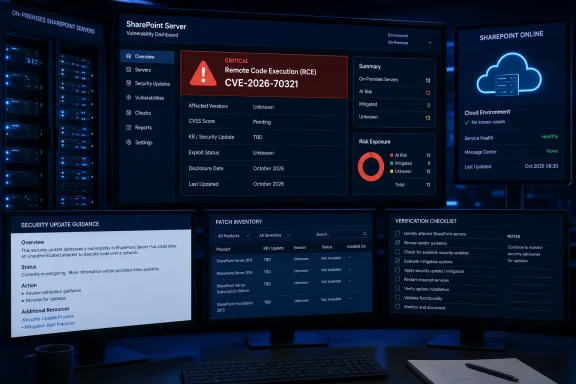
That absence is the news here. Remote code execution in an on-premises collaboration server is inherently serious, but a CVE title is not a remediation plan. Administrators should treat this as a vulnerability record that requires verification against their own SharePoint inventory, rather than assuming that every SharePoint deployment—or SharePoint Online—has a confirmed exposure.
Microsoft’s Security Update Guide is the authoritative source for the advisory’s existence and publication date. Yet searches of the National Vulnerability Database and the CVE Program’s public record did not return a corresponding entry for CVE-2026-70321 at the time of review on August 12. No independent security outlet appears to have published technical reporting, proof-of-concept information, observed exploitation, affected-build data, or a patch mapping for this CVE so far.
The advisory’s confidence language does not confirm exploitation
The text accompanying CVE-2026-70321 explains a CVSS report confidence metric: it measures confidence that the vulnerability exists and that the published technical details are credible. That description is easy to misread as a verdict that the vulnerability itself is confirmed or actively understood by attackers. It is neither.
In CVSS terms, report confidence is a temporal factor separate from severity, exploitability, public disclosure, and exploitation in the wild. Microsoft’s supplied text describes how the metric works, including the progression from an early report to a vendor-confirmed issue. It does not state the actual value assigned to CVE-2026-70321—such as Unknown, Reasonable, or Confirmed.
That distinction matters for incident response. A confirmed RCE with a low-complexity network vector and no authentication requirement deserves an emergency change window. An RCE requiring an authenticated SharePoint user, a specific optional component, or local access calls for a different prioritization. The currently available material does not establish which situation applies.
Likewise, there is no published basis yet for calling this a zero-day. “Remote code execution” names the potential impact if exploitation succeeds; it does not show that a working exploit exists, that attackers know of the flaw, or that Microsoft was fixing an actively exploited issue.
SharePoint Server and SharePoint Online must not be treated as interchangeable
The advisory title says “Microsoft SharePoint,” which is too broad for an operational decision. Microsoft’s security bulletins have historically distinguished among SharePoint Server 2016, SharePoint Server 2019, SharePoint Server Subscription Edition, and Microsoft’s cloud-operated SharePoint Online service. The response model differs sharply across those products.
For self-hosted SharePoint Server farms, administrators own the patching window, installation order, prerequisite checks, post-install configuration, and validation of search, workflow, custom solutions, and distributed cache components. In many environments, a SharePoint security update is also a change-management event: farms may require staged deployment, maintenance windows, backups, service restarts, and a review of any installed language packs or related Workflow Manager components.
SharePoint Online is operated by Microsoft and does not use customer-installed SharePoint Server cumulative updates. A broad advisory title alone therefore cannot establish that a Microsoft 365 tenant has an actionable patch requirement. Until Microsoft names affected products, organizations should avoid both dangerous assumptions: that cloud deployments are definitely unaffected, or that their on-premises SharePoint farm is definitely in scope.
This is particularly important after the sustained scrutiny of on-premises SharePoint vulnerabilities during 2025 and 2026. Those incidents trained security teams to react quickly to the words “SharePoint RCE,” reasonably so. But prior SharePoint Server exposure does not prove that CVE-2026-70321 has the same reach, authentication requirements, exploit chain, or remediation steps.
There is no KB-to-CVE mapping yet
Microsoft normally makes SharePoint remediation actionable by linking a CVE to a specific security update and listing affected product releases. Those details allow an administrator to answer the questions that actually determine risk:
- Is the farm running SharePoint Server 2016, 2019, or Subscription Edition, and is that release listed as affected?
- Which August 2026 security update or out-of-band package remediates the vulnerability?
- Does the update require a particular SharePoint build baseline or a related Workflow Manager update?
- Is the attack remote and unauthenticated, remote but authenticated, or contingent on user interaction?
- Has Microsoft assessed exploitation as more likely, less likely, publicly disclosed, or detected in attacks?
CVE-2026-70321 does not answer those questions in the advisory content presently available. The lack of a KB reference is more than a documentation nuisance: without it, a patch-management team cannot demonstrate that a deployed update fixes this specific CVE, and vulnerability scanners cannot reliably be overridden or validated through normal change-control evidence.
The practical result is that IT teams should not close a CVE-2026-70321 ticket merely because they installed the August 11 Windows cumulative update. Windows servicing and SharePoint Server servicing are distinct processes. A Windows endpoint patch does not establish that a SharePoint farm has received the relevant SharePoint security package—if one is required.
What SharePoint administrators should do today
The appropriate response is verification, not panic. Security and SharePoint teams should first determine whether they operate any self-hosted SharePoint Server farms, including development, disaster-recovery, test, and long-neglected departmental deployments. Internet-facing farms and farms connected to identity infrastructure, file shares, line-of-business systems, or sensitive document repositories warrant the fastest review.
Then check Microsoft’s Security Update Guide directly for CVE-2026-70321 and record the full affected-product list, CVSS vector, exploitability assessment, and remediation links when they become visible. If Microsoft provides a SharePoint Server KB article, map that article to every farm’s current build and validate the installation on a non-production farm before broad rollout where business continuity rules require it.
Administrators should also preserve current evidence: SharePoint build numbers, patch histories, externally exposed URLs, reverse-proxy and WAF logs, IIS logs, and the account privileges assigned to application pools and service accounts. This is ordinary readiness work, but it becomes valuable if Microsoft later identifies active exploitation or publishes indicators tied to the flaw.
CVE-2026-70321 is real enough to warrant tracking because Microsoft has assigned and published the advisory. It is not documented well enough, at this point, to justify claims about severity, affected SharePoint versions, exploit availability, or exposure of SharePoint Online. The next meaningful update is not another restatement of the RCE label; it is Microsoft’s release of the affected-product and security-update mapping that lets administrators patch, test, and prove remediation.