
The advisory, published August 27, identifies CVE-2018-19518 and CVE-2019-11043 in Fuel-Boss V1 Standard, Portal, Master/Slave, and Backflush Systems. CISA says successful exploitation could let an attacker execute commands or code remotely. Fuel-Boss is used to manage fuel dispensing, making this less a conventional web-server patching issue than a potential interruption or manipulation risk for organizations that rely on the equipment for fleet, emergency-service, transportation, defense-industrial-base, or manufacturing operations.
For Windows administrators, one point deserves emphasis: All-Line’s own Fuel-Boss material describes remote management through a Microsoft Windows application, but this advisory concerns the PHP components inside the Fuel-Boss deployment—not a vulnerability in Windows itself or proof that the Windows management client is compromised. A Windows workstation running the client is therefore not the patch target. The management path, network exposure, appliance software version, and vendor-provided remediation status are.
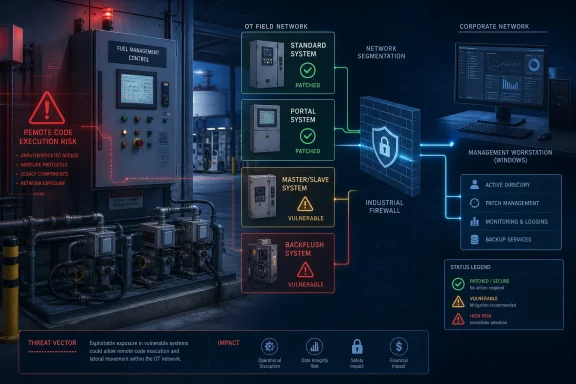 Four Fuel-Boss variants, three different remediation outcomes
CISA’s advisory splits affected deployments into categories that require different decisions.
- Fuel-Boss V1 Standard and Fuel-Boss V1 Portal have vendor fixes available, and owners must contact All-Line directly to obtain installation instructions.
- Fuel-Boss V1 Master/Slave has no fix available at the time of CISA’s publication.
- Fuel-Boss V1 Backflush Systems has no planned fix, meaning isolation or replacement planning is the durable answer rather than waiting for a software update.
That distinction changes the response from a routine maintenance ticket into an asset-management exercise. Organizations using Standard or Portal systems should obtain the vendor fix, test it against their pump, meter, transaction-recording, and remote-management workflows, then deploy it on a defined schedule. Operators using Master/Slave or Backflush configurations should presume that no near-term patch window exists unless All-Line changes its position.
CISA recommends taking unpatched systems off the internet or restricting access by source IP address at the router level. That is a useful emergency control, but an IP allowlist alone should not be mistaken for complete containment. A Fuel-Boss device reachable from a broad corporate network, a vendor remote-support subnet, a flat Wi-Fi segment, or an overly permissive VPN can still be exposed to an attacker who gains a foothold elsewhere.
The underlying PHP bugs are old—and one has a record of exploitation
CVE-2019-11043 is the more urgent of the two underlying flaws. It affects certain PHP-FPM configurations and can cause an out-of-bounds write in FastCGI handling, creating a route to remote code execution. PHP released the fix for the 7.1 branch in PHP 7.1.33 on October 24, 2019; the National Vulnerability Database lists PHP 7.1 releases before 7.1.33 as affected.
Fuel-Boss deployments listed by CISA use PHP 7.1.5, which predates that fixed release by more than 14 years. PHP 7.1 itself reached end of life on December 1, 2019, so even a product-specific fix that addresses these two CVEs does not automatically turn the embedded PHP stack into a presently supported platform. All-Line has not publicly described whether its fixes update PHP, alter the vulnerable configurations, remove exposed functionality, or apply compensating controls around it. Customers should ask that question before treating a vendor-supplied fix as evidence that every PHP-layer risk has disappeared.
The National Vulnerability Database also records CVE-2019-11043 in CISA’s Known Exploited Vulnerabilities catalog. That status is important but easy to overstate: it confirms exploitation of the underlying PHP vulnerability in the wild, not exploitation of Fuel-Boss specifically. CISA’s new Fuel-Boss advisory does not report a compromise, ransomware incident, public exploit chain, or observed attack against an All-Line customer.
The second flaw, CVE-2018-19518, arises in the University of Washington IMAP Toolkit code used by PHP’s IMAP functionality. It can enable operating-system command execution through argument injection when an application accepts an untrusted IMAP server name and the system’s remote-shell behavior meets particular conditions. It is not a blanket claim that every device with PHP 7.1.5 will be remotely compromised through any web request. Exploitation depends on the deployed application and host configuration, including whether the affected IMAP functions are reachable.
CISA describes both issues as requiring high attack complexity in this Fuel-Boss context. Administrators should take that as a statement about the known attack paths, not as permission to defer action. A vulnerability that requires a particular configuration can remain practical for an attacker once an appliance is internet-facing, reachable from an internal compromise, or administered through interfaces whose exposure was never designed for a modern threat model.
The scoring record shows why a single number is not enough
CISA lists a CVSS 3.1 score of 8.7 for CVE-2019-11043 in the Fuel-Boss advisory, while the National Vulnerability Database assigns the vulnerability a 9.8 CVSS 3.1 base score. The difference is not a clerical error: the PHP Group’s scoring assumes high attack complexity and a changed security scope, whereas NVD’s analysis rates attack complexity lower and impact across confidentiality, integrity, and availability higher.
That disagreement matters for triage. A security team that filters work only by the word critical might discount the CISA advisory because its vendor-oriented score is “high.” But the relevant operational facts are clearer than the scoring debate: the affected Fuel-Boss builds rely on an obsolete PHP release, one of the named vulnerabilities has been exploited elsewhere, and half of the affected Fuel-Boss product categories lack a currently available patch.
CVE-2018-19518 is rated 7.5 under CVSS 3.1 in the advisory, reflecting authenticated access and high complexity in the published vector. Its preconditions are narrower, yet it reinforces the same conclusion: the appliance should not expose unnecessary services or accept uncontrolled input from networks beyond the site’s intended management boundary.
Inventory must begin with the product role, not the Windows PC
The most useful first step is identifying every Fuel-Boss V1 installation and classifying it by product variant. The system name alone is insufficient because CISA’s remediation differs among Standard, Portal, Master/Slave, and Backflush products. Sites should also identify whether each unit is directly addressable from the internet, reachable through a routed business network, accessed through a vendor-maintained remote connection, or confined to a segmented operational-technology network.
Administrators should then establish whether a device actually contains the affected PHP 7.1.5 component described by CISA. The advisory’s affected-version notation effectively points to the embedded PHP release supplied with these Fuel-Boss V1 configurations; it should not be read as evidence that any arbitrary installation of PHP 7.1.5 on a Windows server is a Fuel-Boss system.
For systems without a fix, practical compensating controls should be specific:
- Remove direct inbound internet access to Fuel-Boss interfaces and verify the change with an external exposure scan or firewall review.
- Permit administration only through a tightly restricted management network, ideally using a jump host with multifactor authentication and recorded administrative sessions.
- Separate fuel-management devices from ordinary user workstations, guest networks, building systems, and broad server VLANs with explicit firewall rules.
- Restrict both inbound administrative paths and unnecessary outbound connectivity, because a compromised appliance can be used to probe or pivot into adjacent networks.
- Preserve and review Fuel-Boss transaction records, device logs, firewall logs, and remote-access logs so unexpected configuration changes or dispensing anomalies can be investigated.
CISA appropriately advises an impact analysis before deploying controls. In this case, that means testing whether blocking internet access disrupts vendor support, centralized reporting, remote operator workflows, or Windows-based management tools. If remote access is genuinely required, it should be rebuilt around controlled VPN or brokered access rather than an exposed appliance interface.
What All-Line customers need from the vendor
The advisory leaves several material details unanswered. It does not state the exact fixed Fuel-Boss build numbers for Standard and Portal, whether the fix updates PHP beyond 7.1.5, whether an on-device upgrade can be performed remotely, or whether applying it requires downtime. It also does not specify whether Master/Slave remediation is being developed or merely remains unscheduled.
Those omissions should shape the vendor conversation. Customers should request a written fixed-version identifier, deployment steps, rollback procedure, expected outage, verification method, and a statement of which embedded components are updated. Backflush owners should request a documented risk-acceptance or lifecycle path, because “no fix planned” converts the issue into a long-term exposure that must be isolated, replaced, or explicitly accepted by leadership.
The concrete priority is straightforward: patch Fuel-Boss V1 Standard and Portal systems through All-Line’s process, and isolate Master/Slave and Backflush systems now. The Windows management application may remain part of daily operations, but the security decision sits at the Fuel-Boss device and its network boundary—where unsupported embedded software is still carrying the risk.
