
CISA’s August 25 alert is important because KEV inclusion is a statement about exploitation, not merely severity. Gitea’s own advisory, published in late July, described the bug as allowing a user with ordinary repository write access to execute shell commands under the operating-system account that runs Gitea. The advisory identified Gitea versions 1.17 through 1.27.0 as affected and named 1.27.1 as the patched release.
The crucial operational detail is that the flaw is more reachable than “authenticated RCE” sounds. Gitea’s advisory says the exploit requires a writable repository, but an instance with open self-registration can let an outside visitor create the account and repository needed to reach the vulnerable code path. CISA’s active-exploitation finding now removes any room for treating that condition as a theoretical edge case.
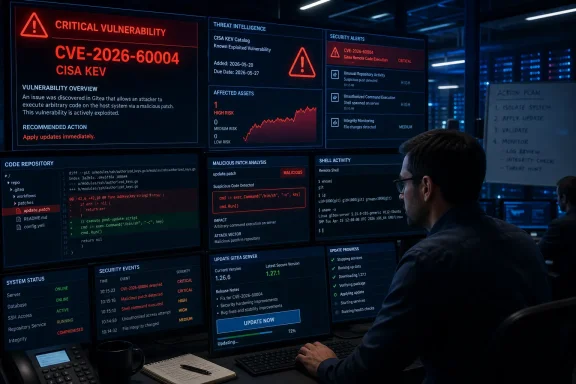 The vulnerable path is Gitea’s diffpatch API
CVE-2026-60004 sits in Gitea’s diffpatch functionality, which processes repository patches through Git. According to Gitea’s GitHub Security Advisory, a malicious user can submit specially constructed patch content that causes Gitea to place an executable Git hook in a temporary repository and run it when Git updates the index.
The result is arbitrary command execution as the account running the Gitea service. On a Linux deployment, that is commonly the dedicated git account. On a Windows deployment, the practical impact depends on how the service was installed: it may be a local service identity, a local user, or—far more dangerously—a shared administrator or domain service account.
That service context is the difference between a contained source-control compromise and a host compromise that reaches far beyond Gitea itself. A successful attacker could read Gitea configuration data, application secrets, repository contents, and database connection details available to the service account. If the same server hosts runners, build tooling, package registries, or deployment credentials, the breach can become a software supply-chain incident.
The exploit chain also has a platform prerequisite that administrators should verify: Gitea says Git 2.32 or newer is required for the vulnerable three-way fallback behavior used by the attack. That does not make older Git a safe mitigation strategy. Downgrading Git may introduce other unsupported or security-sensitive states, and the correct fix remains updating Gitea.
Gitea 1.27.1 is the security floor, not merely a recommended update
Gitea’s official advisory identifies version 1.27.1 as the first patched version. Its current release stream has already moved beyond that release, with Gitea 1.27.2 published on August 14, so administrators should install the latest supported 1.27.x build rather than stopping at the minimum fixed version.
A more awkward finding for organizations on older Gitea branches is that the advisory does not identify a patched 1.26.x, 1.25.x, or older maintenance release. The affected range begins at 1.17 and ends only before 1.27.1. In practice, teams that deliberately remain on an older minor line cannot assume that their normal branch-level update process will resolve this vulnerability; they need to plan a move to the 1.27 release family.
This is where ordinary patch dashboards can produce a false sense of completion. A system may report that it has applied the newest package available from a pinned repository or distribution channel while still running an affected 1.26.x build. Verify the running Gitea binary itself, not just the package-manager status.
For Windows administrators, the relevant check is the server executable version and the version reported in Gitea’s site administration interface or API. If a server was deployed from a downloaded gitea.exe, a container image, a third-party package, or an internal software mirror, each delivery path may lag upstream differently. The official Gitea download archive includes Windows executables for 1.27.1, but internal mirrors and enterprise software catalogs need separate confirmation.
CISA’s KEV designation changes the response standard
CISA’s notice says the flaw was added on evidence of active exploitation. It does not identify the responsible threat actor, victim organizations, campaign, or the specific conditions observed in compromised deployments. That restraint is normal for KEV additions, but it means defenders should not wait for a public malware family or named campaign before acting.
Under the BOD 26-04 framework described in CISA’s alert, Federal Civilian Executive Branch agencies must prioritize KEV vulnerabilities according to exposure and post-exploitation impact. A remotely reachable Gitea instance that permits self-registration is especially concerning because the conditions described in Gitea’s advisory let an untrusted internet visitor create the required repository privileges rather than steal an existing developer account first.
The directive formally applies to federal civilian agencies, but the exposure model applies everywhere. A Gitea server might be viewed as an internal developer tool and receive lighter scrutiny than a public-facing VPN or identity provider. If it accepts internet traffic, exposes registration, or is accessible through a trusted third-party network, it is an application server holding source code, tokens, and build metadata—not a low-priority collaboration site.
Alibaba Cloud’s July security report separately said it had observed exploitation of CVE-2026-60004 to install mining software. That is a useful indicator that opportunistic attacks may already be automated, but it should not narrow the hunt to cryptomining alone. The vulnerability provides code execution under the Gitea service identity, and different operators can use that access for credential theft, persistence, repository tampering, or lateral movement.
Patch first, then determine whether the server was already used
Upgrading Gitea closes the described entry point, but it does not remove commands, scheduled tasks, altered repositories, or credentials an attacker may have obtained before the update. Gitea’s advisory notes that the exploit can execute commands without requiring an outbound callback channel, which further limits the value of relying solely on firewall or proxy logs to rule out compromise.
Administrators should make the following checks part of the remediation window:
- Upgrade every Gitea instance in the affected range to Gitea 1.27.1 or later, preferably the current 1.27.2 release, and confirm the running version after service restart.
- Disable public registration where it is not an explicit business requirement, and review whether anonymous users can create repositories or gain write access through organization defaults.
- Review Gitea access logs for repeated requests to the repository
diffpatchAPI, particularly from newly created accounts or accounts that created repositories immediately before the activity. - Examine the host for unexpected processes, startup items, scheduled tasks, new service definitions, modified deployment scripts, and unexplained outbound connections running under the Gitea service account.
- Rotate secrets reachable by Gitea if there is meaningful evidence of exposure. This includes database passwords, SMTP credentials, OAuth client secrets, webhook tokens, package-registry credentials, CI variables, and SSH keys used by the service.
- Audit repositories and protected branches for unexpected commits, hooks, deploy keys, access tokens, organization membership changes, or workflow modifications.
On Windows, hunt procedures should include the service configuration itself. Determine the account assigned to the Gitea service, inspect its profile and writable directories, and check Task Scheduler, Services, Run keys, and PowerShell operational logging for activity tied to that identity. The server’s service account should also be reviewed for unnecessary local-administrator rights and access to unrelated network shares.
Public registration deserves a second look
CVE-2026-60004 exposes a security assumption embedded in many self-hosted developer platforms: requiring an account is not a meaningful barrier when the platform creates accounts for strangers by default. Gitea’s advisory makes clear that open registration is not technically necessary when an attacker already has repository write permission, but it removes the need for an initial foothold.
Disabling registration is therefore a useful compensating control while upgrades are deployed, especially for external instances. It is not a substitute for patching; a malicious insider, a compromised developer account, or any other user with repository write access can still satisfy the exploit’s permission requirement on a vulnerable server.
The immediate priority is clear: find every Gitea server running 1.17 through 1.27.0, update it beyond 1.27.1, and investigate internet-accessible or open-registration instances for signs of prior abuse. CISA’s KEV entry means the risk is no longer defined by what the flaw could do—the exploitation threshold has already been crossed.
