
esp4, esp6, and rxrpc kernel modules if their installations do not depend on them.That distinction is the operational problem. Disabling modules can reduce exposure, but it is a mitigation with service consequences, not a replacement for a supported appliance patch. Hitachi Energy’s advisory identifies APM Edge 6.10 and earlier as affected by CVE-2026-43284 and CVE-2026-43500, yet does not name a fixed APM Edge release, disclose the embedded Linux kernel version, or provide a timeline for a remedial product image.
For organizations that run APM Edge in operational technology environments, the first task is to establish whether those modules are available and whether IPsec or RxRPC functionality is actually in use. The second is to obtain a supported remediation commitment from Hitachi Energy, rather than treating general perimeter hardening advice as closure.
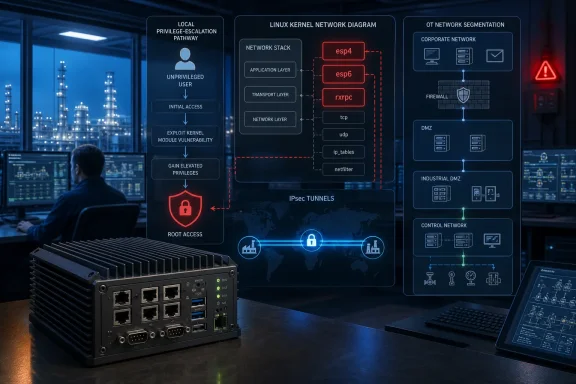 Two local flaws with root-level consequences
The two CVEs sit in different Linux networking components but share the same dangerous condition: an attacker with local code execution can manipulate shared memory pages during packet processing and corrupt data used by privileged programs. When a modified privileged binary is subsequently executed, the attacker’s code can run as root.
CVE-2026-43284 affects the Linux IPsec Encapsulating Security Payload paths, specifically the IPv4 esp4 and IPv6 esp6 modules. The Linux kernel’s own CVE record describes the defect as unsafe in-place decryption of externally shared packet fragments. Hitachi Energy classifies it as a write-what-where condition, a flaw category that is particularly serious because it can give an attacker controlled influence over both the location and content of a memory write.
CVE-2026-43500 is in Linux’s RxRPC implementation. It likewise involves packet fragments backed by memory the socket buffer does not privately own, allowing the kernel’s decryption path to write into pages it should not modify. Hitachi Energy says the rxrpc module can be loaded and exploited by a local user on affected APM Edge versions.
The Canadian Centre for Cyber Security reported in May that working public proof-of-concept code existed for the two Dirty Frag vulnerabilities and warned they could be chained to provide root access for an unprivileged local user. Broadcom’s VMware security team separately characterized the issue as a deterministic controlled write into the page cache of read-only files, with successful exploitation yielding root privileges. Neither Hitachi Energy nor the CISA republication says these APM Edge flaws are being exploited in the wild; that should not be misread as an absence of usable exploit material.
The local attack requirement is important, but it does not make the risk academic. It means the initial foothold must come first: a compromised maintenance credential, abused remote-support path, vulnerable service, malicious removable media, insider access, or a chained remote-code-execution bug. In industrial environments, privilege escalation is often what turns an application-level compromise into control of the appliance itself.
Hitachi’s mitigation may disable functions customers need
Hitachi Energy’s prescribed mitigation is straightforward on paper: disable esp4 and esp6 for CVE-2026-43284, and disable rxrpc for CVE-2026-43500. But those choices can interfere with legitimate functions.
The ESP modules implement Linux IPsec handling. Removing them may break or degrade site-to-site VPNs, protected tunnels, or other network designs that rely on IPsec at the appliance. RxRPC is less commonly used in many enterprise deployments, but disabling it is still a configuration change that must be tested against the vendor-supported APM Edge design and any installed integrations.
The Canadian Cyber Centre’s mitigation guidance makes the trade-off explicit: disabling esp4 and esp6 may disrupt IPsec, while disabling RxRPC may affect AFS-based workloads. That guidance also makes a point missing from many quick response procedures: checking lsmod or /proc/modules only confirms whether a module is loaded at that moment. It does not prove the module cannot be loaded later, especially when Hitachi states that local users can load the relevant modules.
For an APM Edge administrator, a defensible response is therefore more involved than running a one-time unload command. The appliance owner should document whether ESP-based networking is enabled, determine whether RxRPC is exposed or required, apply any vendor-approved module blacklist or hardening configuration, and reboot or otherwise validate that the modules remain unavailable after normal system startup. Those changes should be validated in a maintenance window with the affected operational owners, because breaking a secure communications path while trying to contain a kernel flaw creates its own availability risk.
The advisory omits the information needed to judge patch status
The most significant omission is the lack of a fixed APM Edge version. Linux upstream fixed both code paths months before CISA republished Hitachi Energy’s advisory. CVE-2026-43284 was published on May 8, while CVE-2026-43500 was published on May 11; Linux distribution vendors subsequently issued their own fixes. Ubuntu, for example, lists fixed kernel builds for supported releases and describes the combined Dirty Frag issue as capable of privilege escalation and possible container escape.
That does not establish that APM Edge is already fixed. Appliance vendors frequently use customized, long-lived kernels and backport security patches without changing the upstream kernel’s visible version string. Conversely, a newer-looking kernel version does not prove a backported fix is present. The only reliable answer is a Hitachi Energy statement identifying the corrected APM Edge release or explicitly naming the patched kernel build and package revision inside its appliance image.
Hitachi has not supplied either in the advisory. It says APM Edge versions 6.10 and prior are known affected, but gives customers no inventory method beyond product version, no software bill of materials information, no target date for a corrected release, and no instruction for customers already running a device where disabling IPsec is unacceptable.
That leaves asset owners with a mitigation decision but no clean remediation path. For a product used to support asset performance management in the energy sector, that is more than a documentation gap. It prolongs the period in which administrators must choose between retaining an exposed kernel component and potentially changing networking behavior on an operational appliance.
The severity scores disagree, but the required action does not
Hitachi Energy assigns CVE-2026-43284 a CVSS 3.1 score of 8.8 and CVE-2026-43500 a score of 7.8, both rated High. The higher score for CVE-2026-43284 uses a vector with scope changed, which elevates its rating over the conventional local privilege-escalation profile.
Other security records score CVE-2026-43284 at 7.8 with scope unchanged. Red Hat’s contribution to the NVD record uses a 7.8 vector, and Ubuntu assigns CVE-2026-43500 a 7.8 High rating. The difference is not evidence that one party has found a different vulnerability; CVSS permits multiple scoring authorities to make judgment calls, especially around whether successful compromise crosses a security authority boundary.
The practical conclusion is unchanged: both flaws require local privileges, require no user interaction, have low attack complexity, and can produce complete confidentiality, integrity, and availability impact. A lower numeric score should not cause operations teams to defer action merely because the defects are not remotely exploitable on their own.
CISA’s SSVC data associated with these CVEs did not identify known active exploitation at the time of its assessment, and the Canadian government’s alert stated that the attacks were not automatable. Those factors support controlled mitigation rather than an unplanned production outage. They do not justify leaving a locally reachable privilege-escalation route active indefinitely.
What APM Edge owners should do now
APM Edge owners should treat this as an appliance-hardening and vendor-escalation issue, not a generic Linux patching exercise. Because Hitachi’s advisory covers all releases through 6.10, first identify every deployed APM Edge instance, its product release, its operational role, and the people responsible for its network design.
A useful immediate response should include the following:
- Confirm whether
esp4,esp6, andrxrpcare loaded, available to load, or required by the appliance’s approved configuration. - Review all IPsec dependencies before disabling ESP modules, including remote sites, management tunnels, and any encrypted inter-segment communication.
- Restrict interactive and remote shell access to the appliance, remove unnecessary local accounts, and review privileged access paths because both CVEs depend on a local foothold.
- Separate APM Edge devices from business networks and prevent direct Internet exposure, as CISA and Hitachi Energy recommend for industrial control environments.
- Ask Hitachi Energy for the fixed APM Edge version, the patched kernel package or build identifier, upgrade instructions, and a support position for deployments that cannot disable IPsec.
- Preserve logs and establish monitoring for unexpected local account creation, privilege changes, module loading activity, and unauthorized changes to appliance configuration.
Windows administrators may not administer the embedded Linux kernel directly, but they often own the identity systems, jump servers, VPN infrastructure, endpoint controls, and network segmentation that determine whether an attacker can reach an appliance with a usable local account. Protecting those paths is an immediate compensating control while the product-level fix remains unspecified.
Hitachi Energy’s notice was originally released on July 28 and republished by CISA on August 13. Until the company identifies a corrected APM Edge build, the actionable status for version 6.10 and older is simple: affected, locally exploitable under the stated conditions, and mitigable only by disabling the exposed modules where operations can safely tolerate it.