
According to CISA’s July 30 advisory, the affected units expose a Target Communications Framework (TCF) service on a network-accessible port without authentication. An attacker able to reach that port could interact directly with the device’s Linux environment, including reading or altering files, manipulating processes, and changing network interfaces.
That makes this more than a conventional management-interface issue. Root access can enable deep changes to system behavior and potentially compromise the integrity and availability of a device operating in a fuel or bulk-loading workflow.
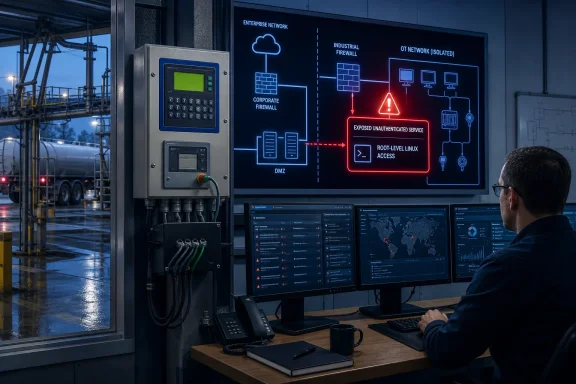 Network segmentation is the immediate control
CISA and Toptech Systems recommend placing affected RCU II+ and Multiload II+ equipment on a closed or properly segmented network with no untrusted access. Administrators should verify that the relevant device interfaces are not reachable from corporate user networks, guest Wi-Fi, vendor remote-access paths, or Internet-facing infrastructure.
For Windows administrators supporting OT environments, that means checking the routes and firewall policy around engineering workstations, jump hosts, VPN concentrators, and any Windows-based supervisory systems that can communicate with the loading equipment. Endpoint protection on a workstation does not mitigate an unauthenticated service exposed directly by the appliance; network boundaries do.
Toptech offers a low-impact removal tool
Toptech’s preferred remediation is its RCU II+/Multiload II+ Vulnerability Removal Tool, or VRT. The company says the tool removes the vulnerable service without breaking Weights and Measures seals, making it the lowest-disruption option for operational sites.
The alternative is installing the latest firmware available from Toptech. That path requires stopping the bay and breaking the W&M seal, and Toptech advises customers to back up the existing Multiload configuration before beginning the update.
Operators should treat the VRT as an urgent change-management task rather than a routine maintenance item. Before deployment, document the affected units, preserve configuration backups, confirm the tool’s source and integrity through Toptech support channels, and test communications and loading functions after remediation.
The operational cost of delay is higher than the maintenance window
The core exposure is unauthenticated remote access, not a flaw that requires a malicious file, user interaction, or existing account. Sites that cannot apply the VRT or firmware immediately should keep the devices isolated until the work can be completed.
Toptech Systems directs customers with questions to its security support team and has published a firmware vulnerability notice alongside the removal tools. The decisive next step is straightforward: identify every RCU II+ and Multiload II+ unit reachable from a broader network, segment it now, and schedule the VRT before an attacker gets a root shell first.
