
A small but important Linux kernel hardening landed this month: the framebuffer console (fbcon) subsystem was patched to clear stale pointers by setting fb_display*->mode to NULL when a framebuffer mode is released, closing a use‑after‑free discovered by syzkaller that could otherwise allow a local actor to crash or corrupt kernel memory.
 Background / Overview
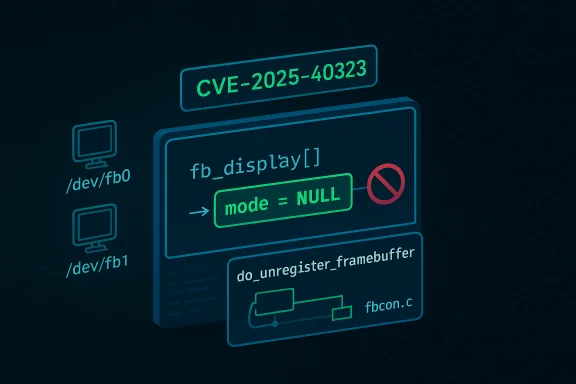
The Linux framebuffer console (fbcon) provides a simple kernel-side text console on framebuffer devices and is widely used in embedded systems, appliance kernels, and some distributions' fallback console implementations. A recently assigned CVE — CVE‑2025‑40323 — tracks a robustness defect in fbcon where a released videomode could leave a dangling pointer in the global fb_display[] array. The issue was surfaced by syzkaller (a kernel fuzzing tool), which produced a KASAN-detectable slab use‑after‑free in fb_mode_is_equal that led to a kernel read of freed memory. The kernel community accepted a surgical patch that clears fb_display->mode during framebuffer unregistration, preventing later accesses from following a freed pointer. This is a defensive, correctness fix: the underlying cause is lifecycle/cleanup asymmetry in the framebuffer code paths (mode lists being freed without nulling out pointers stored in fb_display[]). The practical risk is primarily availability (kernel oops/panic) and stability, although any kernel memory corruption has a theoretical potential to contribute to a more serious exploit chain under additional, unrelated primitives. Multiple vulnerability databases have recorded the CVE and the upstream/stable patches have been merged. What went wrong — technical anatomy
The failing lifetime model
At a high level, the kernel framebuffer code manages per‑device mode lists (fb_info->modelist) and a global array of console display descriptors (fb_display[]). Some userspace/driver operations can cause a given fb_info's mode structures to be freed (for example when a framebuffer device module is removed), yet those same mode pointers may have previously been referenced from fb_display[]. The bug occurs when the code frees modelist memory but does not sweep fb_display[] to remove references to now‑freed mode objects. Subsequent code paths that reference fb_display*->mode can therefore touch freed memory and trigger a use‑after‑free. This exact sequence was reproduced in a multi‑step syzkaller test case posted by the reporter. Example reproduction (simplified)
This sequence maps directly to the syzkaller output included in the public advisories and to the patch discussion. The root cause is a mismatch between the code paths that free modelist memory and the code paths that maintain the global display pointers. The pragmatic fix is to make the unregistration path defensive: when a mode is being unregistered, ensure no fb_display[] entries still point to it.
The upstream fix: small, surgical, and targeted
The accepted upstream patch (small modifications in drivers/video/fbdev/core/fbcon.c and a couple of related spots) adds logic to the framebuffer unregistration path so that when a mode is freed the code walks the fb_display[] array and clears any entries that pointed to the freed mode. The patch set is intentionally tiny — roughly 20 lines of insertion — and focuses on explicit pointer hygiene rather than refactoring bigger subsystems. The change was applied to the upstream kernel and cherry‑picked into the stable trees; stable maintainers have included the fix in the 6.17 stable update series. Why is this approach appropriate?
Severity, exploitability, and practical risk
Attack surface and vector
CVSS and scoring
At the time of publication the NVD record is present but marked "Awaiting Analysis" for NVD’s numeric CVSS scoring; public trackers have recorded the technical details but distribution vendors are treating this as a robustness/DoS fix rather than an immediate RCE/ESC vector. Operators should assume the fix is prioritized for availability/stability reasons and follow normal patching practice for kernel updates. Who is affected
Not every Linux installation is affected. Many modern distributions compile out the legacy fbdev/fbcon or do not expose /dev/fb in common server images. However, embedded images, custom kernels, or vendor kernels may still be vulnerable. Review your environment’s kernel config (CONFIG_FB_CONSOLE, CONFIG_FB) and whether /dev/fb devices exist on running hosts to triage exposure. Patching and mitigation guidance
Apply the upstream and vendor patches promptly in the following order of preference:
Operationally, the most practical remediation is to install the vendor kernel update and reboot into the patched kernel; the risk and regression surface of this patch are low given its surgical nature. For long‑lived appliances without easy patch cycles, consider vendor guidance or vendor-provided backports. Quick triage checklist
Operational considerations for cloud and enterprise environments
Enterprises should remember that containers inherit the host kernel. A patched container image does not mitigate an unpatched host kernel. In shared or multi‑tenant environments, a local kernel crash on a host affects all tenants; therefore patching host kernels that include the vulnerable code should be prioritized according to your risk model. For Azure and other cloud customers, vendor attestations and product‑scope mappings can help prioritize remediation, but they are inventory statements — they do not guarantee the absence of the vulnerable code in other vendor artifacts. Microsoft and other vendors have adopted machine‑readable VEX/CSAF attestations to help automate triage; use those attestations in conjunction with host‑level inventory to make patching decisions. Why this class of bug matters beyond immediate crashes
Even though the patch and the vulnerability look modest — a missing NULL assignment for a pointer swept into a global array — these are the exact kinds of lifetime bugs that produce flakey crashes and hard-to‑diagnose behavior in production systems. A few operational implications:
Patch anatomy — what changed in the code
The upstream commits add logic to the framebuffer unregistration routine (do_unregister_framebuffer/ fbcon_mode_deleted paths) to walk fb_display[] and set any fb_display*->mode pointers equal to the mode being freed to NULL. The change is minimal:
Because the change only clears pointers (rather than modifying allocation semantics or refcount behavior), the reconciliation and backport effort is small and carries minimal regression risk.
What to tell operations and managers
Strengths and potential risks of the upstream response
Notable strengths
Potential risks and caveats
Recommended next steps (concise)
Closing analysis
CVE‑2025‑40323 is a reminder that small lifecycle mistakes in kernel drivers produce stability and availability issues that matter in the real world. The Linux kernel community’s response — a minimal, carefully reviewed patch and stable backports — is the right practical approach for a bug that is primarily a local, availability‑oriented robustness defect. The technical fix (nulling stale pointers during unregister) eliminates the observed KASAN-detected use‑after‑free and is low‑risk to deploy.
Administrators should treat this as a routine kernel hardening: verify whether fbcon/fbdev is present and in use in their infrastructure, prioritize the vendor kernel updates that include the stable backport, and apply the patches in the next maintenance window. Systems that do not need framebuffer support are good candidates for further hardening by disabling the subsystem entirely. The community discussion, upstream commits, and stable patching activity provide sufficient evidence that the issue has been analyzed and resolved; however, operators must still perform host‑level inventory and confirm the applied kernel commits when validating remediation.
