
That materially changes this article's conclusion and also requires a correction to our original reporting. On August 12, a stable remediation was not clearly identified and Microsoft's published version threshold pointed to the 1.30.80 preview. Warning administrators not to guess that 1.29.280 was fixed was justified. However, the original article was wrong to say Microsoft had published no CVSS score or affected-version data: Microsoft's initial CNA record already contained the 7.3 score, CWE-269, and an App Installer range beginning at 1.0.0.0 and ending before 1.30.80. The ending threshold was later corrected to 1.29.280.
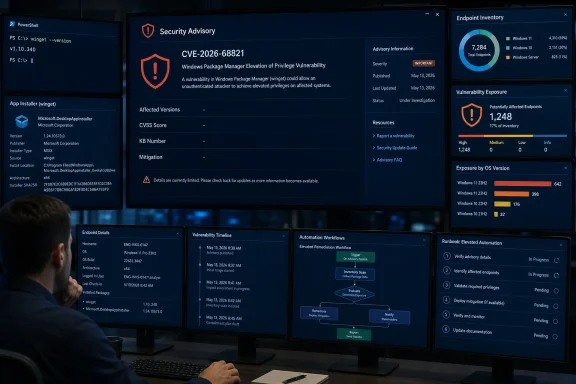
The confirmed fix is stable App Installer 1.29.280 or later
The current position is straightforward:
- Affected product: Microsoft App Installer, which includes Windows Package Manager.
- Affected range: Version 1.0.0.0 through versions below 1.29.280.
- First confirmed fixed stable release: WinGet/App Installer 1.29.280.
- Preview release required: No. Version 1.30.80 is not required solely to remediate this CVE.
- Microsoft severity: Important, with a CVSS v3.1 base score of 7.3 High.
- Maximum disclosed outcome: Microsoft's current FAQ says successful exploitation can yield SYSTEM privileges.
- Remediation: Update Microsoft.DesktopAppInstaller and WinGet to 1.29.280 or later stable.
WinGet 1.29.280 was released June 24, almost seven weeks before the CVE became public. Its release notes included a change titled “Fix configuration elevation validation for standard flow (1.29),” but did not identify CVE-2026-68821. The original article therefore correctly stopped short of declaring that release fixed: suggestive release-note wording alone was not enough to establish a security boundary.
The missing linkage arrived August 20 in Microsoft's official WinGet repository. WinGet product manager Demitrius Nelon explicitly identified 1.29.280 as the stable release addressing the vulnerability and said newer 1.29.x builds include the changes. Microsoft maintainer John McPherson said on August 21 that the CVE listing had been corrected on Microsoft's side, while warning that downstream databases and scanners might take time to synchronize.
Microsoft's current August security data now lists FixedBuild: 1.29.280, points to the stable 1.29.280 installer, and says no restart is required. The corrected Microsoft CNA data expresses the affected range as App Installer 1.0.0.0 inclusive through 1.29.280 exclusive.
This explains why some vulnerability scanners briefly treated a remediated 1.29.280 installation as vulnerable: they had ingested the earlier 1.30.80 threshold. Administrators should refresh scanner content and re-scan before treating such a result as evidence that the stable fix failed.
This is an App Installer version issue, not a Windows KB test
CVE-2026-68821 is scoped to Microsoft App Installer rather than to a named Windows cumulative update or OS build. Microsoft Learn documents WinGet as part of App Installer on Windows 11, modern Windows 10, and Windows Server 2025. App Installer is normally serviced through the Microsoft Store on Windows desktop systems and through updates on Server 2025.
Windows 11 systems and supported Windows 10 systems can therefore be exposed when the installed App Installer package is below 1.29.280. The WinGet CLI is supported from Windows 10 version 1809, build 17763, onward, but Microsoft has not published a CVE-specific matrix of Windows 10 or Windows 11 builds. No cumulative-update KB is identified as the remediation vehicle.
A device can consequently be current on monthly Windows security updates while still requiring an App Installer package check. Conversely, a machine should not be reported as vulnerable merely because an outdated scanner expects version 1.30.80 when App Installer 1.29.280 or later is installed.
Microsoft scores the flaw 7.3 High, while NVD scores it 7.8
Microsoft describes the vulnerability as improper privilege management in Windows Package Manager that allows an authorized attacker to elevate privileges locally. It assigns CWE-269, Improper Privilege Management, and the following CVSS v3.1 base vector:
CVSS:3.1/AV:L/AC:L/PR:L/UI:R/S:U/C:H/I:H/A:HThat produces Microsoft's authoritative CNA base score of 7.3 High. Microsoft models the attack as local and low-complexity, requiring an attacker who already has low privileges plus user interaction. Confidentiality, integrity, and availability impacts are all rated High. MSRC's current FAQ adds that successful exploitation could grant SYSTEM privileges.
This is best understood as a post-compromise local privilege-escalation vulnerability, not an unauthenticated remote-code-execution flaw, network worm, or initial-access mechanism. Under Microsoft's model, an attacker must already have local execution or access in a low-privileged context.
Some security tools may instead display 7.8 High. That is NVD's separate analyst assessment, which uses User Interaction: None rather than Microsoft's User Interaction: Required. The difference is a scoring-model disagreement over an exploitation prerequisite, not a disagreement about whether the vulnerability exists or whether 1.29.280 fixes it. Vendor-oriented reporting should use Microsoft's 7.3 score while clearly labeling NVD's 7.8 assessment when it appears.
No CVSS v4.0 score is present in the current Microsoft CNA or NVD records. The 6.4 figure visible in some Patch Tuesday data is Microsoft's CVSS v3.1 temporal score, not CVSS v4.
The source change is useful context, not an exploit recipe
The open-source change associated with the fixed release was merged into the 1.29 branch on June 22. Pull request 6318 describes a case-sensitive Boolean conversion that interfered with elevation validation in standard WinGet Configuration flows containing elevated units. The change made that conversion case-insensitive, and its merge commit is the commit identified by the 1.29.280 release.
That establishes the implementation lineage of the elevation-validation fix, but it should not be turned into a speculative exploit recipe. Microsoft's CVE description does not explicitly say the Boolean conversion alone is the complete vulnerability, and the vendor has not published the precise user action or a complete exploitation sequence. The defensible conclusion is narrower: 1.29.280 contains the elevation-validation change, and Microsoft both lists that build as fixed and identifies it as the stable CVE remediation.
No credible public proof of concept was identified in the authoritative and public material reviewed through August 27. Microsoft's current exploitability fields say Exploited: No, Publicly Disclosed: No, and Exploitation Less Likely. CISA's enrichment records exploitation as none, automation as no, and technical impact as total.
Those findings indicate limited demonstrated exploit maturity; they do not prove exploitation is impossible or that no private exploit exists. They also do not justify delaying the available stable update, given the potential SYSTEM-level outcome.
How administrators should verify and apply remediation
Check both the WinGet CLI and App Installer package inventory. On shared or multi-user machines, run the package query from an elevated PowerShell session so all-user registrations can be reviewed:
winget --version

Get-AppxPackage -AllUsers Microsoft.DesktopAppInstaller |
    Select-Object Name, Version, PackageFullName, PackageUserInformation
The security comparison is:
Microsoft.DesktopAppInstaller below 1.29.280 = affected
Microsoft.DesktopAppInstaller 1.29.280 or later = fixed

WinGet 1.29.280 or later stable = confirmed remediation
A fixed package may display the four-part version 1.29.280.0, while winget --version reports v1.29.280. Administrators should account for that formatting difference rather than treating it as a mismatch.
Microsoft documents winget upgrade Microsoft.AppInstaller for updating App Installer. Desktop systems that normally receive App Installer through Microsoft Store servicing should also be checked to ensure app updates are functioning. Organizations that disable Store delivery, use private application management, or maintain offline images can distribute the trusted stable App Installer bundle through their normal enterprise channel; moving to the 1.30.x preview channel is unnecessary for this CVE.
Multi-user devices deserve extra attention. The interactive administrator's winget --version result does not necessarily describe every staged or per-user App Installer registration. Review PackageUserInformation and investigate older registrations rather than validating only the currently signed-in account.
Security teams should update vulnerability-scanner feeds before re-scanning. Definitions created during the metadata mismatch may still expect 1.30.80 and can incorrectly flag the fixed 1.29.280 stable build.
No separate workaround or CVE-specific indicators are published
Microsoft has not specified a separate configuration workaround in the current record. Because a stable fixed release exists, updating App Installer is preferable to relying on compensating controls. Disabling WinGet fleet-wide is neither required by the advisory nor necessary once the fixed package is installed.
Where immediate servicing is impossible, reasonable temporary precautions include limiting unnecessary WinGet Configuration or DSC use on high-value systems, reviewing configuration files before execution, maintaining least privilege, and preventing elevated automation from consuming untrusted configuration content. Microsoft already warns users to review WinGet Configuration files and verify the credibility of their associated resources. These are defense-in-depth measures, not Microsoft-prescribed CVE workarounds.
No CVE-specific hashes, filenames, network indicators, or other indicators of compromise have been published. Version compliance is therefore the most reliable exposure check. Defenders may also monitor unusual execution of winget configure from low-trust user contexts, especially when followed by elevated child activity. Such monitoring is a behavioral hunting heuristic, not a published signature for exploitation.
Disclosure and correction timeline
- June 22: The elevation-validation fix is merged into the WinGet 1.29 release branch.
- June 24: WinGet 1.29.280 stable ships with that change.
- July 31: CVE-2026-68821 is reserved.
- August 11: Microsoft publicly discloses the vulnerability. The initial CNA record carries CVSS 7.3, CWE-269, and an affected range below 1.30.80, but does not identify a defensible stable remediation.
- August 12: WindowsForum reports that Microsoft published no CVSS or affected-version data; this revision corrects that part of the original article.
- August 20: A Microsoft WinGet maintainer confirms that stable version 1.29.280 addresses the vulnerability and that later 1.29.x versions include the changes.
- August 21: Microsoft says its CVE listing has been corrected.
- August 26: The Microsoft CNA record identifies App Installer versions below 1.29.280 as affected.
- August 27: The corrected threshold is visible in current Microsoft, CVE, and NVD data.
The June release date is the date of the first fixed stable build, not the public security-disclosure date. Microsoft has not publicly identified who discovered the vulnerability or when its security significance was first recognized.
The current administrator takeaway
CVE-2026-68821 now has a concrete remediation: update Microsoft App Installer and WinGet to 1.29.280 or later stable. Do not move endpoints to a 1.30.x preview solely for this vulnerability, and do not use Windows cumulative-update compliance as proof that App Installer is fixed.
Prioritize shared endpoints, developer and administrative workstations, and systems that use WinGet Configuration or DSC in elevated workflows. Verify package state across relevant users, refresh scanner content, and use behavioral monitoring where appropriate. The issue remains a meaningful local privilege-escalation risk with a potential SYSTEM-level outcome, but current evidence does not support describing it as remotely exploitable, actively exploited, or backed by a public proof of concept.