
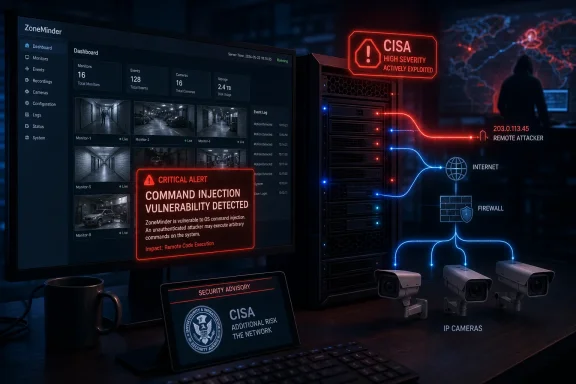
For administrators, the immediate concern is not whether ZoneMinder is an industrial-control product in the narrow sense. It is that the software commonly occupies a sensitive position: it stores camera streams, retains event footage, connects to IP cameras, and is often reachable from a browser on a business or home network. Code execution as the account running Apache, Nginx/PHP-FPM, or another web service may not equal root access, but it can be enough to read application material, tamper with recordings, pivot toward reachable cameras, or establish a foothold on a poorly segmented network.
CISA says it has no reports of exploitation specifically targeting this flaw. That statement should not be confused with an absence of exploitability: the same advisory says a public proof of concept exists. A public exploit lowers the work required to test exposed installations and makes internet-facing ZoneMinder deployments the first systems administrators should examine.
 CISA’s version listing leaves the remediation question open
The most important omission in CISA’s August 25 advisory is a clear fixed-version path. It lists “1.37.48 | 1.38.3” under affected versions, but does not identify a CVE number, vulnerable endpoint, authentication requirement, patch commit, workaround, or release that resolves the issue.
That is an operational problem, not a paperwork issue. A security team cannot responsibly close a finding merely by upgrading to a newer-looking package unless the vendor or advisory explicitly connects that package to the flaw. ZoneMinder’s GitHub release history shows version 1.38.4 was released on August 11, before CISA published this notice, and describes a broad group of authorization and injection-hardening changes. But its release notes do not plainly identify the vulnerability in CISA’s advisory or say that 1.38.4 fixes it.
Administrators should therefore not assume that ZoneMinder 1.38.4 is a documented fix for this specific CISA finding. It may contain relevant hardening, but the record available in the advisory does not establish that connection. The same caution applies to distributions that backport patches while retaining an older upstream version string: package changelogs and vendor security trackers matter more than the visible ZoneMinder version alone.
The lack of a CVE identifier also makes normal vulnerability-management correlation harder. Asset teams using CISA feeds, scanners, CMDB records, or SIEM enrichment will have difficulty tracking exposure and closure if they cannot map the advisory to a stable vulnerability record. Until ZoneMinder or CISA publishes that identifier and a verified fixed build, this should be treated as an active patch-validation task rather than a routine version update.
“Web server user” is a meaningful compromise boundary
CISA characterizes the impact as remote code execution “as the web server user.” That wording establishes a limit: the advisory does not claim direct root-level code execution. But treating the distinction as harmless would be a mistake.
ZoneMinder deployments typically need access to application configuration, a database, event media, snapshot paths, and camera connection details. The exact permissions vary by package and installation method, but a compromised web process can often reach information and services that are valuable to an intruder even if it cannot immediately modify the operating system’s protected files.
The practical consequences depend on deployment design:
- A ZoneMinder server exposed directly to the public internet gives an attacker an external path to the surveillance environment, especially where the web interface has weak authentication or no reverse-proxy access controls.
- A server on the same flat network as cameras can offer a route to camera administration interfaces and video feeds, even when those devices are not themselves exposed externally.
- A host that stores events locally may allow footage to be copied, deleted, encrypted, or altered under the permissions available to the ZoneMinder stack.
- A service account with overly broad sudo rights, writable startup paths, container-management access, or reusable credentials can turn a web-process compromise into a broader server compromise.
Those are risk scenarios, not claims that every vulnerable installation is rooted or every camera is accessible. The decisive factor is the service account’s actual permissions and the network routes available from the ZoneMinder host. That is why reviewing the account boundary and network segmentation belongs in the response plan alongside patching.
The public proof of concept changes the exposure calculation
CISA says it discovered a public proof of concept authored by Scriptkittens and reported the issue to ZoneMinder. It simultaneously says there is no known public exploitation specifically targeting the vulnerability.
Both facts can be true. A proof of concept demonstrates that someone has published a method or code capable of exercising the bug, while confirmed exploitation means CISA has evidence of malicious use against real targets. The first condition creates urgency for defenders; the second determines whether the agency has observed a campaign. Organizations should not wait for the latter before reducing exposure.
The advisory identifies the weakness as CWE-78, improper neutralization of special elements used in an operating-system command—the classic command-injection category. In these flaws, application data reaches a shell command without adequate separation or escaping, allowing crafted input to alter what the operating system executes. CISA’s 8.8 score reflects the seriousness of remotely running commands through a surveillance-management web application.
ZoneMinder’s own project history gives additional reason to avoid complacency. The project’s 1.38.3 release notes, published in May, documented numerous security and injection-hardening changes across web, API, export, ONVIF, camera-probe, and command-execution paths. That does not prove those earlier fixes are related to this new CISA advisory. It does show that command construction and user-controlled input have been recurring hardening areas in the codebase, which makes exact patch verification more important than broad assurances that a deployment is “reasonably current.”
What ZoneMinder administrators should do today
The first step is to inventory every ZoneMinder installation, including appliances, virtual machines, containers, test environments, and systems managed by third-party security or facilities vendors. Confirm the running application version and the package revision supplied by the distribution or repository. CISA specifically names 1.37.48 and 1.38.3; any installation reporting either should be considered exposed until its package maintainer or ZoneMinder publishes a remediation statement.
Next, remove direct internet exposure. CISA’s guidance is straightforward: minimize network exposure, place control and remote devices behind firewalls, and use more secure remote-access methods such as a maintained VPN where remote access is required. For ZoneMinder, that means the web UI should normally be reachable only from an administration network, a VPN, or a tightly controlled reverse proxy with strong authentication—not from an unrestricted public address.
Administrators should also inspect the web-facing path rather than relying solely on application login controls. Verify firewall rules, router port forwards, cloud security groups, reverse-proxy routes, IPv6 exposure, and any remote-support tunnels. A deployment can appear internal from the administrator’s workstation while remaining externally reachable through an old NAT rule or a vendor-managed access service.
Then review the web server account’s privileges. Identify which user runs the ZoneMinder web application, what directories it can read and write, whether it can invoke privileged helpers, and whether it has access to database credentials, SSH keys, backup shares, Docker sockets, or service-management commands. The goal is to ensure that code execution at the web layer remains confined to the smallest possible boundary.
Finally, preserve evidence before making disruptive changes if there is any reason to suspect compromise. Review web-server access and error logs for unusual requests, unexpected shell activity, new scheduled tasks, unfamiliar processes under the web-service account, altered ZoneMinder files, and outbound network connections from the surveillance host. CISA does not provide exploit indicators in the August 25 advisory, so there is no authoritative request pattern to hunt for yet. Generic web-shell and anomalous-process checks are appropriate, but they are not a substitute for a vendor-specific detection signature.
Do not close this advisory on a guessed upgrade
The defensible short-term position is simple: isolate or restrict vulnerable ZoneMinder instances, validate whether your package includes a vendor-confirmed fix, and watch for a CISA revision or ZoneMinder security notice that supplies the missing CVE and corrected releases.
The public proof of concept means this is already beyond a theoretical coding defect. Until the project ties the advisory to a specific patched version, the concrete consequence for administrators is that network exposure and service-account privilege are the controls they can verify today—and they may be the difference between a contained web application flaw and a compromised surveillance environment.
