

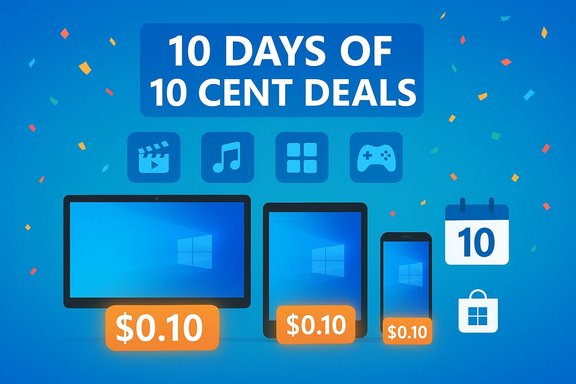
Microsoft’s surprise “10 Days of 10 Cent Deals” was a high‑visibility Windows Store promotion that let Windows 10 users pick up music, movies, apps and games for just $0.10 apiece — a marketing stunt that boosted discovery, drove new customers to the Store, and left a lasting lesson about platform promos, digital storefront economics, and the limits of “blowout” pricing as a retention tool. The campaign ran as a Thanksgiving‑season thank‑you to Windows 10 customers, was executed as a rotating daily list of heavily discounted items, and was framed by Microsoft as a device‑exclusive incentive tied to the Windows 10 platform and the then‑new November update.
Microsoft’s Windows Store (later rebranded Microsoft Store) has long been both a product distribution channel and a marketing lever for the company’s broader OS strategy. In November 2015 Microsoft announced a time‑limited, high‑volume sale — offering over 1,000 items for $0.10 each over roughly ten days — to celebrate Windows 10 adoption and to encourage customers to explore the Store on Windows 10 devices. The company positioned the promo as a consumer thank‑you tied to the platform’s momentum and to the release of the November update. The promotion was packaged as a daily rotation of deals: each day a fresh set of movies, music albums, apps and games were placed at the $0.10 price point. Some days also included bonus offers and additional categories, and a final “bonus day” was added after the initial run in response to the promotion’s performance. Microsoft limited the promotion to Windows 10 devices and the US market (50 states + DC for the initial run), and the deals were transient — many were available for a single day only.
Source: BetaNews https://betanews.com/article/microsoft-windows-store-dime/]
 Background
Microsoft’s Windows Store (later rebranded Microsoft Store) has long been both a product distribution channel and a marketing lever for the company’s broader OS strategy. In November 2015 Microsoft announced a time‑limited, high‑volume sale — offering over 1,000 items for $0.10 each over roughly ten days — to celebrate Windows 10 adoption and to encourage customers to explore the Store on Windows 10 devices. The company positioned the promo as a consumer thank‑you tied to the platform’s momentum and to the release of the November update. The promotion was packaged as a daily rotation of deals: each day a fresh set of movies, music albums, apps and games were placed at the $0.10 price point. Some days also included bonus offers and additional categories, and a final “bonus day” was added after the initial run in response to the promotion’s performance. Microsoft limited the promotion to Windows 10 devices and the US market (50 states + DC for the initial run), and the deals were transient — many were available for a single day only. What the promotion actually offered
The mechanics: rentals vs purchases, device restrictions, and time windows
- The promotion included a mix of movie rentals, music album purchases, app purchases, and game purchases. Notably, many of the movie deals were rentals (you paid $0.10 to rent for the standard rental window), while albums, apps and games were typically one‑time purchases at the dime price. This distinction is crucial for buyers: a $0.10 movie rental is not the same as owning the digital copy.
- The deals were device and platform‑restricted: to view and take advantage of the list, you needed to browse the Windows Store from a Windows 10 device (desktop, tablet or phone). Attempting to view the promo pages from non‑Windows 10 platforms produced errors or prevented checkout. Microsoft expressly limited the program to Windows 10 devices as a marketing incentive to use — and upgrade to — the platform.
- The daily rotation structure meant many items were available for a short, predictable window (one day), encouraging daily visits and impulse buys. A small set of items was highlighted each day — usually a “top 10” list across movies, music, apps and games — but Microsoft indicated there were many more items available at the discounted price in the Store each day.
Examples of deals that appeared
Microsoft and tech outlets highlighted specific titles to illustrate the breadth and appeal of the sale. Sampling the days shows the mixture of content types and recognizable brands involved:- Movies (rental examples): Inside Out, Mad Max: Fury Road, The Dark Knight Rises, Cinderella, San Andreas.
- Music albums: Zedd — Clarity, Maroon 5 — Overexposed, The Weeknd — Trilogy, Steve Aoki — Neon Future II.
- Games & apps: Rayman Fiesta Run, Halo: Spartan Assault / Spartan Strike on certain days, Mini Motor Racing, 8 Zip / Readiy Pro.
How Microsoft measured success — and what they reported
Microsoft publicly described the campaign as a success and released early performance metrics. According to the Windows Experience Blog, the company saw:- About a 10× daily increase in customers making a purchase on the Windows Store during the promotion versus the prior week.
- A 29× increase in the purchase rate of apps, games, movies and music compared with performance the week before the promotion.
- Over 75% of deal purchasers were new to the Store during the promotion window, indicating strong acquisition impact.
Why this mattered for the Windows Store and UWP adoption
Short‑term wins: discovery and conversion
Limited‑time, ultra‑low pricing is one of the fastest ways to increase download numbers and broaden the user base for apps — and Microsoft’s data show the tactic worked. Pricing at $0.10 made many purchases impulse‑driven and dramatically lowered the friction for trying an app or buying an album. For smaller developers that landed on the day’s list, the promotional bump could translate to new users, install momentum, and in‑app engagement that outlasts the promotion.Longer‑term questions: retention, monetization, and developer value
A surge of low‑price downloads doesn’t automatically translate into long‑term active users or recurring revenue. When a purchaser’s cost of acquisition is $0.10, the Store and the developer must still find ways to drive continued usage or monetize with add‑ons and subscriptions. That tradeoff — high acquisition volume versus low per‑unit revenue — is a common tension in marketplace promotions. Developers benefit from exposure, but only if follow‑on monetization or retention improves sufficiently after the promotion. The campaign’s value to developers therefore depended on how many new users converted to paying customers later or stayed active.Consumer considerations and caveats
Region, device, and legal terms
Microsoft limited the promo to the United States (50 states + DC) and Windows 10 devices for the initial run. Consumers outside the region or on different OS versions could be blocked from seeing or buying deals. The official fine print made geographic and device restrictions explicit — buyers needed to be mindful of region limitations and the need to use a Windows 10 device to check the Store.Movie rentals vs purchases
A frequent customer misunderstanding with mixed content promos is the difference between renting a movie and buying an album or app outright. Many movie entries were rentals priced at $0.10; renting restricts your access window (e.g., 30 days to begin watching, 24–48 hours after you start). Customers should confirm the purchase type before buying. If the goal is outright ownership of a film, a rental at $0.10 may be appealing for short‑term viewing but not for long‑term archiving.DRM, platform lock‑in, and account billing
- Purchases were tied to Microsoft accounts and to the Store. License management, device limits, and DRM rules could affect playback and re‑downloads. Consumers should understand that content purchased at deep discounts remains subject to platform licensing terms.
- Because the Store checkout used the Microsoft ecosystem (payment methods on file, account billing), unexpected purchases or mis‑clicks could be an issue for families or shared devices. Parents should use account controls and purchase confirmation settings to avoid accidental buys.
Transience and FOMO
The rotating daily format cultivated fear‑of‑missing‑out (FOMO). Short windows increased urgency — which can be good for driving visits, but also can result in purchasers loading their libraries with low‑value content they won’t actually use. For collectors or bargain hunters, FOMO can lead to a “digital junk drawer” of unused purchases.Developer and marketplace impact — analysis
Benefits for small and mid‑sized developers
- Exposure on the front page or in the promotional feed is hard to buy organically; inclusion in a curated sale can massively increase installs and visibility. For many indie developers the promotional boost can produce a measurable uplift in ratings, reviews and new users accessing in‑app purchases or subscriptions later. The Windows Store’s promise of cross‑device reach on Windows 10 (desktop, tablet, phone) gave participating apps additional channels for discovery.
Risks for app economics
- Heavy discounting sets a low price anchor that can make it harder to raise prices post‑promo. If a customer bought an app during the dime sale, converting that user to a paid subscription at full price later becomes harder because of expectations set by the promo.
- The Store’s revenue share and fees mean developers received only a portion of each $0.10 sale — for very small purchases the net revenue after fees could be negligible. That makes volume and follow‑on monetization essential for developer benefit.
Platform strategy signal
The campaign reinforced Microsoft’s strategy at the time: push Windows 10 adoption, showcase the Windows Store as a destination for entertainment and apps, and accelerate Universal Windows Platform (UWP) adoption by generating demand for Windows‑native apps. The promotion was both a marketing vehicle and an execution test for Store engagement mechanics (daily rotations, curated collections, and cross‑category merchandising).How to responsibly approach these kinds of deals (consumer checklist)
- Confirm whether the item is a purchase or rental before clicking Buy.
- Use account controls to prevent accidental purchases on shared devices.
- Check region and device restrictions before assuming a deal is available to you.
- Read the Store item page for DRM or device limits if you plan long‑term access.
- For app purchases, look at recent reviews and the developer’s update cadence; a $0.10 purchase of an abandoned app is still a bad buy.
- If you’re a developer, prepare a post‑promo retention plan (in‑app events, push notifications, or follow‑up offers) to convert low‑value buyers into engaged users.
Promotional effectiveness — what the numbers tell us (and what they don’t)
Microsoft’s publicly reported multipliers (10× more daily purchasers; 29× increase in purchases vs. the week prior; 75% of deal purchasers were new to the Store) show the promotion drove user acquisition and transactions. However, those metrics are short‑term and don’t answer longer‑term questions such as:- Did the promotion materially increase lifetime value (LTV) of new customers?
- How many new customers became repeat purchasers or subscribers?
- Did the promotional buyers return to the Store after the promotion ended?
Broader context: why companies do dime‑price promotions
- Visibility: Featuring content at a trivial price is a guaranteed attention driver. Coverage‑worthiness and social sharing often follow because the offer is so extreme.
- Inventory monetization: Platforms with large catalogs can use low prices to monetize older inventory or highlight partner content.
- Acquisition funnel: Ultra‑low prices can seed a funnel for subscriptions, consumables, or in‑app purchases later.
What happened after the promotion
Microsoft extended the event with a one‑day “bonus” because of strong demand, then returned to more conventional Store merchandising and seasonal sales models. The Windows Store continued to experiment with promotional tactics — including holiday sales, themed collections and developer‑focused promotions — but the dime campaign remains a prominent example of a platform‑level, time‑boxed blitz intended to drive downloads and trial. The initiative’s immediate uplift validated the Store’s potential as a discovery engine, but did not eliminate the longer‑standing challenges of developer economics and user retention on the Windows platform.Strengths and weaknesses — a final assessment
Notable strengths
- Massive acquisition spike: The reported 10×/29× performance gains show the tactic worked to stimulate purchase activity.
- Broad appeal: Combining movies, music, apps and games widened the sale’s relevance across demographic groups.
- Platform alignment: Tying the offer to Windows 10 usage reinforced the upgrade and engagement narrative for Microsoft.
Potential risks and downsides
- Revenue dilution: $0.10 price points generate tiny per‑unit revenue, which can undercut developer economics unless volume or follow‑on conversions compensate.
- Expectation setting: Regular or frequent ultra‑low pricing trains customers to wait for big discounts, reducing willingness to buy at full price.
- Short‑term focus: Without transparent long‑term retention metrics, acquisition spikes alone don’t demonstrate sustained platform health.
Lessons for platforms, developers, and buyers
- Platforms should pair short‑term promotional spikes with clear retention programs and measurement plans that assess whether new customers become active, paying users.
- Developers benefiting from such promotions should optimize onboarding and retention flows so the temporary visibility converts into ongoing engagement.
- Buyers should be mindful of content type (rental vs purchase), DRM and device constraints, and resist impulse accumulation of unused purchases.
Conclusion
The “10 Days of 10 Cent Deals” campaign was an audacious, PR‑friendly promotion that succeeded visibly at one thing: driving traffic and new buyers into the Windows Store. Microsoft’s public metrics support that outcome, reporting large multipliers in daily purchase activity and substantial numbers of new Store customers during the event. But the promotion also illustrates the classic marketing tradeoff between short‑term acquisition and long‑term value: a dime‑priced impulse buy may cost a platform very little on a per‑transaction basis, but only sustained engagement, repeat purchases, or successful post‑promo monetization convert a fleeting spike into enduring platform health. For consumers, the sale was a rare bargain — provided they understood rentals, DRM limits, and regional restrictions. For developers, it was a high‑visibility chance that came with the usual caveats about pricing, revenue share, and the importance of converting trial users into lasting customers.Source: BetaNews https://betanews.com/article/microsoft-windows-store-dime/]

