

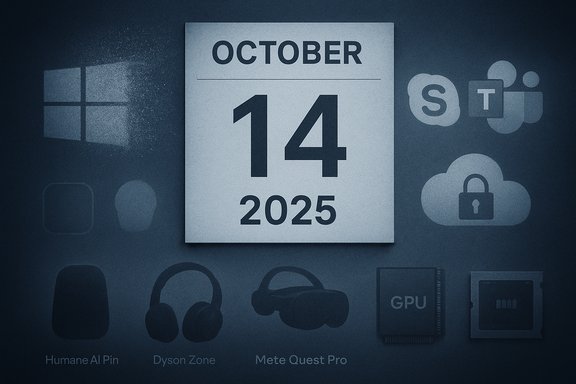
2025 closed like a slow-motion exhale across the tech industry: a year when familiar software, experimental hardware, and long-lived services reached their finish lines—sometimes by schedule, sometimes by strategic reprioritization—and left users, IT teams, and policymakers grappling with the practical consequences of sudden consolidation, reduced portability, and supply-side realignment.
Background / Overview
The list of retirements and shutdowns collected throughout 2025 reads less like a roll call of isolated failures and more like a map of where the industry is headed. Several clear patterns emerged:- Calendar-driven retirements: long-expected end-of-support events (notably Windows 10) that created mass migration pressure.
- Product pruning and consolidation: companies killing redundant consumer-facing apps or folding features into larger platforms (Skype → Teams; Zelle’s standalone app; various password managers).
- Failed hardware experiments: high-profile, high-cost devices (Humane AI Pin, Dyson Zone, Meta Quest Pro) that never found broad daily-utility or price-justified adoption.
- Cloud-first control moves: vendors removing local export features and tightening delivery channels (Amazon’s removal of Kindle USB downloads), shifting ownership dynamics of digital purchases.
The tectonic shift: operating systems and platform end-of-life
Windows 10 — the calendar that moved millions
Microsoft’s decision to end mainstream support for Windows 10 on October 14, 2025 was the most consequential scheduled retirement of the year. The company’s lifecycle pages and consumer guidance make the stakes straightforward: after October 14 the OS no longer receives routine feature updates, mainstream technical support, or security fixes unless a device is enrolled in a time-bound Extended Security Updates (ESU) program. That formal end-of-support date is published on Microsoft’s site. Why this mattered in practical terms: Windows 11 enforces stricter platform requirements—TPM 2.0, Secure Boot, UEFI firmware expectations, and a constrained list of supported CPU families—which left a sizeable subset of still-functional PCs ineligible for a free in-place upgrade. The result was a multi-pronged pressure:- Security risk for households and small organizations that could not or would not upgrade.
- Sudden capital demands on budget-constrained institutions (schools, nonprofits) that must choose between paid ESU, hardware refresh, or migration to alternatives.
- A stimulus to the second-life and refurbishment market—ChromeOS Flex and Linux distributions saw increased interest as pragmatic mitigation paths.
Platform consolidation — Skype, Chime and the push toward unified stacks
The consumer communications space also witnessed tectonic consolidation. Microsoft formally retired the consumer Skype apps in May 2025 and encouraged migration to Microsoft Teams Free; the company published detailed transition guidance and timelines for data portability and subscription handling. Amazon’s Chime followed a similar fate as parent companies assessed overlap and scale: maintaining multiple general-purpose conferencing services is increasingly expensive in a market dominated by a few strong incumbents. These retirements illustrate a larger vendor calculus: duplicate consumer products that don’t drive enterprise stickiness or recurring revenue are prime targets for consolidation.AI and the fast-moving model lifecycle
GPT-4 retires from ChatGPT — model deprecation at internet scale
OpenAI’s decision to remove GPT‑4 from the ChatGPT model picker on April 30, 2025—replacing it with GPT‑4o—was more than a product tweak; it exposed the operational reality of AI model churn. OpenAI documented the move in release notes and framed it as an upgrade: GPT‑4o is a natively multimodal successor, and GPT‑4 remains available via the API for developers who need continuity. Why this matters: enterprises that locked products or pipelines to a specific model face migration costs. When a high-capability model that powered large swaths of tooling is retired from front-end products, customers must update prompts, fine-tunes, and safety filters. The AI lifecycle therefore becomes a new item on the IT operations checklist: expect and budget for model transitions.Hardware gambles — Humane, Dyson, Meta and the limits of novelty
2025 illustrated that software-first AI and cloud-hosted models scale better than single-purpose hardware. Humane’s AI Pin is the poster child: after critical reviews, returns eclipsing sales, and battery and UX complaints, much of Humane’s technology and patents were acquired by HP, and the Pin itself was discontinued—with online services shut down at the end of February 2025. Tech reporting confirmed HP’s purchase of Humane assets and the effective end of the consumer device. Other experiments with high novelty but modest daily utility also folded. Meta discontinued the premium Quest Pro headset as it refocused on mass-market headsets; Dyson stopped the Zone air‑purifying headphone project when the product failed to scale despite engineering polish. The lesson is blunt: novelty does not equal necessity, and consumers already carry superset devices (smartphones and smartwatches) that meet most “assistant” use cases.Ownership, portability, and the cloud squeeze
Digital purchases and the shrinking perimeter of ownership
Amazon’s removal of the “Download & Transfer via USB” option for Kindle purchases on February 26, 2025 tightened vendor control over purchased ebooks. Independent technology outlets reported the change and Amazon confirmed that users could still deliver books to Wi‑Fi–enabled Kindles and apps but could no longer download purchased books to a local PC for manual transfer or archiving. This small UI change has outsized implications for users who prefer independent backups or who rely on older devices without Wi‑Fi. This is an example of a broader movement: carriers of user content are migrating to cloud-first delivery models that improve convenience and DRM control—but also reduce portability and the ability to archive purchases outside the vendor ecosystem. The fallout is practical: users who care about true file ownership must act proactively to back up content before vendor-imposed cutoffs.Cloud-first features removed or repackaged
Across 2025 vendors removed standalone features and folded them into platform-level experiences—streams now expire sooner, separate apps were shuttered, and certain free perks were removed. These moves increase convenience for the majority while reducing optionality for users who favored modular or offline workflows. It’s a trade-off between scale economics and consumer autonomy.Supply-side economics: memory, GPUs, and prioritizing AI scale
Micron’s shift away from Crucial and the consumer memory crunch
The AI compute build‑out in 2024–2025 reshaped component priorities. Micron announced it would exit the Crucial consumer business, redirecting capacity toward enterprise and HBM memory for data centers. The company confirmed plans to phase consumer Crucial shipments through the end of its fiscal Q2 (February 2026) and to continue warranty and support during the transition. Coverage from independent outlets and financial reporting corroborated the shift and highlighted dramatic market effects—dramatically higher DDR prices and tighter consumer supply as vendors prioritize lucrative AI customers. Why this is consequential: RAM and SSD supply squeezes reverberate through PC builders, gamers, and OEMs. When major manufacturers privilege HBM and enterprise DRAM for data centers, consumer prices climb and availability becomes volatile—especially for new PC builds timed to holiday or educational buying seasons. The longer-term effect can be structural: higher entry prices for capable consumer devices and slowed refresh cycles for mainstream users.The consolidation of smaller services and the death of “nice-to-have” apps
Throughout 2025 many single-purpose or low-usage consumer services were cut: Dropbox discontinued its password manager; Dashlane removed its free tier; the standalone Zelle app was retired; the Amazon Appstore for Android folded; smaller media stores and loyalty programs were discarded. Vendors rationalized overlapping functionality or eliminated features that had low adoption in favor of core revenue drivers. These closures underline a pragmatic fact: companies increasingly prioritize scaleable, recurring-revenue services and AI infrastructure over marginal consumer utilities.Strengths revealed and risks exposed
Notable strengths
- Operational discipline: Companies that focused resources on high-value, scalable services (AI compute, enterprise tooling, unified platforms) improved margin profile and product focus. This discipline reduces engineering scatter and can accelerate innovation where usage and monetization align.
- Refurbishers and community action: The forced migrations catalyzed vibrant community responses—non-profits, refurbishers, and local programs repurposed eligible hardware (installing ChromeOS Flex or modern Linux) to reduce waste and preserve access.
Material risks and downstream costs
- Concentration and lock-in: As vendors remove portability (ebooks, standalone apps) and consolidate services, consumer choice and inter-operability shrink. This favors incumbents and raises switching costs for users and enterprises.
- Security exposure from EOL: OS and platform EOLs are not merely theoretical; unsupported software becomes an attack vector. Households and small organizations with limited upgrade budgets either pay for temporary ESU, migrate to alternatives, or accept rising risk.
- Supply fragility: Prioritizing HBM and enterprise DRAM to feed AI data centers tightens the consumer market, raising the upfront cost of capable PCs and potentially depressing device refresh cycles—this has social equity implications for access to modern computing.
- Environmental cost: Hardware gating and forced replacements accelerate e‑waste unless offset by robust refurbishment programs, warranties, and policy incentives for repairability.
What to do now: practical guidance for users and IT leaders
- Inventory and triage: identify devices, OS versions, and criticality. Prioritize mission-critical endpoints for paid ESU or hardware refresh.
- Confirm Windows 11 eligibility early: use vendor tools such as PC Health Check and consult Microsoft support guidance. For ineligible machines, plan alternative futures (ChromeOS Flex, managed Linux images, or targeted hardware replacement).
- Back up vendor-tethered content now: If you rely on Kindle USB downloads, DRM-free local archives, or similar export paths, take action before vendor cutoffs. Small features can have outsized portability effects.
- Plan for AI model churn: when embedding models in production, assume deprecation windows and design abstraction layers so you can switch providers or models with minimal disruption. The GPT‑4 → GPT‑4o transition is a cautionary example.
- Vendor contract hygiene: insist on portability and export clauses for chat logs, recordings, and model outputs; require lifecycle disclosures in procurement.
- Consider supply risks for hardware projects: if you build or provision PCs, account for component cost volatility (DRAM/SSD) and plan purchasing/risk hedges accordingly.
Where reporting remains thin — flagged claims and cautionary notes
Not every figure or motive in retrospective lists is fully verifiable in public filings. For example, some narratives connect corporate political donations or settlement figures to strategic product moves; those financial or political linkage claims should be treated cautiously unless confirmed in primary filings or vendor statements. The PCMag compilation includes items that rely on press reporting and should be read as a curated contemporaneous inventory rather than a definitive ledger of corporate motives. Where corporate press releases or regulatory filings are available (Windows EOL, OpenAI changelog, Micron statement, Humane asset sale, Amazon UI change), those are used here to substantiate the most consequential claims. Other attributions—especially internal settlement figures, undisclosed donations, or private negotiation terms—remain subject to confirmation.Long view: what 2025’s obituaries signal about the decade ahead
- The center of gravity is shifting to AI compute and enterprise services. Expect more capital, talent, and supply-chain priority to flow to data‑center scale needs (chips, HBM, specialized DRAM) while low-margin consumer experiments get thinned. The Micron move and memory-price effects are an early, visible symptom.
- Consumers will trade convenience for constrained ownership. Cloud-first convenience—instant access, cross-device sync—will coexist with reduced portability and, in some cases, the inability to export content or run devices offline without vendor services. The Kindle USB removal is a micro-case of a broader pattern.
- Model and platform lifecycles become operational realities. AI models will deprecate faster than enterprise cycles; companies embedding models need migration plans, version controls, and budget lines for revalidation and safety testing. The GPT‑4 to GPT‑4o transition demonstrates the scale of cost and coordination required.
- The policy conversation will intensify. E‑waste, lifecycle disclosures, consumer right-to-repair and portability, and antitrust/regulatory examination of cloud and platform concentration will grow louder as the social costs of rapid consolidation become clearer. Community refurbishment programs will mitigate but not replace systemic policy measures.
Conclusion
The “tech that died in 2025” list is not a mere set of memorials for beloved apps or forgotten gadgets. It’s a practical ledger of choices—corporate, technical, and political—that redirect where engineering money flows, what consumers control, and how scarcity is rationed. Some endings were tidy and expected: scheduled EOLs and product roadmaps. Others were abrupt, symptomatic of a market optimizing for scale, margin, and AI compute.For users and IT leaders the takeaway is unambiguous: plan for finite lifecycles, demand portability, and bake migration and contingency into procurement and architecture decisions. For policymakers, the year is a prompt to revisit lifecycle disclosure, right-to-repair incentives, and the distributional effects of a market that increasingly privileges data-center scale over consumer optionality.
If 2025 taught us anything, it’s that technology retirement is no longer a niche operational task—it’s a civic and economic event that touches security, equity, environmental sustainability, and digital ownership. The choices we make now—about transparency, contractual rights, and where to allocate scarce resources—will determine whether future obituaries read like avoidable losses or orderly transitions.
Source: PCMag Australia Connection Lost: The Tech That Died in 2025
