

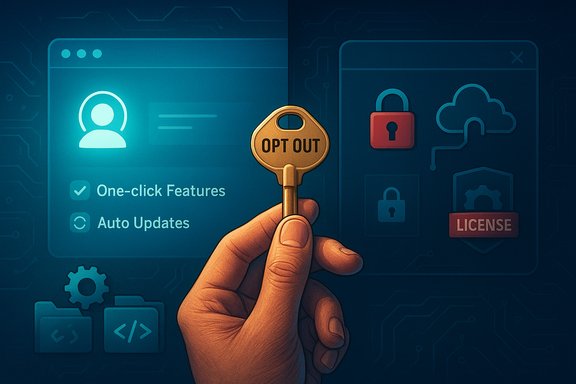
Big Tech’s convenience promises have quietly become mechanisms of control, and 2025 is the year the trade‑off between ease and autonomy became impossible to ignore. What started as helpful defaults — automatic updates, cloud sync, integrated assistants — has hardened into a set of platform assumptions that increasingly require users to accept vendor-managed infrastructures, subscription gates, and AI systems that make operational and policy choices on behalf of end users. The result is a broad push toward open‑source alternatives, self‑hosting, and regulatory scrutiny as users, institutions, and governments scramble to reclaim agency over their devices, data, and workflows. The evidence is now public, technical, and political — and it changes how we should think about the PC as a personal, user-controlled platform.
The arc of personal computing since the 2010s has been toward managed services: automatic security patches, cloud backups, and a growing set of AI‑driven features baked into operating systems. Vendors argued these moves reduced maintenance burden and improved security — and for many users they did. But as the lines between local device, cloud service, and corporate policy blurred, a new problem emerged: convenience began to look like coercion.
By late 2025 two visible trends converged. First, platform vendors accelerated the monetization of AI and convenience features through paid Copilot/Copilot+ offerings and Microsoft’s broader Copilot integration across Windows and Microsoft 365. Microsoft’s Copilot+ PCs were announced as a new hardware/software category built around on‑device NPUs and tight cloud integration — a category accompanied by premium features and new licensing models. Microsoft’s own product pages and blog explain the Copilot+ device concept and the exclusive experiences tied to it. Second, real world incidents — high‑profile cloud outages and policy actions affecting institutional access to cloud accounts — reinforced concerns about centralization. Microsoft Azure’s October 2025 Front Door disruption and multiple cloud provider outages that year are stark reminders that when essential services pivot to centralized clouds, outages and configuration mistakes ripple far beyond a single data center. Independent monitoring and post‑mortems documented significant, multi‑hour disruptions to Entra ID, Microsoft 365, and management portals during an Azure Front Door incident. These technical and commercial realities have provoked institutional shifts: governments and major public bodies are explicitly prioritizing digital sovereignty and open stacks that they can audit, host, and control. The International Criminal Court’s reported migration toward a European open‑source collaboration stack is emblematic — a geopolitical, legal, and operational choice that signals a broader movement in public procurement.
The technical response must be multifaceted: better standards for portability and model governance, procurement that values auditability, and consumer options that make opting out a real choice without crippling functionality. The political response will be messy — a dialectic between market-driven consolidation and legal/regulatory attempts to preserve competition, privacy, and user agency.
For users and institutions who value autonomy, the era ahead will require tradeoffs: investing in operational capability, accepting different UX tradeoffs, or insisting on contractual protections. For vendors, the moral economy is equally clear: long‑term trust will come from transparency, meaningful choice, and responsible product stewardship that recognizes user sovereignty as a feature, not a bug. The road to a computing future that is both convenient and free will be contested, but it is navigable — if companies, regulators, and users insist that convenience never again be permitted to mean surrender.
Source: WebProNews Big Tech’s Control Erodes User Autonomy: Open-Source Rise in 2025
 Background / Overview
The arc of personal computing since the 2010s has been toward managed services: automatic security patches, cloud backups, and a growing set of AI‑driven features baked into operating systems. Vendors argued these moves reduced maintenance burden and improved security — and for many users they did. But as the lines between local device, cloud service, and corporate policy blurred, a new problem emerged: convenience began to look like coercion.By late 2025 two visible trends converged. First, platform vendors accelerated the monetization of AI and convenience features through paid Copilot/Copilot+ offerings and Microsoft’s broader Copilot integration across Windows and Microsoft 365. Microsoft’s Copilot+ PCs were announced as a new hardware/software category built around on‑device NPUs and tight cloud integration — a category accompanied by premium features and new licensing models. Microsoft’s own product pages and blog explain the Copilot+ device concept and the exclusive experiences tied to it. Second, real world incidents — high‑profile cloud outages and policy actions affecting institutional access to cloud accounts — reinforced concerns about centralization. Microsoft Azure’s October 2025 Front Door disruption and multiple cloud provider outages that year are stark reminders that when essential services pivot to centralized clouds, outages and configuration mistakes ripple far beyond a single data center. Independent monitoring and post‑mortems documented significant, multi‑hour disruptions to Entra ID, Microsoft 365, and management portals during an Azure Front Door incident. These technical and commercial realities have provoked institutional shifts: governments and major public bodies are explicitly prioritizing digital sovereignty and open stacks that they can audit, host, and control. The International Criminal Court’s reported migration toward a European open‑source collaboration stack is emblematic — a geopolitical, legal, and operational choice that signals a broader movement in public procurement.
The mechanics of control: how convenience became enforcement
Automatic updates, enablement packages, and opaque rollouts
Operating systems have long pushed automatic security updates; in 2025 the posture evolved toward automatic enablement of new OS versions and feature packages. Microsoft’s managed rollout strategies — including machine‑learning driven targeting for feature packages and enablement bits — aim to accelerate migration off unsupported OSes such as Windows 10 (which reached end‑of‑support on October 14, 2025). Microsoft documented the end‑of‑support timeline and recommended upgrade paths, while third‑party incident reporting highlighted the tighter coupling between update mechanics and device control. Users who decline or are unable to upgrade face shrinking compatibility and a steady erosion of functionality over time. The technical problem is simple: when OS logic, update servers, and subscription checks live under vendor control, the vendor defines what constitutes a “supported” machine. That definition becomes a gate to functionality — for example, AI features or integrated assistants that are only available on certified Copilot+ hardware or paid Copilot subscriptions. The upshot: opting out is possible only at the cost of losing features or even security updates.AI as an enforcement layer
AI features introduce a second vector of control. Machine learning models can automate governance (content moderation, account flagging, configuration selection) and make opaque decisions at scale. When an AI-driven moderation or account management system interprets policy and enforces access controls without transparent appeal mechanisms, organizations and users can lose meaningful recourse. Academic analysis of Big Tech’s policy influence shows how the industry’s technical and political reach can shape regulatory frameworks that eventually normalize such automated governance. Practical examples in 2025 made this visible: bank and government policies began to require AI‑capable endpoints for certain services, tying access to platform capabilities; and vendors introduced agent‑style features that could act on users’ behalf, raising questions about consent, auditability, and fallback. The moral and legal implications are substantial: when algorithmic decisions determine service continuity, users and institutions must be able to audit the logic and challenge errors.Cloud dependencies and outage vulnerability
Cloud infrastructure brings scale but also single points of failure. 2025 produced a string of outages — including global disruptions tied to Azure Front Door and significant incidents affecting other major providers — that interrupted services for enterprises and consumers alike. Analyses by monitoring firms documented cascading failures when an edge fabric or identity fronting layer degraded, bringing down sign‑ins, admin portals, and dependent SaaS services. The practical consequences for end users are immediate:- Cloud‑dependent features (real‑time collaborative editing, AI assistants, license validation) can become unavailable during outages.
- For institutions, the loss of access to email, evidence repositories, or identity services can be operationally catastrophic.
- Vendor clouds concentrated in specific geographies or controlled by a few hyperscalers increase geopolitical and legal exposure.
Policy power plays: lobbying, regulation, and the antitrust moment
Big Tech’s influence extends into policy circles. In 2025 regulators in Europe and the U.S. took more aggressive actions: the EU fined Apple and Meta for breaches of the Digital Markets Act and national authorities initiated probes of App Tracking Transparency, while U.S. antitrust litigation forced remedies that constrained exclusive distribution deals for search and imposed data‑sharing requirements. These developments demonstrate how legal pressure is beginning to rebalance distribution power and enforce interoperability. But regulation is an uneven remedy. Lobbying, revolving doors, and strategic funding of standards or advocacy groups mean Big Tech retains outsized influence on how rules are shaped. Scholarly work documents how industry actors act as “super policy entrepreneurs,” aligning technical capacity, lobbying muscle, and expert networks to shape generative AI governance. The result is contested regulatory terrain where convenience features can become codified in compliance language unless regulators insist on opt‑out rights, portability, and auditability.The flight to open source and decentralized alternatives
Institutional pivot: sovereignty, auditability, and escape hatches
Public institutions that face legal or geopolitical exposure have been quickest to switch. The International Criminal Court’s reported decision to migrate significant productivity and collaboration tooling to a European open‑source stack — combining Nextcloud, Open‑Xchange, Jitsi, and related components in an assembled sovereign stack — is both symbolic and practical. It underscores the desire for auditable systems that can be hosted under trusted jurisdictional control and operated without unilateral vendor dependency. Open‑source stacks provide several advantages for these actors:- Auditability: Source code and deployment artifacts can be inspected and verified.
- Jurisdictional control: Hosting can be constrained to specific national or regional infrastructures.
- Composability: Modular stacks allow organizations to swap problematic components without wholesale migration.
Consumer and community uptake
At the consumer level, the end of Windows 10 catalyzed a tangible spike in interest in Linux distributions designed for mainstream users. Zorin OS — positioning itself as a Windows‑friendly Linux alternative — reported an explosive download run for Zorin OS 18, claiming roughly 1 million downloads within weeks of release and a large share of installs originating from Windows machines. While download numbers are not a complete migration metric, they signal shifting consumer appetite for workable alternatives that preserve user control. Community projects and small vendors are also pushing innovations that combine usability with autonomy: lightweight Linux distros, self‑hosted Nextcloud appliances, and turnkey open‑source AI tools that run locally or at the edge. These approaches lower the technical bar for hobbyists and small organizations to avoid the vendor‑managed path, but they still require local operational capability.Economic and market effects
Monetization and subscription fatigue
Big Tech’s shift to subscription and services margins is financially rational but socially contentious. Microsoft’s packaging of Copilot capabilities across consumer and enterprise plans — from Copilot Pro to Microsoft 365 Copilot and Copilot Studio for enterprises — shows how AI becomes a recurring revenue stream rather than a one‑time feature. The company’s pricing pages and market reporting document paid tiers and enterprise billing models for agent usage. Consumers are pushing back in predictable ways: surveys and industry reporting in 2025 documented growing “subscription fatigue” — a willingness to cut or consolidate recurring charges when perceived value falls short. That dynamic pressures vendors to demonstrate clear, continuous value for paid AI features or risk churn.Concentration risks and supply‑side effects
Consolidation around hyperscalers and vertically integrated platform stacks has secondary market impacts:- Supply concentration: Hyperscalers’ demand for advanced silicon and cooling increases component scarcity and pricing pressure for PC builders and OEMs.
- Repairability and E‑waste: Hardware gating of OS upgrades accelerates device replacement cycles, increasing e‑waste and deepening inequality for users who cannot afford frequent upgrades.
- Investor incentives: The market rewards scale and data advantages — but it also concentrates risk. Outages, legal remedies, or model deprecation events (for example, rapid model retirement) can create sudden costs for customers who built critical workflows on specific vendor APIs.
Practical implications and action checklist
For individual users
- Audit your critical data and ensure offline backups. Vendor exports may be removed or degraded over time.
- Evaluate device eligibility for current OS versions using official tools (e.g., Microsoft’s PC Health Check) and consider alternatives — lightweight Linux distributions or ChromeOS Flex — if hardware is incompatible.
- Consider adopting privacy and control tools: local backups, self‑hosted storage (Nextcloud), and privacy‑forward apps where feasible.
For IT leaders
- Inventory your dependency map: which services, authentication providers, and cloud APIs are mission‑critical?
- Build redundancy: multi‑cloud or hybrid architectures and defined failover plans reduce single‑vendor risk.
- Contract for portability: insist on data export, code escrow, and defined deprecation windows in procurement contracts.
- Treat AI as a component: require model governance, reproducibility, and rollback paths for model changes.
For policymakers and advocates
- Mandate clearer lifecycle disclosures at point of sale (expected software servicing windows, upgradable components).
- Encourage repairability and refurbishment incentives to mitigate e‑waste and equity impacts.
- Enforce portability, interoperability, and meaningful opt‑out mechanisms for AI-driven governance features.
Strengths, risks, and an honest appraisal
Notable strengths of the current trend toward centralized AI and integrated clouds
- Rapid innovation: centralized investment brought powerful on‑device and cloud AI features to broad markets quickly.
- Security benefits: centralized patching and telemetry can reduce the prevalence of unpatched systems.
- Usability gains: many users prefer a maintenance‑free experience that “just works” across devices.
Important risks and trade‑offs
- Loss of agency: default opt‑ins, opaque rollouts, and subscription gating reduce user choice.
- Systemic fragility: centralized outages and supply constraints can have outsized systemic effects.
- Regulatory capture risk: concentrated industry influence over standards and policy can lock in control‑centric models.
Looking ahead: trajectories to watch
- Regulatory balance: Expect continued legal action and implementation of remedies that preserve competition while stopping short of structural breakups. Remedies that enforce distribution choice and data portability may meaningfully reduce lock‑in.
- Sovereign stacks: Governments and large institutions will continue to build or procure auditable, jurisdictionally bound stacks for sensitive workloads. The ICC and several European public bodies are early examples.
- Consumer hybridity: Many consumers will prefer hybrid models — mixing open‑source desktops with targeted Big Tech services for specific features — rather than a binary choice. Zorin OS adoption shows a subset already willing to switch.
- Edge and model portability: Advances in NPUs and edge AI could reduce cloud dependency for some workloads, but the economics will favor vendors that can offer seamless hybrid cloud + edge ecosystems.
- Market correction: Subscription fatigue and increasing scrutiny of AI feature value may force vendors to adopt clearer value propositions, improved opt‑out choices, and more transparent deprecation policies.
Conclusion
The defining tension of modern personal computing is no longer performance versus price; it is convenience versus control. The year 2025 exposed how quickly convenience features can harden into control mechanisms — through automatic updates, AI-enforced behavior, subscription gating, and cloud centralization. Against that backdrop, open‑source alternatives, sovereign stacks, and regulatory action are not nostalgic returns to a bygone era: they are pragmatic responses to the new realities of distributed risk and concentrated power.The technical response must be multifaceted: better standards for portability and model governance, procurement that values auditability, and consumer options that make opting out a real choice without crippling functionality. The political response will be messy — a dialectic between market-driven consolidation and legal/regulatory attempts to preserve competition, privacy, and user agency.
For users and institutions who value autonomy, the era ahead will require tradeoffs: investing in operational capability, accepting different UX tradeoffs, or insisting on contractual protections. For vendors, the moral economy is equally clear: long‑term trust will come from transparency, meaningful choice, and responsible product stewardship that recognizes user sovereignty as a feature, not a bug. The road to a computing future that is both convenient and free will be contested, but it is navigable — if companies, regulators, and users insist that convenience never again be permitted to mean surrender.
Source: WebProNews Big Tech’s Control Erodes User Autonomy: Open-Source Rise in 2025
