

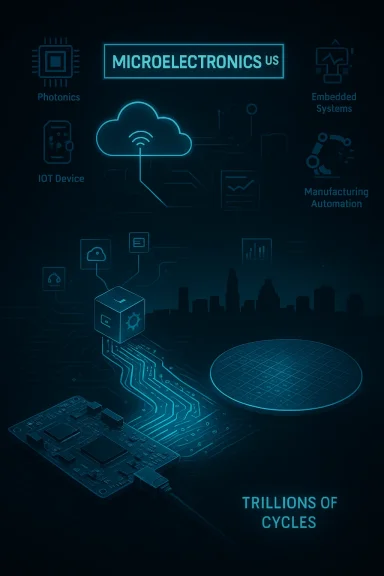
The embedded computing world is getting a useful snapshot of where the market is headed: deeper pre-silicon verification, tighter cloud-to-edge IoT integration, and more industry-specific event ecosystems built around embedded systems, microelectronics, and manufacturing. In ICYMI Ep. 58, Siemens and NVIDIA are pushing hardware-assisted verification to new scale, eInfochips is bringing its EIC PROPEL platform into the Microsoft Marketplace, and Microelectronics US is positioning Austin as a new hub for cross-disciplinary technical exchange. Taken together, these stories say something important about 2026: embedded computing is no longer just a product category, but a convergence layer for AI, industrial automation, semiconductor design, and systems engineering.
The first story centers on Siemens’ announcement that Veloce proFPGA CS is running and capturing trillions of verification cycles before first silicon availability, in collaboration with NVIDIA. Siemens says the effort reflects a broader push to make hardware-assisted verification more scalable for the age of AI/ML SoCs, where simulation alone increasingly struggles to keep pace with design complexity. The announcement is not just about speed; it is about confidence, coverage, and the ability to explore behavior that would otherwise remain hidden until late in the development cycle.
This matters because modern chip programs are under extraordinary pressure. AI accelerators, automotive compute platforms, and industrial SoCs all combine dense logic, heterogeneous memory, high-speed I/O, and software stacks that must be validated together. In that environment, the old tradeoff between time-to-market and design certainty becomes more painful, and technologies like FPGA-based prototyping and hardware emulation move from “advanced options” to strategic necessities.
The second story, eInfochips’ arrival in the Microsoft Marketplace, reflects a different but equally significant trend. The company is packaging its enterprise IoT platform so customers can deploy it more quickly across Azure-centric workflows, with integrations spanning Azure IoT, Azure Synapse Analytics, and Azure Data Explorer. The message is clear: IoT is no longer being sold as a standalone stack, but as a cloud-native operational fabric that can feed analytics, AI, and governance tools.
That shift has major implications for enterprise buyers. Instead of stitching together device management, telemetry pipelines, data lakes, and dashboards from multiple vendors, companies increasingly want a platform that aligns with the cloud estate they already trust. Marketplace distribution also lowers the friction of procurement, which may be as important as the technology itself in regulated or procurement-heavy environments.
The third story is about Microelectronics US, a new event in Austin designed to bring together semiconductors, photonics, embedded systems, and manufacturing leaders. On the surface, it looks like another conference launch. In practice, it signals that the industry sees enough overlap among these disciplines to justify a more integrated forum, especially at a moment when embedded systems are being reshaped by AI, safety requirements, supply-chain localization, and the rising cost of engineering fragmentation.
Austin is a logical choice. Texas has emerged as a major microelectronics and advanced manufacturing center, and the region’s mix of design talent, industrial infrastructure, and market momentum makes it a credible venue for a show focused on implementation, not just aspiration. The event’s program also suggests the industry is hungry for practical discussion on interoperability, reliability, autonomous manufacturing, and the role of embedded systems in new markets.
Siemens has been building in this direction for years through its Veloce family, which sits within a broader hardware-assisted verification strategy. The company’s long-standing pitch is that software simulation, while essential, cannot fully reproduce the scale and timing behavior of modern chips. FPGA prototyping and emulation therefore become key tools for early software bring-up, hardware/software co-design, and system-level debugging before silicon arrives.
The NVIDIA angle is also important. AI-centric systems have changed the nature of validation because workloads are large, data-intensive, and often coupled to custom hardware accelerators. When a chip vendor can burn through trillions of cycles before tape-out, the point is not just to brag about throughput. It is to gain a statistically meaningful window into system behavior that improves confidence in launch readiness.
On the enterprise side, eInfochips is tapping a familiar but still evolving market: industrial IoT. For years, companies have struggled to move from pilot deployments to durable, scalable operations. Device onboarding, telemetry collection, schema management, analytics, and security often get treated as separate projects, which slows adoption. Bringing a platform into the Microsoft Marketplace is a commercial and technical strategy at once, because it positions the solution where enterprise buyers are already shopping for cloud services.
Microsoft’s own ecosystem matters here. Azure remains a major anchor for industrial data pipelines, and services like Synapse and Data Explorer help turn raw telemetry into something closer to operational intelligence. In that context, eInfochips is not merely selling device management; it is selling an integrated path from edge data to analytics to AI.
Microelectronics US fits a third macro trend: event convergence. Shows and conferences increasingly mirror the technology stack they cover. Rather than separating semiconductors from embedded systems and photonics, the new event structure suggests that the market now sees them as interdependent. That is especially true for automotive, industrial, medical, and defense applications, where design teams can no longer optimize a single layer in isolation.
The phrase hardware-assisted verification can sound abstract, but the practical payoff is straightforward. Designers want faster debug, broader workload coverage, and earlier confidence that the chip can do what it is supposed to do. When those goals are met through scalable FPGA-based prototyping, teams can move more of the risk left, which often reduces downstream surprises.
Siemens and NVIDIA are also addressing a very modern engineering problem: software and hardware now evolve together. A chip is not just a block of logic, but a platform for AI frameworks, drivers, firmware, and workload-specific optimizations. The earlier those layers can be exercised together, the better the odds that the final product behaves as intended in the field.
The integration story is equally important. Support for Azure IoT, Synapse Analytics, and Azure Data Explorer suggests a pipeline that spans ingestion, storage, analysis, and decision-making. In practice, that can reduce the integration tax that often slows industrial and operational IoT programs.
This also reflects the growing importance of operational analytics. Enterprises do not want isolated dashboards; they want device telemetry that can feed predictive AI, machine learning, and increasingly generative AI workflows. That means the platform value proposition is expanding from device monitoring to business intelligence to automation.
The choice of Austin is practical as well as symbolic. Texas has become a central node in the US microelectronics landscape, and the region offers access to design talent, manufacturing activity, and a growing concentration of companies tied to advanced electronics. The show’s emphasis on implementation also matters, because the industry increasingly values events that help solve problems rather than merely showcase products.
Perhaps the most interesting aspect is the agenda itself. Sessions around safety-critical platforms, cross-industry interoperability, reliability, and autonomous manufacturing suggest a forum built for the realities of production engineering. That is a different tone from the hype-driven conference circuit, and it may be exactly what the market needs right now.
The automotive sector has become a proving ground for mixed workloads. Infotainment, ADAS, sensor fusion, communications, diagnostics, and gateway functionality all place different demands on compute architecture. In that environment, FPGAs can act as glue, acceleration, prototyping infrastructure, or even production elements in certain designs.
Their value is not just raw performance. It is flexibility under constraint. A platform that can be updated, reconfigured, or validated in stages has obvious appeal when safety, longevity, and compliance all matter.
Embedded systems are increasingly expected to support local intelligence, remote observability, and compliance-aware operation. That means they have to be trustworthy in ways that go beyond functional correctness. They must also be secure, maintainable, and capable of evolving as data models, workloads, and regulatory requirements change.
For manufacturers, this creates a strong incentive to invest in self-healing electronics, predictive maintenance, and improved monitoring. Lights-out manufacturing becomes more realistic when edge systems can detect faults, report them, and sometimes correct them automatically. But that future depends on strong validation and data pipelines, which brings us back to the earlier stories.
Microelectronics US is the most immediate near-term watch item because the Austin event is almost here. Attendance, speaker quality, and the depth of discussion will tell us whether the market is hungry for a more integrated embedded and microelectronics forum. If the event lands well, it could become a meaningful annual gathering point for engineers who are tired of fragmented industry conversations.
That is the story beneath the headlines. The future of embedded computing is not one single breakthrough, but a steady tightening of the links between silicon, software, cloud, and manufacturing. And that is exactly why this week’s mix of verification scale, enterprise IoT packaging, and community building feels so relevant to where the market is headed next.
Source: Embedded Computing Design ICYMI Ep 58: Siemens, eInfochips, MicroelectronicsUS - Embedded Computing Design
 Overview
The first story centers on Siemens’ announcement that Veloce proFPGA CS is running and capturing trillions of verification cycles before first silicon availability, in collaboration with NVIDIA. Siemens says the effort reflects a broader push to make hardware-assisted verification more scalable for the age of AI/ML SoCs, where simulation alone increasingly struggles to keep pace with design complexity. The announcement is not just about speed; it is about confidence, coverage, and the ability to explore behavior that would otherwise remain hidden until late in the development cycle.This matters because modern chip programs are under extraordinary pressure. AI accelerators, automotive compute platforms, and industrial SoCs all combine dense logic, heterogeneous memory, high-speed I/O, and software stacks that must be validated together. In that environment, the old tradeoff between time-to-market and design certainty becomes more painful, and technologies like FPGA-based prototyping and hardware emulation move from “advanced options” to strategic necessities.
The second story, eInfochips’ arrival in the Microsoft Marketplace, reflects a different but equally significant trend. The company is packaging its enterprise IoT platform so customers can deploy it more quickly across Azure-centric workflows, with integrations spanning Azure IoT, Azure Synapse Analytics, and Azure Data Explorer. The message is clear: IoT is no longer being sold as a standalone stack, but as a cloud-native operational fabric that can feed analytics, AI, and governance tools.
That shift has major implications for enterprise buyers. Instead of stitching together device management, telemetry pipelines, data lakes, and dashboards from multiple vendors, companies increasingly want a platform that aligns with the cloud estate they already trust. Marketplace distribution also lowers the friction of procurement, which may be as important as the technology itself in regulated or procurement-heavy environments.
The third story is about Microelectronics US, a new event in Austin designed to bring together semiconductors, photonics, embedded systems, and manufacturing leaders. On the surface, it looks like another conference launch. In practice, it signals that the industry sees enough overlap among these disciplines to justify a more integrated forum, especially at a moment when embedded systems are being reshaped by AI, safety requirements, supply-chain localization, and the rising cost of engineering fragmentation.
Austin is a logical choice. Texas has emerged as a major microelectronics and advanced manufacturing center, and the region’s mix of design talent, industrial infrastructure, and market momentum makes it a credible venue for a show focused on implementation, not just aspiration. The event’s program also suggests the industry is hungry for practical discussion on interoperability, reliability, autonomous manufacturing, and the role of embedded systems in new markets.
Background
Embedded computing has spent the last decade moving from a narrow discipline to a connective tissue between several industries. The same design teams now have to think about silicon, firmware, cloud services, cyber resilience, thermal constraints, machine learning inference, and compliance regimes that vary by market. That complexity has created demand for both better development infrastructure and better places to exchange ideas.Siemens has been building in this direction for years through its Veloce family, which sits within a broader hardware-assisted verification strategy. The company’s long-standing pitch is that software simulation, while essential, cannot fully reproduce the scale and timing behavior of modern chips. FPGA prototyping and emulation therefore become key tools for early software bring-up, hardware/software co-design, and system-level debugging before silicon arrives.
The NVIDIA angle is also important. AI-centric systems have changed the nature of validation because workloads are large, data-intensive, and often coupled to custom hardware accelerators. When a chip vendor can burn through trillions of cycles before tape-out, the point is not just to brag about throughput. It is to gain a statistically meaningful window into system behavior that improves confidence in launch readiness.
On the enterprise side, eInfochips is tapping a familiar but still evolving market: industrial IoT. For years, companies have struggled to move from pilot deployments to durable, scalable operations. Device onboarding, telemetry collection, schema management, analytics, and security often get treated as separate projects, which slows adoption. Bringing a platform into the Microsoft Marketplace is a commercial and technical strategy at once, because it positions the solution where enterprise buyers are already shopping for cloud services.
Microsoft’s own ecosystem matters here. Azure remains a major anchor for industrial data pipelines, and services like Synapse and Data Explorer help turn raw telemetry into something closer to operational intelligence. In that context, eInfochips is not merely selling device management; it is selling an integrated path from edge data to analytics to AI.
Microelectronics US fits a third macro trend: event convergence. Shows and conferences increasingly mirror the technology stack they cover. Rather than separating semiconductors from embedded systems and photonics, the new event structure suggests that the market now sees them as interdependent. That is especially true for automotive, industrial, medical, and defense applications, where design teams can no longer optimize a single layer in isolation.
Why this matters now
The timing is not accidental. The industry is facing several overlapping pressures at once, including AI adoption, supply chain reshoring, software-defined products, and the need for faster verification cycles. Those forces reward companies that can reduce handoffs between engineering disciplines.- Pre-silicon verification is no longer optional for advanced SoCs.
- Cloud-connected IoT platforms are becoming procurement-friendly productized services.
- Cross-domain events are becoming more valuable than niche silos.
- Austin is increasingly central to US microelectronics conversations.
- Embedded systems now sit at the intersection of hardware, software, and data.
Siemens and NVIDIA: Why Trillions of Cycles Matter
Siemens’ announcement is notable because it highlights a threshold shift in verification scale. Capturing trillions of verification cycles before first silicon means teams can expose behaviors that would normally show up much later, or only in corner cases after deployment. In a world where AI/ML SoCs are highly complex and expensive to re-spin, that kind of scale is more than a technical achievement; it is a business advantage.The phrase hardware-assisted verification can sound abstract, but the practical payoff is straightforward. Designers want faster debug, broader workload coverage, and earlier confidence that the chip can do what it is supposed to do. When those goals are met through scalable FPGA-based prototyping, teams can move more of the risk left, which often reduces downstream surprises.
Siemens and NVIDIA are also addressing a very modern engineering problem: software and hardware now evolve together. A chip is not just a block of logic, but a platform for AI frameworks, drivers, firmware, and workload-specific optimizations. The earlier those layers can be exercised together, the better the odds that the final product behaves as intended in the field.
Verification at AI scale
The significance of the Siemens announcement lies in how it reframes verification as a systems problem, not a point-tool problem. AI accelerators are not validated by checking a handful of transactions; they are validated by observing real workloads over long periods, with realistic interactions between memory, compute, and control logic. That is why tens of trillions of cycles is meaningful language in this context.- It improves coverage across unusual operational states.
- It reduces dependence on late-stage silicon surprises.
- It supports hardware/software co-design earlier in the cycle.
- It helps teams optimize designs before mask costs are locked in.
- It aligns with the needs of AI/ML SoCs, which are behaviorally complex.
eInfochips and Microsoft Marketplace: Packaging IoT for Enterprise Scale
eInfochips’ move into the Microsoft Marketplace is a classic example of technology becoming easier to buy because it is easier to trust. Enterprises rarely want another bespoke IoT build; they want something that fits into existing governance, procurement, identity, and data infrastructure. Being available through a trusted marketplace changes the buying conversation from should we build this? to how quickly can we deploy it?The integration story is equally important. Support for Azure IoT, Synapse Analytics, and Azure Data Explorer suggests a pipeline that spans ingestion, storage, analysis, and decision-making. In practice, that can reduce the integration tax that often slows industrial and operational IoT programs.
This also reflects the growing importance of operational analytics. Enterprises do not want isolated dashboards; they want device telemetry that can feed predictive AI, machine learning, and increasingly generative AI workflows. That means the platform value proposition is expanding from device monitoring to business intelligence to automation.
The cloud-to-edge proposition
The strongest part of eInfochips’ pitch is that it treats the device fleet as part of a larger data system. That is how IoT projects stop being isolated pilots and start becoming operational assets. A marketplace presence helps because it can reduce friction not just technically, but commercially.- Unified procurement through Microsoft Marketplace.
- Integrated analytics across Azure services.
- Scalable device management for distributed fleets.
- Security and governance framed for enterprise buyers.
- AI-ready data pipelines for forecasting and optimization.
Microelectronics US: A New Stage for a Converging Industry
Microelectronics US looks like more than a trade show; it looks like a statement about where the industry thinks the action is. By bringing together semiconductors, photonics, and embedded systems in one venue, the organizers are acknowledging that the boundaries between these areas are getting thinner. For engineers, that means fewer isolated conversations and more system-level thinking.The choice of Austin is practical as well as symbolic. Texas has become a central node in the US microelectronics landscape, and the region offers access to design talent, manufacturing activity, and a growing concentration of companies tied to advanced electronics. The show’s emphasis on implementation also matters, because the industry increasingly values events that help solve problems rather than merely showcase products.
Perhaps the most interesting aspect is the agenda itself. Sessions around safety-critical platforms, cross-industry interoperability, reliability, and autonomous manufacturing suggest a forum built for the realities of production engineering. That is a different tone from the hype-driven conference circuit, and it may be exactly what the market needs right now.
Why events still matter
In an era of webinars and virtual demos, live events still serve a crucial role when the subject matter is deeply technical. Embedded systems are full of tacit knowledge, and the best conversations often happen when hardware designers, software architects, validation experts, and manufacturing specialists can compare notes in real time. Microelectronics US seems designed for exactly that kind of exchange.- It combines business development with technical depth.
- It brings together adjacent disciplines that usually meet too late.
- It creates a place for cross-domain standards conversations.
- It serves both vendors and practitioners.
- It reflects the shift toward system-level integration.
FPGA in Automotive: The Quiet Backbone of Modern Vehicle Electronics
Ken’s Trends on FPGA in Automotive lands at an opportune moment because vehicle electronics are becoming more compute-intensive, more software-defined, and more safety constrained all at once. Automotive engineers need platforms that can adapt, validate quickly, and support deterministic behavior across increasingly complex subsystems. FPGAs are not always visible in the spotlight, but they often make those requirements possible.The automotive sector has become a proving ground for mixed workloads. Infotainment, ADAS, sensor fusion, communications, diagnostics, and gateway functionality all place different demands on compute architecture. In that environment, FPGAs can act as glue, acceleration, prototyping infrastructure, or even production elements in certain designs.
Their value is not just raw performance. It is flexibility under constraint. A platform that can be updated, reconfigured, or validated in stages has obvious appeal when safety, longevity, and compliance all matter.
From prototyping to production support
The automotive discussion matters because it shows how a technology often associated with development labs is now relevant across the product lifecycle. FPGA-based systems can support early design exploration, but they also enable specialized runtime functions where fixed silicon would be too rigid or too expensive to revise.- Early validation for complex vehicle electronics.
- Adaptive processing for changing workloads.
- Bridging roles in ADAS and infotainment architectures.
- Support for safety-critical design flows.
- Faster iteration for hardware/software teams.
Embedded Systems, AI, and the Manufacturing Shift
One of the most interesting throughlines across all three stories is the way AI is being absorbed into embedded systems without replacing them. Instead, AI is changing what embedded teams must design, verify, and deploy. That is true whether the setting is a chip prototype, a cloud-connected industrial platform, or an autonomous factory floor.Embedded systems are increasingly expected to support local intelligence, remote observability, and compliance-aware operation. That means they have to be trustworthy in ways that go beyond functional correctness. They must also be secure, maintainable, and capable of evolving as data models, workloads, and regulatory requirements change.
For manufacturers, this creates a strong incentive to invest in self-healing electronics, predictive maintenance, and improved monitoring. Lights-out manufacturing becomes more realistic when edge systems can detect faults, report them, and sometimes correct them automatically. But that future depends on strong validation and data pipelines, which brings us back to the earlier stories.
The systems mindset
The real shift is from isolated components to integrated systems. Each of the stories in this roundup touches a different layer of that stack, but the common thread is integration across silicon, software, data, and operations.- Verification tools are getting smarter and more scalable.
- IoT platforms are being tied directly to cloud analytics.
- Events are becoming forums for cross-disciplinary problem solving.
- Automotive and industrial systems are becoming more software-defined.
- AI is raising the bar for reliability and observability.
Strengths and Opportunities
The strongest aspect of this week’s roundup is that it shows multiple parts of the embedded ecosystem maturing at the same time. Siemens is solving a pre-silicon validation problem, eInfochips is simplifying enterprise adoption, and Microelectronics US is building a stronger community around implementation. That combination suggests a healthy market where both technical depth and commercial packaging are improving.- Siemens gains credibility by showing scale in verification rather than simply talking about roadmap ambition.
- NVIDIA benefits from validation infrastructure that supports increasingly complex AI silicon.
- eInfochips can reach buyers where they already procure cloud solutions.
- Microsoft Azure strengthens its position as a practical backbone for industrial IoT.
- Microelectronics US gives the US market a new venue for cross-domain technical collaboration.
- Automotive FPGA adoption continues to expand as vehicle electronics become more software-defined.
- Embedded professionals gain more opportunities to connect silicon, systems, and operations in one conversation.
Risks and Concerns
The biggest risk in this kind of market narrative is overpromising integration without reducing complexity. A Marketplace listing does not automatically solve deployment friction, and trillion-cycle verification does not by itself guarantee a better product if teams lack the process maturity to act on the results. The industry has seen enough platform announcements to know that adoption depends on execution.- Verification scale can impress, but it must translate into shorter debug cycles and fewer respins.
- Marketplace convenience may still leave customers with integration and change-management work.
- IoT platforms can create lock-in if portability and interoperability are weak.
- Event launches can generate buzz without necessarily changing industry behavior.
- AI claims in embedded marketing often outpace real operational readiness.
- Automotive validation remains slow because safety requirements are inherently demanding.
- Cross-domain convergence can create internal organizational friction for companies built in silos.
Looking Ahead
The next several months will show whether these announcements are isolated moments or signs of a deeper shift. For Siemens and NVIDIA, the key question is whether this level of pre-silicon verification becomes a repeatable operating model rather than a one-off headline. For eInfochips, the test is whether customers treat EIC PROPEL as a practical deployment path, not just another marketplace entry.Microelectronics US is the most immediate near-term watch item because the Austin event is almost here. Attendance, speaker quality, and the depth of discussion will tell us whether the market is hungry for a more integrated embedded and microelectronics forum. If the event lands well, it could become a meaningful annual gathering point for engineers who are tired of fragmented industry conversations.
What to watch
- Whether Siemens and NVIDIA publish more detail on verification outcomes and workflows.
- Whether eInfochips converts Marketplace visibility into enterprise adoption.
- Whether Azure-native IoT buyers see faster procurement and deployment.
- Whether Microelectronics US attracts a durable audience beyond the launch year.
- Whether automotive FPGA use cases expand beyond prototyping into broader system roles.
That is the story beneath the headlines. The future of embedded computing is not one single breakthrough, but a steady tightening of the links between silicon, software, cloud, and manufacturing. And that is exactly why this week’s mix of verification scale, enterprise IoT packaging, and community building feels so relevant to where the market is headed next.
Source: Embedded Computing Design ICYMI Ep 58: Siemens, eInfochips, MicroelectronicsUS - Embedded Computing Design
Last edited:
