

Microsoft’s cloud licensing model has moved from a regulatory irritation to a full-scale legal and market test, and the latest development is a major one. The UK Competition Appeal Tribunal has allowed a £2bn class action over Windows Server licensing to proceed on an opt-out basis, opening the door to compensation claims from an estimated 59,000 businesses and public bodies that ran Microsoft software on rival clouds. The decision lands at a moment when the company is already under close scrutiny from the UK Competition and Markets Authority and other regulators investigating whether Microsoft’s licensing terms distort competition in cloud infrastructure.
Microsoft’s cloud market power has long rested on a simple but potent reality: many organisations depend on its server software, productivity tools, and identity stack even when they do not host workloads on Azure. That dependence gives Microsoft a commercial lever that rivals say can shape where customers place infrastructure, how much they pay, and how easily they can move workloads between providers. The dispute over Windows Server licensing is therefore not just about one product, but about whether a dominant software vendor can use licensing design to influence broader cloud competition.
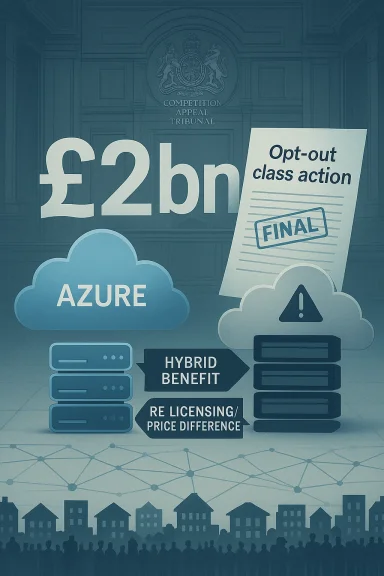
The legal claim now heading toward trial was brought by digital markets regulation expert Maria Luisa Stasi and concerns alleged overcharging for Windows Server when customers run it on non-Microsoft public clouds. The case claims that Microsoft charges higher wholesale prices under its Service Provider License Agreement than the equivalent licensing available to Azure users, and that it also imposes re-licensing penalties when customers want to move on-premises Windows Server licenses to other clouds. Those two theories — pricing abuse and re-licensing abuse — are the backbone of the action.
The Competition Appeal Tribunal’s decision matters because an opt-out collective action dramatically changes the scale of potential exposure. Rather than requiring each affected organisation to opt in individually, the claim can proceed on behalf of the class unless members choose to exclude themselves, making it far more practical for large-scale business claims. In a market with thousands of public and private sector users, that procedural choice can be as consequential as the legal theory itself.
The tribunal also rejected Microsoft’s attempt to stop certification at this stage, finding that the claim has a real prospect of success. That phrase is not a final merits finding, but it is a meaningful signal: the case has cleared the gateway that separates speculative allegations from litigation the tribunal considers serious enough to justify full proceedings. For Microsoft, that means the burden now shifts from defeating certification to defending the substance of its licensing model under sustained judicial scrutiny.
That allegation resonates because licensing costs in enterprise IT are rarely isolated line items. They ripple across architecture decisions, migration strategies, support contracts, and procurement cycles. A higher licence cost can make an otherwise technically sound cloud choice commercially impractical, especially for organisations running large fleets of Windows-based workloads.
This issue matters because it is not simply about nominal prices. It is about whether the rules surrounding existing licences and mobility rights are neutral across providers. In a market where vendors compete on portability, service quality, latency, and price, any licensing architecture that tilts the field can have disproportionate effects on competition.
For Microsoft, that scale means the case is no longer just a dispute with one complainant or a handful of cloud customers. It becomes a reputational and strategic event, one that could embolden other claimants or regulators if the tribunal ultimately accepts the core theory. It also gives the action a symbolic power far beyond the courtroom.
The CMA has also signalled concern about egress fees and interoperability, which broadens the terrain beyond Windows Server. The broader policy logic is clear: if customers cannot move data easily, cannot interoperate cleanly, and face different licensing terms depending on provider, then the market may be competitive only in appearance. That is the kind of structure competition authorities are now trying to untangle.
That international context matters because it reduces the chance that Microsoft can treat the UK case as a one-off local dispute. When multiple jurisdictions are converging on similar concerns, a single adverse finding can have broader commercial implications, influencing how enterprise buyers, cloud partners, and competitors evaluate the company’s posture.
The practical consequence is that cloud price comparisons can become misleading. A rival cloud may advertise lower base infrastructure costs while the real-world bill rises after Windows Server licensing is factored in. That is why the case has drawn attention from public and private sector buyers alike: the nominal cloud price is only part of the commercial equation.
Still, competition law often looks beyond formal labels to practical effects. If the economic result of a licensing structure is to make rival clouds materially less attractive for the same workload, then the pro-competitive justification must be compelling. The harder Microsoft leans on product integration, the more the tribunal may ask whether the integration is essential or simply convenient for Microsoft’s own platform strategy. That distinction is crucial.
This is why the case matters beyond the immediate £2bn headline. If the tribunal finds the licensing model distorted competition, rival clouds could argue for more neutral terms, while customers might gain leverage in negotiations. Even if Microsoft ultimately prevails, the litigation itself may pressure the company to rethink how it prices software across deployment models.
It also offers a chance to reset expectations around cloud fairness, especially for public sector buyers and large enterprises that have little tolerance for opaque pricing. If the litigation forces more transparency, that could produce benefits even without a final damages award. In that sense, the claim may be as much about market discipline as it is about compensation.
There is also a risk that the litigation becomes so broad and technical that it obscures the customer harms it is supposed to remedy. Cloud licensing disputes can become dense, with formulae, service tiers, and contractual exceptions crowding out the core question of fairness. That complexity may favour a well-resourced defendant unless the claimants can translate the issue into plain economic harm. That will be essential.
A further concern is that even strong scrutiny may not immediately change market behaviour. Microsoft and AWS have already begun adjusting aspects of egress fees and interoperability under pressure, but these reforms may not fully address licensing asymmetry. Regulators and courts can move slowly, while enterprise buyers continue paying today’s invoices.
If the claimants can prove that Microsoft’s licensing structure systematically made rival clouds more expensive for identical workloads, the implications could be significant. It would strengthen the case for intervention across digital markets where software, infrastructure, and licensing are tightly intertwined. If Microsoft succeeds in showing that its model is commercially justified, the result could still push regulators toward narrower, more targeted remedies rather than broad-brush penalties.
What to watch next:
Source: Computer Weekly Microsoft faces court battle in £2bn Windows Server class action | Computer Weekly
 Background
Microsoft’s cloud market power has long rested on a simple but potent reality: many organisations depend on its server software, productivity tools, and identity stack even when they do not host workloads on Azure. That dependence gives Microsoft a commercial lever that rivals say can shape where customers place infrastructure, how much they pay, and how easily they can move workloads between providers. The dispute over Windows Server licensing is therefore not just about one product, but about whether a dominant software vendor can use licensing design to influence broader cloud competition.The legal claim now heading toward trial was brought by digital markets regulation expert Maria Luisa Stasi and concerns alleged overcharging for Windows Server when customers run it on non-Microsoft public clouds. The case claims that Microsoft charges higher wholesale prices under its Service Provider License Agreement than the equivalent licensing available to Azure users, and that it also imposes re-licensing penalties when customers want to move on-premises Windows Server licenses to other clouds. Those two theories — pricing abuse and re-licensing abuse — are the backbone of the action.
The Competition Appeal Tribunal’s decision matters because an opt-out collective action dramatically changes the scale of potential exposure. Rather than requiring each affected organisation to opt in individually, the claim can proceed on behalf of the class unless members choose to exclude themselves, making it far more practical for large-scale business claims. In a market with thousands of public and private sector users, that procedural choice can be as consequential as the legal theory itself.
The tribunal also rejected Microsoft’s attempt to stop certification at this stage, finding that the claim has a real prospect of success. That phrase is not a final merits finding, but it is a meaningful signal: the case has cleared the gateway that separates speculative allegations from litigation the tribunal considers serious enough to justify full proceedings. For Microsoft, that means the burden now shifts from defeating certification to defending the substance of its licensing model under sustained judicial scrutiny.
The Licensing Model Under Fire
At the centre of the dispute is a complaint that Microsoft’s licensing rules treat identical software differently depending on where it is deployed. If a customer wants to run Windows Server in Azure, it can use the Azure Hybrid Benefit and avoid some of the extra re-licensing costs that might otherwise apply. But if that same customer chooses a rival cloud, the complaint argues, it faces a less favourable and more expensive path. That asymmetry is what critics say turns licensing into a competitive moat.SPLA Pricing
The first limb of the case targets Microsoft’s Service Provider License Agreement pricing. According to the claim, wholesale prices for Windows Server under SPLA are higher than equivalent licence terms available to Azure users, which would mean customers using rival clouds are effectively paying a penalty for not choosing Microsoft’s own platform. In competition terms, that kind of differential pricing can behave like a de facto switching tax.That allegation resonates because licensing costs in enterprise IT are rarely isolated line items. They ripple across architecture decisions, migration strategies, support contracts, and procurement cycles. A higher licence cost can make an otherwise technically sound cloud choice commercially impractical, especially for organisations running large fleets of Windows-based workloads.
Re-licensing and Hybrid Benefit
The second limb concerns re-licensing abuse, as the claim describes it. Microsoft allows customers with on-premises Windows Server licences to move to Azure without paying the same re-licensing fees that can apply when moving to approved rival clouds. The complaint argues that this structure effectively rewards Azure adoption and penalises equivalent deployment elsewhere, reinforcing Microsoft’s own cloud ecosystem at the expense of competitors.This issue matters because it is not simply about nominal prices. It is about whether the rules surrounding existing licences and mobility rights are neutral across providers. In a market where vendors compete on portability, service quality, latency, and price, any licensing architecture that tilts the field can have disproportionate effects on competition.
Why the Tribunal’s Decision Matters
Certification of a collective action is often the inflection point where a legal theory becomes an industrial-scale dispute. The tribunal’s willingness to certify the case on an opt-out basis indicates that it believes the claim is coherent, large enough, and suitable for collective resolution. That does not mean Microsoft has lost; it does mean the courtroom now becomes a venue where commercial cloud strategy may be examined through competition law rather than product marketing.Opt-Out Scale
The estimated class size of roughly 59,000 businesses and organisations underscores the potential breadth of alleged harm. Opt-out proceedings create the possibility of redress for entities that may not even be closely tracking the litigation, which is especially important in public sector and mid-market procurement environments where licensing costs can be diffuse and hard to challenge individually. In practice, the structure improves access to justice, but it also magnifies the financial stakes.For Microsoft, that scale means the case is no longer just a dispute with one complainant or a handful of cloud customers. It becomes a reputational and strategic event, one that could embolden other claimants or regulators if the tribunal ultimately accepts the core theory. It also gives the action a symbolic power far beyond the courtroom.
The “Real Prospect of Success” Threshold
The tribunal’s conclusion that the claim “comfortably crosses the hurdle of having a real prospect of success” is not the same as finding liability. Still, that wording matters because it suggests the court saw enough evidential substance and legal coherence to justify a full trial. For a dominant platform vendor, surviving certification is often the hardest public milestone; failing to defeat it can shape market perceptions long before final judgment.The Regulatory Backdrop
The class action is not unfolding in isolation. In March 2026, the CMA announced it would launch a Strategic Market Status investigation into Microsoft’s business software ecosystem, focusing on licensing practices that may restrict competition in cloud services. That investigation follows years of concern about whether Microsoft uses software licensing to make rival clouds less attractive or more expensive.CMA Pressure Builds
The CMA’s cloud services work has already pointed toward the possibility of interventions on licensing, interoperability, and switching costs. Its provisional findings had recommended considering strategic market status designations for Microsoft and AWS, and the March 2026 announcement moved Microsoft’s investigation forward while AWS escaped the same immediate designation. That sequence suggests regulators are increasingly willing to separate cloud infrastructure power from software licensing power and treat the latter as a competition issue in its own right.The CMA has also signalled concern about egress fees and interoperability, which broadens the terrain beyond Windows Server. The broader policy logic is clear: if customers cannot move data easily, cannot interoperate cleanly, and face different licensing terms depending on provider, then the market may be competitive only in appearance. That is the kind of structure competition authorities are now trying to untangle.
International Scrutiny
Microsoft’s cloud licensing strategy has also attracted scrutiny outside the UK, including in Europe, where Google Cloud had considered an antitrust complaint before later withdrawing it after the European Commission investigation into Microsoft was announced. Even without a formal complaint moving forward, the pattern is consistent: rivals and regulators alike are increasingly asking whether Microsoft’s licensing terms function as a hidden form of market access control.That international context matters because it reduces the chance that Microsoft can treat the UK case as a one-off local dispute. When multiple jurisdictions are converging on similar concerns, a single adverse finding can have broader commercial implications, influencing how enterprise buyers, cloud partners, and competitors evaluate the company’s posture.
Enterprise Customers: The Practical Stakes
For enterprise IT teams, this case is not abstract competition theory. It goes to the heart of migration planning, total cost of ownership, and vendor lock-in. If Windows Server carries materially different economics depending on whether workloads sit in Azure or on a rival platform, then the cloud decision is no longer purely about architecture or service performance. It becomes a licensing arbitration.Procurement and Migration
Many organisations build their infrastructure around Microsoft’s stack because it is deeply embedded in identity, directory services, security tooling, and application compatibility. That dependency can be operationally rational even when it creates strategic friction. If switching clouds triggers higher licensing bills, procurement teams may find themselves locked into Azure not because it is the best fit, but because it is the least penalised one.The practical consequence is that cloud price comparisons can become misleading. A rival cloud may advertise lower base infrastructure costs while the real-world bill rises after Windows Server licensing is factored in. That is why the case has drawn attention from public and private sector buyers alike: the nominal cloud price is only part of the commercial equation.
Public Sector Implications
Public bodies are especially sensitive to this kind of issue because they often run long-lived workloads, face procurement constraints, and are expected to justify every platform choice. If Microsoft licensing practices are found to have distorted competition, taxpayers may ultimately have borne some of the cost. That possibility helps explain why collective action is being framed as an access-to-justice mechanism rather than merely a dispute between vendors.- Budget predictability becomes harder when licensing rules vary by cloud destination.
- Vendor neutrality is undermined if one provider offers a privileged migration path.
- Legacy applications become more expensive to modernise when they remain Windows-dependent.
- Multi-cloud strategies can lose credibility if Microsoft software is priced unevenly.
- Public procurement can be distorted when cloud selection is shaped by licensing penalties.
Microsoft’s Commercial Logic
Microsoft will almost certainly argue that its licensing structure reflects legitimate product differentiation, investment recovery, and channel design rather than anti-competitive conduct. The company has long maintained that cloud markets are dynamic and that customers have meaningful alternatives across software stacks, infrastructure providers, and deployment models. That defence is plausible on its face, but the tribunal certification means it will now have to be tested against evidence rather than assertion.Platform Strategy
From Microsoft’s perspective, the integration of Windows Server, Azure, and its broader software ecosystem is a feature, not a flaw. The company may argue that customers benefit from consistency, simplified support, and hybrid-cloud tooling that lowers operational complexity. In that framing, Azure Hybrid Benefit is not a subsidy for lock-in but a reward for loyalty and continuity.Still, competition law often looks beyond formal labels to practical effects. If the economic result of a licensing structure is to make rival clouds materially less attractive for the same workload, then the pro-competitive justification must be compelling. The harder Microsoft leans on product integration, the more the tribunal may ask whether the integration is essential or simply convenient for Microsoft’s own platform strategy. That distinction is crucial.
The Difficulty of Defending Differential Treatment
A central challenge for Microsoft is that cloud customers increasingly understand price through the lens of portability. The modern enterprise wants optionality, not merely service quality. When a vendor’s own cloud receives licensing advantages that rivals do not, critics can recast the arrangement as a market barrier rather than a commercial incentive.- Microsoft can argue the model incentivises integrated deployment.
- Claimants can argue the model penalises independence.
- Regulators can interpret the difference as a barrier to switching.
- Customers are left to absorb the complexity either way.
Competitive Effects Across the Cloud Market
The wider cloud market has been built on a narrative of scale, innovation, and choice, but licensing can quietly reshape those dynamics. If Microsoft can make Windows Server cheaper in Azure than elsewhere, the effect may not show up as a direct price war. Instead, it appears as a growing imbalance in customer mobility and a narrowing of viable alternatives.Rival Clouds and Market Share
Competitors such as AWS and Google Cloud have repeatedly argued that Microsoft’s software licensing makes it harder to win workloads that depend on Windows or other Microsoft tools. That claim aligns with the CMA’s broader concern that software licensing can reduce the attractiveness of non-Microsoft platforms. In other words, market share may be won not only by better infrastructure, but by controlling the cost of the software that runs on top of it.This is why the case matters beyond the immediate £2bn headline. If the tribunal finds the licensing model distorted competition, rival clouds could argue for more neutral terms, while customers might gain leverage in negotiations. Even if Microsoft ultimately prevails, the litigation itself may pressure the company to rethink how it prices software across deployment models.
The Lock-In Question
The real market issue is whether Microsoft’s licensing practices create functional lock-in even when customers technically have choices. That distinction is central to modern competition debates in digital markets: a customer may be able to choose another provider, but if the economics are distorted enough, the choice is nominal rather than real. The tribunal trial may become a test case for how far competition law can go in addressing that kind of soft coercion.Strengths and Opportunities
The immediate strength of the case is that it has already passed a significant procedural hurdle, and that alone makes it more than a speculative complaint. For claimants, the tribunal’s certification decision validates the view that licensing terms can be examined as a competition issue, not just a contractual one. For the market, the case creates an opportunity to clarify where legitimate product bundling ends and unlawful leveraging begins.It also offers a chance to reset expectations around cloud fairness, especially for public sector buyers and large enterprises that have little tolerance for opaque pricing. If the litigation forces more transparency, that could produce benefits even without a final damages award. In that sense, the claim may be as much about market discipline as it is about compensation.
- Certification success gives the claim real momentum.
- Opt-out scope dramatically increases the potential class size.
- Regulatory overlap strengthens the public-interest narrative.
- Enterprise buyers may gain bargaining leverage.
- Cloud rivals may find their objections validated.
- Licensing transparency could improve across the market.
- Trial evidence may clarify how migration costs are actually imposed.
Risks and Concerns
The biggest risk for claimants is that a compelling policy narrative does not automatically translate into liability. Microsoft will have substantial room to argue that the differences in pricing and deployment rights reflect legitimate commercial design, technical support models, or product packaging choices. If the evidence does not show clear abuse, the case could narrow substantially at trial.There is also a risk that the litigation becomes so broad and technical that it obscures the customer harms it is supposed to remedy. Cloud licensing disputes can become dense, with formulae, service tiers, and contractual exceptions crowding out the core question of fairness. That complexity may favour a well-resourced defendant unless the claimants can translate the issue into plain economic harm. That will be essential.
A further concern is that even strong scrutiny may not immediately change market behaviour. Microsoft and AWS have already begun adjusting aspects of egress fees and interoperability under pressure, but these reforms may not fully address licensing asymmetry. Regulators and courts can move slowly, while enterprise buyers continue paying today’s invoices.
- Microsoft’s defence may hinge on pro-competitive justifications.
- Technical complexity could slow understanding of the real harm.
- Damages calculations may be contested aggressively.
- Regulatory remedies may take years to land.
- Interim market change may be too limited for customers.
- Opt-out administration could create additional procedural friction.
- Public expectations may outrun what the law can actually deliver.
Looking Ahead
The next stage of this case will likely determine whether it becomes a landmark in cloud competition law or another expensive battle over licensing semantics. Discovery, expert evidence, and economic analysis will be central, because the tribunal will need to assess both the mechanics of Microsoft’s agreements and the market consequences of those terms. The broader regulatory environment suggests the claim will not be judged in a vacuum; it will sit alongside the CMA’s ongoing scrutiny and the industry’s wider frustration with switching costs.If the claimants can prove that Microsoft’s licensing structure systematically made rival clouds more expensive for identical workloads, the implications could be significant. It would strengthen the case for intervention across digital markets where software, infrastructure, and licensing are tightly intertwined. If Microsoft succeeds in showing that its model is commercially justified, the result could still push regulators toward narrower, more targeted remedies rather than broad-brush penalties.
What to watch next:
- Case management and trial scheduling in the CAT.
- Disclosure of licensing evidence around Azure Hybrid Benefit and SPLA.
- The CMA’s SMS investigation and any overlap with the litigation.
- Industry reaction from rival clouds and enterprise customer groups.
- Whether Microsoft adjusts licensing terms before judgment.
Source: Computer Weekly Microsoft faces court battle in £2bn Windows Server class action | Computer Weekly
