

360WiSE’s December announcement — that multiple leading AI assistants and generative engines have “independently recognized” the Miami-based media-tech firm as a rising global media authority — crystallizes a new battleground in digital discovery: being legible to AI. The claim, carried widely across PR networks and republished on news aggregators, names Grok, Google Gemini, Perplexity, ChatGPT and Microsoft Copilot as platforms that returned autonomous summaries identifying 360WiSE as an “AI-powered media ecosystem” and a “trending media authority.” This report parses the claims, verifies what can be independently corroborated, flags what cannot, and assesses the broader implications for publishers, brands, and IT teams that must now steward reputation in a world of assistant-first discovery.
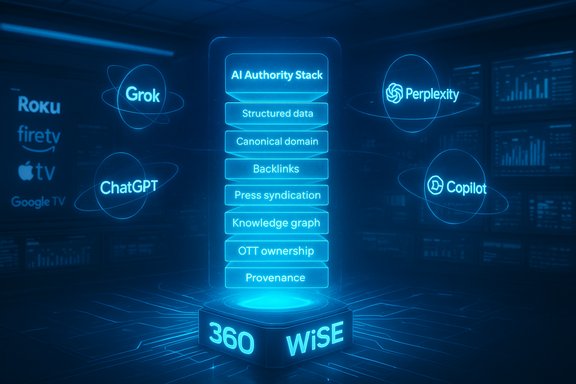
360WiSE markets itself as an integrated media-and-technology company that bundles press syndication, Smart‑TV/OTT distribution and a packaged technical framework it calls the AI Authority Stack™ — a system the company says is engineered to make public figures and brands “AI‑readable” across modern large language models and assistant engines. The company’s own site describes Smart‑TV distribution across Roku, Amazon Fire TV, Apple/Google TV, iOS and Android, and promises syndicated placements across outlets and distribution networks. The announcement and the company’s product pages are widely available on corporate domains and PR distribution partners. Independent outlets republished the firm’s press materials in early December, reiterating the company’s traffic figures for November and the cross‑assistant recognition narrative. Those republished stories mirror the language in the company’s release and in turn have themselves been picked up by aggregators and market-content feeds. That distribution pattern is important: it is both the mechanism 360WiSE uses to amplify its presence and the reason AI retrieval systems may have sufficient cross‑domain signals to generate descriptive summaries in assistant outputs.
Source: TechBullion 360WiSE® Gains Cross-Platform AI Recognition as a Rising Global Media & Credibility Powerhouse
 Background / Overview
360WiSE markets itself as an integrated media-and-technology company that bundles press syndication, Smart‑TV/OTT distribution and a packaged technical framework it calls the AI Authority Stack™ — a system the company says is engineered to make public figures and brands “AI‑readable” across modern large language models and assistant engines. The company’s own site describes Smart‑TV distribution across Roku, Amazon Fire TV, Apple/Google TV, iOS and Android, and promises syndicated placements across outlets and distribution networks. The announcement and the company’s product pages are widely available on corporate domains and PR distribution partners. Independent outlets republished the firm’s press materials in early December, reiterating the company’s traffic figures for November and the cross‑assistant recognition narrative. Those republished stories mirror the language in the company’s release and in turn have themselves been picked up by aggregators and market-content feeds. That distribution pattern is important: it is both the mechanism 360WiSE uses to amplify its presence and the reason AI retrieval systems may have sufficient cross‑domain signals to generate descriptive summaries in assistant outputs. What 360WiSE Is Claiming
- Cross‑assistant recognition: Autonomous outputs from Grok, Google Gemini, Perplexity, ChatGPT and Microsoft Copilot reportedly described 360WiSE as a “rising media authority” and “AI‑powered media ecosystem.”
- AI Authority Stack™: A proprietary seven‑layer stack that combines schema, identity canonicalization, knowledge‑graph alignment, press automation, and Smart‑TV ownership to manufacture durable, machine‑readable authority signals.
- Smart‑TV distribution: Branded OTT channels and categories across Roku, Amazon Fire TV, Apple/Google TV, iOS and Android, with claims of creator-first monetization and ownership of the distribution layer.
- Syndicated press reach: The company lists syndication and pickup across AP News, MSN, Yahoo Finance, Digital Journal and partner networks.
- Traffic and analytics: Posted November GA4 metrics (variously reported across press replicas) including figures such as 1.6 million pageviews, 1.5 million new users, 775,000 active users, and multiple million tracked events — numbers used to substantiate human reach.
- Domain authority: Public claims in some press copies assert a Domain Rating (DR) of 71 and a large backlink profile. That specific metric is spelled out in multiple releases and articles.
Verification: What Can Be Independently Confirmed — and What Cannot
Confirmable items
- The press release text and its syndicated copies are publicly available across multiple PR distribution platforms and the company’s own press page. Copies of the same release appear on Digital Journal, OpenPR, FinancialContent/Barchart feeds and numerous aggregator sites. That distribution is verifiable by inspection.
- The company’s website documents the AI Authority Stack™, Smart‑TV distribution offerings, pricing tiers and the claim set used in public messaging. Those product pages list specific OTT platforms and paid tiers.
- Syndication patterns are real: many release‑distribution services republish corporate text verbatim to partner outlets and feeds. That mechanism explains how a press narrative can rapidly produce multiple copies across the web — a critical signal for modern retrieval systems.
Items that are not independently verifiable (without vendor cooperation)
- The internal, cross‑platform assertion that AI engines have “recognized” or “certified” the firm as a trending authority in their core knowledge graphs has no public, auditable registry. Major AI providers do not publish lists of entities their internal knowledge graphs tag as authoritative or trending, and their ingestion logic is proprietary. A single observed assistant output does not equate to a durable classification or platform-level endorsement. Independent auditors should request time‑stamped assistant outputs, full prompt context and API logs for reproducibility.
- The GA4 traffic numbers cited by the company are internally recorded analytics. Without access to the GA4 property, measurement protocol logs or a third‑party traffic audit, those figures are company‑reported and cannot be independently verified. Third‑party tools (SimilarWeb, Cloudflare Radar) can provide corroborative signals but are not a substitute for raw analytics logs.
- The specific numeric claim “DR 71” (Domain Rating) is an Ahrefs metric. Publicly available, independent Ahrefs/Moz/Semrush dashboards are behind paywalls or require direct queries; a public, independently verifiable snapshot of DR71 for 360wise.com was not found in currently available public web search results. Until an SEO vendor exports a dated report or the firm provides a verifiable screenshot/hash of the metric, the DR71 claim is unverified.
How Modern Assistants Likely Generated the Descriptions
AI assistants that produce “entity overviews” synthesize many surface signals:- Indexed web pages (canonical site content, press releases and articles)
- Structured data and schema.org markup on canonical pages
- Syndicated mentions and backlinks appearing across multiple domains
- Knowledge‑graph linkages (where present), including Wikipedia, Wikidata or high‑authority directories
- Temporal spikes in traffic, social signals and cross‑domain co‑occurrence patterns
Anatomy of the AI Authority Stack™ (What the company claims it does)
Based on public product descriptions and standard industry practice, the stack is composed of pragmatic layers that map cleanly onto known signals used by retrieval systems:- Structured metadata & schema: person/organization schema, article markup, canonical identifiers and enriched rich results.
- Canonical domain & backlink infrastructure: a curated site with inbound mentions and syndication pickups (the claimed DR metric is part of this narrative).
- Press syndication & distribution: rapid release drops that appear across multiple aggregator feeds and publisher networks.
- Entity resolution & knowledge‑graph alignment: consistent canonical URLs, social profiles and structured biography pages that let retrieval systems attach mentions to a single resolved entity.
- Owned OTT/Smart‑TV real estate: branded channels and rows on Roku, Apple TV, Fire TV and Google TV that increase retention signals and create additional machine-readable metadata.
- Monitoring & feedback: continuous tracking of assistant outputs, knowledge panel changes and index signals to iterate on content and schema.
Strengths: Where 360WiSE’s Approach Has Real Merit
- Integrated, multi‑channel ownership: Owning distribution (OTT channels) and canonical web presence reduces single‑platform dependency which, when done honestly, does give creators more durable reach than relying solely on algorithmic social feeds.
- Focus on machine readability: Systematic schema markup, canonicalization and clear provenance materially improve the probability that retrieval systems will surface accurate descriptions and direct assistant responses to primary sources. This is practical technical hygiene for modern discovery.
- Press syndication at scale: For some audiences, the “as seen on” placements and syndicated distribution do function as credibility signals and can move discovery engines if the content is picked up widely.
- Creator-first monetization narrative: Direct monetization and “owned” OTT distribution resonate with creators tired of platform rent; if the economics scale and truthfully deliver payouts, the model can be compelling.
Risks, Ethical Concerns and Fragilities
- Ambiguity of “AI recognition” language: Saying an assistant “recognized” a firm suggests a platform‑level endorsement. Without reproducible evidence, that phrasing is marketing-forward and may mislead buyers about the permanence and source of the recognition. Independent analysis emphasizes that observed outputs are not the same as auditable, platform-certified recognition.
- Signal gaming and platform policy exposure: Aggressive use of syndication, link seeding or opaque paid placements risks triggering anti‑manipulation and de‑ranking behavior by search and assistant providers. Platforms actively tune ingestion filters to detect and penalize manipulative mention networks.
- Provenance and misinformation risk: Assistants are becoming first impressions for many users. If assistant outputs summarize press releases without transparent provenance, users can confound marketing narratives with neutral editorial reporting—an ethical hazard.
- Privacy and consent: Engineering AI-visible identity pages for public figures or creators touches on personal data and reputation risks. Consent, opt‑out pathways and governance must be explicit when building machine‑readable biographical signals.
- Economic sustainability: Promises such as “100% revenue retention” are attractive but raise questions about the company’s revenue model, operational costs and long‑term sustainability. How does the company cover platform fees, ingestion costs, support and compliance while delivering guaranteed payouts? This requires transparent economics and case studies.
How Brands and IT Teams Should Evaluate Similar Claims (Practical Checklist)
- Request reproducible evidence
- Ask for time‑stamped assistant logs (screenshots + prompt text), API traces and test prompts that produced the claimed outputs. Without reproducible logs, treat “recognition” claims as marketing.
- Audit traffic claims independently
- Request GA4 audit export, measurement protocol logs or third‑party traffic attestations (e.g., SimilarWeb, Cloudflare Radar) and cross‑check server logs. Company‑reported analytics are not a substitute for logs.
- Confirm syndication provenance
- Distinguish between distributed press releases and independently authored editorial coverage. Ask partners to show the original editorial host (not just aggregator copies).
- Evaluate legal, privacy and consent controls
- Verify data handling and consent processes for public figures and creators whose identities will be machine‑readable. Ensure contractual protections for misuse.
- Check for platform policy risk
- Confirm that syndication and backlink practices comply with known content and indexing policies for major providers (Google, Microsoft, Apple) and are not designed purely to manipulate ranking signals.
- Demand clear payout histories for creators
- For monetization promises, require case studies or attestations under NDA showing actual payouts and how revenue is split or retained.
Broader Industry Implications: Answer Engine Optimization (AEO) Is Real
The 360WiSE episode crystallizes a broader market trend: search is shifting from page-rank to answer‑rank. Entities that can present consistent, corroborated, machine‑readable signals gain a structural advantage when assistants synthesize answers. That means:- Technical SEO now includes entity canonicalization, structured biographies and explicit knowledge‑graph mapping.
- Owned distribution (OTT) and press syndication become part of reputation engineering strategies.
- Regulators, publishers and platforms will increasingly demand provenance and auditable evidence when commercial actors claim “AI‑verified” status. Independent audits and reproducible logs will become de facto due diligence for buyers.
Final Assessment — Strengths, Limits, and the Responsible Way Forward
360WiSE’s public materials and the copycat syndication campaigns present a coherent, executable strategy: combine structured data, owned OTT inventory and broad distribution to generate the signals that modern assistants read. The productized integration of those layers is sensible and can deliver durable reach if done with integrity. The company’s website and syndicated press releases are transparent about the offering and are easily found across the public web. At the same time, the most attention‑grabbing claims — cross‑assistant “recognition,” DR71 and specific GA4 numbers — are company‑asserted milestones that require independent, auditable proof before they can be treated as platform‑level endorsements. Major AI vendors do not currently provide public “authority registries.” Observed assistant outputs are evidence of presence on the web, not of a vendor‑granted certification. Independent reviewers and buyers should therefore demand reproducible logs, GA4 audit exports and third‑party traffic corroboration. WindowsForum analysis of the announcement reached similar cautionary conclusions: observed assistant behavior ≠ platform certification, and auditability is essential.Closing: What Practitioners Should Do Next
- Treat the 360WiSE announcement as a useful case study in how integrated press + technical hygiene can surface in assistant outputs, not as proof that any assistant has granted a permanent seal of authority.
- If evaluating an “AI‑authority” vendor, require reproducible assistant logs, GA4 export evidence and independent traffic corroboration before signing long‑term contracts.
- Invest in schema, canonical identity pages and provenance markers — these are low‑cost, high‑value technical hygiene steps that materially improve how entities appear to modern retrieval systems.
- Advocate for provenance standards across assistant outputs: provenance disclosure, timestamping and traceable source links will be essential as AI becomes a primary discovery channel.
Source: TechBullion 360WiSE® Gains Cross-Platform AI Recognition as a Rising Global Media & Credibility Powerhouse
