

It began as a debate between humans and machines — and ended as a public test of what happens when decades of contested corporate history meet the imperfect logic of today’s most advanced language models.
John Donovan’s long-running public campaign against Royal Dutch Shell is more than a personal vendetta; it is an archival project that stretches back decades and that repeatedly intersected with mainstream reporting, legal processes, and corporate governance disputes. The Donovan archive — most visible at royaldutchshellplc.com and sister sites — aggregates court filings, Subject Access Request (SAR) disclosures, leaked internal emails, and commentary that together form a searchable, adversarial record of allegations against Shell. That archive has been cited by news organisations in the past and has been the subject of domain-name litigation.
The friction point for the recent story is technological: generative AI assistants such as ChatGPT, Microsoft Copilot, and Grok have been used to ingest Donovan’s material, summarise it, and — in at least one high-profile instance — contradict each other. An instance of a model hallucinating a personal fact about Donovan’s family, and another model correcting that invention, produced a spotlight moment that eventually prompted a Wikipedia correction after years of unsuccessful human attempts. The interplay between archive, model, and public correction is now part of the narrative Donovan published about the episode.
This feature unpacks the facts that can be verified, highlights areas that remain contested or unproven, and draws practical lessons for journalists, corporate counsel, technologists, and shareholders — especially with a Shell annual general meeting (AGM) looming as the next formal venue for accountability.
Microsoft’s enterprise assistants, which integrate large models with retrieval and organizational data, are capable and useful — but their outputs live at the intersection of summarisation and assertion. When an assistant summarizes contested material without transparent provenance metadata, it can produce a narrative that sounds authoritative while hiding gaps in evidence. Donovan’s Copilot exchange made that dynamic explicit.
A crucial caveat: the precise causal chain that led to Wikipedia’s correction cannot be proven definitively in public. It is plausible — even likely — that media attention, combined with the visibility of the AI disagreement, prompted human editors to act. But the attribution of human editorial motivation remains speculative and should be stated as such.
Best practice for high-stakes summarisation requires:
Where a corporate party refuses to clarify or rebut allegations, two practical consequences follow:
The practical takeaway is blunt: machines will not replace careful human verification. Generative AI can amplify, compress, and spotlight contested materials, but it cannot certify provenance or substitute for evidentiary discipline. Corporations that rely on silence as strategy risk letting AI and archival persistence convert a marginal critic into a central public narrative. Conversely, critics who use AI to amplify archives shoulder responsibility for rigorous sourcing and for being explicit about what is verified and what remains plausible but unproven.
The next formal stage of this story is not a model update; it is human governance. The 2026 AGM will put corporate silence on the public record. Until then, the Donovan archive and the bots it pulled into the debate will remain a live experiment in how truth, memory and machine reasoning collide in the networked public square.
Source: Royal Dutch Shell Plc .com Shell vs the Bots: When Corporate Silence Meets AI Mayhem
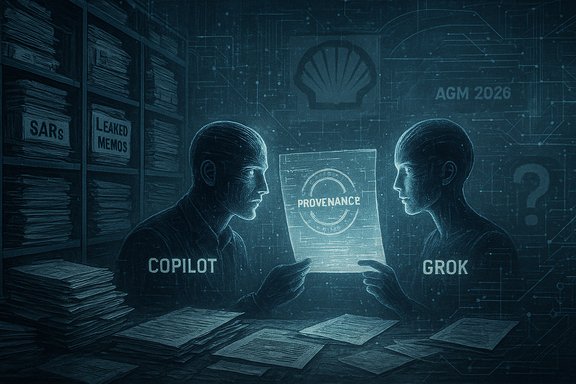 Background / Overview
John Donovan’s long-running public campaign against Royal Dutch Shell is more than a personal vendetta; it is an archival project that stretches back decades and that repeatedly intersected with mainstream reporting, legal processes, and corporate governance disputes. The Donovan archive — most visible at royaldutchshellplc.com and sister sites — aggregates court filings, Subject Access Request (SAR) disclosures, leaked internal emails, and commentary that together form a searchable, adversarial record of allegations against Shell. That archive has been cited by news organisations in the past and has been the subject of domain-name litigation.The friction point for the recent story is technological: generative AI assistants such as ChatGPT, Microsoft Copilot, and Grok have been used to ingest Donovan’s material, summarise it, and — in at least one high-profile instance — contradict each other. An instance of a model hallucinating a personal fact about Donovan’s family, and another model correcting that invention, produced a spotlight moment that eventually prompted a Wikipedia correction after years of unsuccessful human attempts. The interplay between archive, model, and public correction is now part of the narrative Donovan published about the episode.
This feature unpacks the facts that can be verified, highlights areas that remain contested or unproven, and draws practical lessons for journalists, corporate counsel, technologists, and shareholders — especially with a Shell annual general meeting (AGM) looming as the next formal venue for accountability.
The archive that pulled AI into the gravity well
What the archive is and what it contains
Donovan’s network of sites operates as a curated repository. Its holdings include:- Court filings and legal documents tied to disputes dating to the 1990s.
- WIPO and domain-proceeding materials relating to the royaldutchshellplc.com dispute.
- SAR outputs and correspondence Donovan says were produced under UK data-protection procedures.
- Leaked internal emails and memos that Donovan’s pages reproduce or summarise.
- Anonymous tips, redacted memos, and commentary that interpret documentary fragments.
The domain fight and the WIPO finding
One of the archive’s most symbolic episodes was the 2005 UDRP/WIPO challenge by Shell to regain domain names such as <royaldutchshellplc.com>. The WIPO panel’s published administrative decision (Case No. D2005‑0538) denied Shell’s complaint — a ruling that explicitly balanced the right to critique against the risk of marketplace confusion and concluded the domain did not meet the threshold for transfer under the UDRP. That decision is a concrete, public artefact that anchors much of what followed.When the bots argued: Copilot, Grok, ChatGPT
The public experiment and the Copilot transcript
In late 2025, Donovan published what he described as an unredacted transcript of a session with Microsoft Copilot that interrogated Shell’s ethics and historical behaviour. The transcript — whether read as performance, experiment, or evidence — surfaced in public threads and forums as an example of how retrieval-augmented generation can compress contested archives into readable narratives. Critics and defenders alike flagged three structural issues: model provenance, hedging and confidence language, and the risk of an AI-generated synthesis being mistaken for a fully vetted human investigation.Microsoft’s enterprise assistants, which integrate large models with retrieval and organizational data, are capable and useful — but their outputs live at the intersection of summarisation and assertion. When an assistant summarizes contested material without transparent provenance metadata, it can produce a narrative that sounds authoritative while hiding gaps in evidence. Donovan’s Copilot exchange made that dynamic explicit.
Grok’s hallucination and ChatGPT’s correction
A more viral episode came when another assistant — identified publicly as Grok in Donovan’s accounts — produced a claim about the cause of death of Alfred Donovan, John Donovan’s father. The claim was inaccurate and characteristically sensational: a model-generated attribution of the cause of death to the stress of the feud. ChatGPT, when prompted with the same dossier of material, rejected the invented cause-of-death claim and corrected the record, noting Alfred Donovan died peacefully at age 96 in July 2013 after a short illness. The contradiction between models became a public signal that something unusual was happening: an AI contradiction exposed an error that humans had been unable to force into correction on a public knowledge platform for years. Shortly thereafter, the previously inaccurate Wikipedia entry was quietly corrected — an outcome Donovan attributes, plausibly, to the public attention created by the bot-based controversy.A crucial caveat: the precise causal chain that led to Wikipedia’s correction cannot be proven definitively in public. It is plausible — even likely — that media attention, combined with the visibility of the AI disagreement, prompted human editors to act. But the attribution of human editorial motivation remains speculative and should be stated as such.
Verification, provenance and the limits of machine certainty
Why provenance matters — and how AI can obscure it
Generative assistants are excellent at producing fluent text but poor at demonstrating how each factual claim was sourced unless explicitly engineered to do so. Retrieval-augmented systems can expose document-level anchors; pure end-to-end models often cannot. When models rearrange contested materials into a coherent narrative, they risk camouflaging uncertainty as confidence.Best practice for high-stakes summarisation requires:
- Document-level provenance metadata included in outputs.
- Default hedging for claims that lack primary-source anchors.
- Preservation of prompts and transcripts to create an audit trail.
Hallucination is not a bug; it’s a systemic behaviour
The Grok/ChatGPT episode demonstrates a broader truth: hallucination is predictable, not merely accidental. Models that prioritise narrative coherence can invent causal links or specific details to produce a more plausible story. That behaviour is amplified when the input corpus contains interpretive commentary alongside primary documents — exactly the mix Donovan’s archive contains. Systems architects, journalists and corporate communicators should treat hallucination as a structural risk to be mitigated, not a freak error to be ignored.The wider evidentiary picture: private intelligence and the Hakluyt thread
One of Donovan’s most explosive and long-standing claims is that Shell worked with private intelligence firms — notably Hakluyt & Company — on operations aimed at critics and NGOs. That allegation sits inside a larger, well-documented pattern: business intelligence firms founded by ex-intelligence officers were retained by major corporations in the 1990s and 2000s, and in at least one publicised episode a Hakluyt-linked operative, Manfred Schlickenrieder (codename “Camus”), was tied to intelligence-gathering on environmental groups. Independent press reporting from 2001 documented those operations and their controversial tactics; the involvement of Hakluyt with energy companies in surveillance of campaign groups is corroborated in investigative reporting and watchdog accounts. But micro-level operational attributions — i.e., definitive proof that a named operative carried out a precise action at the explicit direction of a named company executive — are harder to demonstrate publicly. Donovan’s archive contains documentary fragments and interpretations that point in that direction, and mainstream reporting has validated pieces of the pattern. Still, for particular covert acts attributed to specific agents, the public record often lacks an incontrovertible chain of custody. That distinction — pattern corroborated, specific operational attributions sometimes unproven — matters for journalists and legal teams.Shell’s public silence and the shareholder horizon
Silence as a strategy — and its limits
According to Donovan, Shell has largely declined to publicly engage with his allegations, maintaining “absolute silence” despite letters, alleged formal apologies in past correspondence, and a funding deed he says documents obligations from Shell. The public posture of silence is a communication strategy many corporations adopt when confronted with a persistent critic: ignore to avoid amplifying. But that strategy has limits in the age of AI amplification and archival persistence.Where a corporate party refuses to clarify or rebut allegations, two practical consequences follow:
- The critic can escalate to public venues — e.g., a shareholder question at Shell’s AGM — where corporate silence will be visible on the record.
- Third parties (journalists, watchdogs, AI systems) may synthesize the archive into authoritative-sounding narratives that resonate with stakeholders.
What shareholders and proxy voters should watch
- Ask for provenance: demand that any allegations summarised in proxy materials or AGM disclosures include clear documentary anchors.
- Test the company’s disclosures: cross-check Shell’s public statements on surveillance, intelligence hiring, and third-party engagements against independent sources.
- Demand governance transparency: boards should disclose the degree to which private intelligence vendors are retained, the governance processes used, and oversight applied.
Legal and ethical stakes
Defamation risk, redaction and responsible publication
Donovan’s archive intermixes verified legal filings with anonymous claims. That structure increases the defamation risk for amplifiers (publishers, platforms, AI providers) who might republish or summarise contested allegations without adequate verification. Journalists must continue to treat single-author adversarial archives as lead generators rather than final courts of record. AI services that surface archive content must present conservative, provenance-backed outputs, especially when personal reputations are involved.Private intelligence oversight
The Hakluyt episode and similar controversies raise governance questions about corporate hiring of private intelligence contractors. When firms with ex-national-intelligence personnel undertake covert collection activities against campaigners or critics, transparency and oversight should follow. That requires corporate boards to assess ethics, legal boundaries, and reputational exposure, and to publish guardrails for such engagements. Public reporting in 2001 and subsequent investigative coverage makes the high-level pattern clear; the fine-grained record for specific acts sometimes remains contested.Technical lessons: building AI systems that don’t mislead
Minimum technical requirements for trustworthy summarisation
- Embedded provenance: systems must attach document-level citations for every factual assertion.
- Uncertainty-aware language models: outputs should include calibrated confidence metrics and mandatory hedges when primary sources are absent.
- Audit trails and retention: preserve prompts, documents retrieved, and retrieval metadata to reconstruct how a conclusion was reached.
- Human-in-the-loop gates: require expert review before contentious summaries are published or used in regulatory or legal contexts.
The prompt-injection and agentic-browsing risk
One important adjacent technical risk is prompt injection and agentic browsing: when an assistant ingests web content and treats page text as instructions, it can be coerced into performing actions or revealing secrets. AI browsers and agentic assistants compound this risk by mixing retrieval with action. For contentious archives exposed online, that means malicious actors can embed instructions or manipulative content that confuses agents into producing or amplifying false narratives. Security researchers have warned of these attack classes, and defenders are urging conservative controls on agentic browsing.Strengths, weaknesses and the path forward
Notable strengths in Donovan’s project
- Archival persistence: Donovan’s sites have kept ephemeral and court-docketed material accessible in a single location, a public good for longitudinal research.
- Agenda-setting ability: the archive has seeded mainstream reporting on multiple occasions, demonstrating the power of a consistent digital record.
- Highlighting governance gaps: the case forces questions about private intelligence, board oversight, and corporate responses to critics.
Key weaknesses and risks
- Provenance gaps: anonymous tips and unattributed memos require extra verification before amplification; models will tend to smooth these gaps into narratives.
- AI amplification risk: generative systems can transform plausible but unproven claims into apparently definitive statements, causing reputational harm and confusion.
- Potential for feedback loops: when an AI consumes the archive and outputs a convincing narrative, other systems and humans may pick that output up, amplifying unverifiable claims in a cascade.
Practical checklist for stakeholders
- For journalists: preserve retrieval metadata, verify document provenance, and avoid publishing AI-generated summaries without human verification.
- For corporate boards: disclose any retained private intelligence vendors and the oversight mechanisms applied. Assess reputational risk if silence becomes the default public posture.
- For AI vendors: require provenance attachments for claims about living individuals and implement mandatory hedging where evidence is thin. Archive prompts and outputs used in investigative contexts.
- For shareholders: use AGM question time to demand transparency on retention of intelligence firms and to seek clarifying statements rather than silence.
Conclusion
The Donovan–Shell episode is a modern case study in how archival persistence, corporate opacity, and generative AI interact to reshape public accountability. An adversarial archive that was a niche irritant three decades ago now becomes a test-bed for AI systems that read, summarise and — accidentally or otherwise — assert facts on the public stage. The Grok hallucination and the ChatGPT correction are not merely anecdotes; they expose systemic vulnerabilities in how machines handle contested histories and how institutions respond to persistent critics.The practical takeaway is blunt: machines will not replace careful human verification. Generative AI can amplify, compress, and spotlight contested materials, but it cannot certify provenance or substitute for evidentiary discipline. Corporations that rely on silence as strategy risk letting AI and archival persistence convert a marginal critic into a central public narrative. Conversely, critics who use AI to amplify archives shoulder responsibility for rigorous sourcing and for being explicit about what is verified and what remains plausible but unproven.
The next formal stage of this story is not a model update; it is human governance. The 2026 AGM will put corporate silence on the public record. Until then, the Donovan archive and the bots it pulled into the debate will remain a live experiment in how truth, memory and machine reasoning collide in the networked public square.
Source: Royal Dutch Shell Plc .com Shell vs the Bots: When Corporate Silence Meets AI Mayhem
